
Spirit’s stuck right-front wheel exposed a bright patch of Martian ground that turned out to be unusually rich in silica. The wheel revealed the material; measurements by the rover’s instruments established its composition and gave scientists evidence for an ancient environment where water interacted with hot rock.
The discovery near Home Plate in Gusev crater did not reveal a pool of water or a fossil. It revealed a mineral deposit whose chemistry, structure and geological setting could be used to investigate conditions that no longer existed when the rover arrived.
How did a broken wheel uncover the deposit?#
Spirit’s right-front wheel became immobile in 2006. The rover could still move using its other wheels, often driving backwards while dragging the failed wheel through the soil. The dragged wheel disturbed the surface and exposed material below the darker covering.
NASA’s image record dates the exposure of the patch called Gertrude Weise to 29 March 2007, mission sol 1,150. A sol is a Martian solar day. Later observations and chemical measurements followed; the day the wheel uncovered the ground was not the same day that every scientific conclusion was reached.
The failure remained a mobility problem. Its scientific benefit came from what the scraped ground happened to reveal and the team’s decision to investigate it. Damaging a rover is not a reliable method for finding an interesting mineral deposit.
How did scientists know the bright material was silica?#
Brightness alone was insufficient. Spirit had previously exposed other light-coloured soils with different compositions. The Miniature Thermal Emission Spectrometer, or Mini-TES, examined the patch remotely and detected a spectral signature suggesting abundant silica.
That result prompted a closer investigation with the Alpha Particle X-ray Spectrometer, or APXS, on the robotic arm. The chemical measurements indicated roughly 90 percent silica in the analysed soil. The two instruments contributed different kinds of evidence: a mineral-related spectrum and elemental composition.
A photograph helped locate and describe the target, but it was not the chemical assay. Likewise, a result from the spot beneath an instrument should not be treated as the average composition of all soil in Gusev crater. The finding concerned particular deposits near Home Plate.
What is silica, and was Spirit finding glass?#
Silica is silicon dioxide, a compound of silicon and oxygen. Familiar terrestrial forms include crystalline quartz and the silica used to make glass. Those comparisons describe related chemistry, not identical geological histories.
The Martian material was interpreted as opaline silica, with a disordered rather than a quartz-like crystal structure. The 2008 scientific report described silica-rich material both in light-toned soil and in rock outcrops associated with volcanic deposits. It was not simply a loose shard resembling a manufactured window.
The reported percentage is a compositional measurement, not the percentage of the deposit that consists of liquid water. Even where a mineral contains water in its structure, identifying that mineral does not mean a rover has found a usable reservoir. Our discussion of life-support resources for a Mars city explains why geological evidence and an accessible supply are different questions.
How can water produce a silica-rich deposit?#
Scientists considered two broad mechanisms. In one, water transports dissolved silica and deposits it as conditions change, as can happen around hot springs. In the other, acidic alteration removes much of the surrounding rock’s other components and leaves a silica-rich residue.
The distinction is between adding a material to a location and preferentially taking other materials away. Both can leave a high concentration in the sample that remains, so concentration alone does not uniquely identify the process.
In the 2008 study, the deposits’ association with volcanic material supported a hydrothermal interpretation: water and heat had interacted in the local geological system. The paper discussed alternatives for how the enrichment occurred. A modern wheel trench was the means of exposure, not the process that originally created the ancient deposit.
Did later research settle the hot-spring versus steam-vent question?#
Later analysis tested the alternatives against more than silica abundance. A 2011 study considered chemical composition, spectra, textures and the arrangement of the outcrops. It found that the low sulfur enrichment and oxidation characteristics did not fit the particular Hawaiian acid-leaching analogue previously proposed.
The authors also found features consistent with silica precipitating from solution. A 2020 study strengthened the case for hot springs: it combined rover observations with field and laboratory comparisons and argued that spring deposits best explained the silica rocks, while fumarolic activity explained nearby sulfur-rich materials. The interpretation does not require every altered patch in the area to have formed in exactly the same way.
Comparisons with Earth are useful because researchers can examine both the deposits and the environments that produce them. But a resemblance has to survive tests against the rest of the Martian evidence. One shared feature is weaker support than agreement across several independent measurements.
Does the silica prove that Mars once had life?#
No. Hydrothermal environments can be relevant to habitability because they combine water, heat and chemical interactions. Similar environments on Earth support microorganisms. Those facts make the Martian deposits interesting places to investigate; they do not establish that organisms were present there.
JPL’s mission assessment described Spirit’s discovery as evidence for settings that could have offered favourable conditions for microbial life. The cautious wording is essential. An environment can have potential biological value even when the available observations do not demonstrate habitation.
To argue for life, researchers would need evidence that distinguishes biological activity from non-biological mineral formation and alteration. Spirit’s silica measurements answered a geological question more directly than a biological one. They helped reconstruct a wet environment without identifying its inhabitants.
What should readers look for in the rover image?#
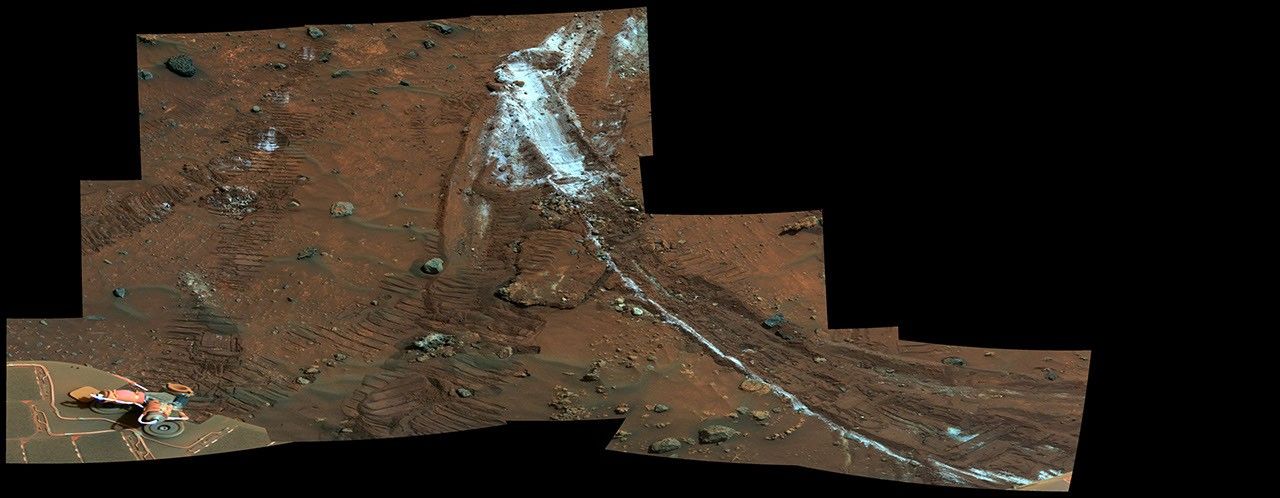
The panorama above shows disturbed ground near Home Plate, including the bright track associated with Gertrude Weise. Spirit acquired the mosaic on 21 May 2007, sol 1,202. It is a later view of the exposed area, not a photograph of the instant the wheel first scraped it.
NASA published this version in false colour to emphasize differences between materials. The pale blue-white appearance therefore should not be read as proof of ice, snow or an exact human-eye colour. Black gaps mark areas outside the assembled image coverage.
The picture preserves the spatial relationship between tracks, disturbed soil and nearby rocks. The instruments supplied the compositional evidence. Together, the image and measurements connect a specific patch of disturbed ground to the geological interpretation.
Sources: [7]
Keep exploring
Sources & further reading
Follow the original research, records, and explanations behind this story.
- Mars Rover Spirit Unearths Surprise Evidence of Wetter Past NASA/JPL
Instrument sequence and roughly 90 percent silica.
- Silica-Rich Soil in Gusev Crater NASA/JPL/Cornell
Exposure date, instrument follow-up and silicon dioxide.
- Detection of silica-rich deposits on Mars Squyres et al., Science (2008)
Opaline silica in soil and bedrock associated with volcanic materials.
- Characteristics, distribution, origin, and significance of opaline silica observed by the Spirit rover in Gusev crater, Mars Ruff et al., Journal of Geophysical Research (2011)
Tests of acid leaching and precipitation, sulfur and oxidation constraints.
- The Case for Ancient Hot Springs in Gusev Crater, Mars Ruff et al., Astrobiology (2020)
Later interpretation favours spring sinter for silica and fumarolic activity for nearby sulfur-rich material.
- NASA’s Spirit Rover Completes Mission on Mars NASA/JPL
Failed wheel in 2006, backwards driving and habitability interpretation.
- Rover’s Wheel Churns Up Bright Martian Soil (False Color) NASA/JPL-Caltech/Cornell
Mosaic sol 1202, 21 May 2007, false colour.
Follow the thread