
A city on Mars would need a continuous supply of breathable air, clean water, food and power, along with people and equipment able to keep those supplies working. Building enough rooms would address only one part of the problem.
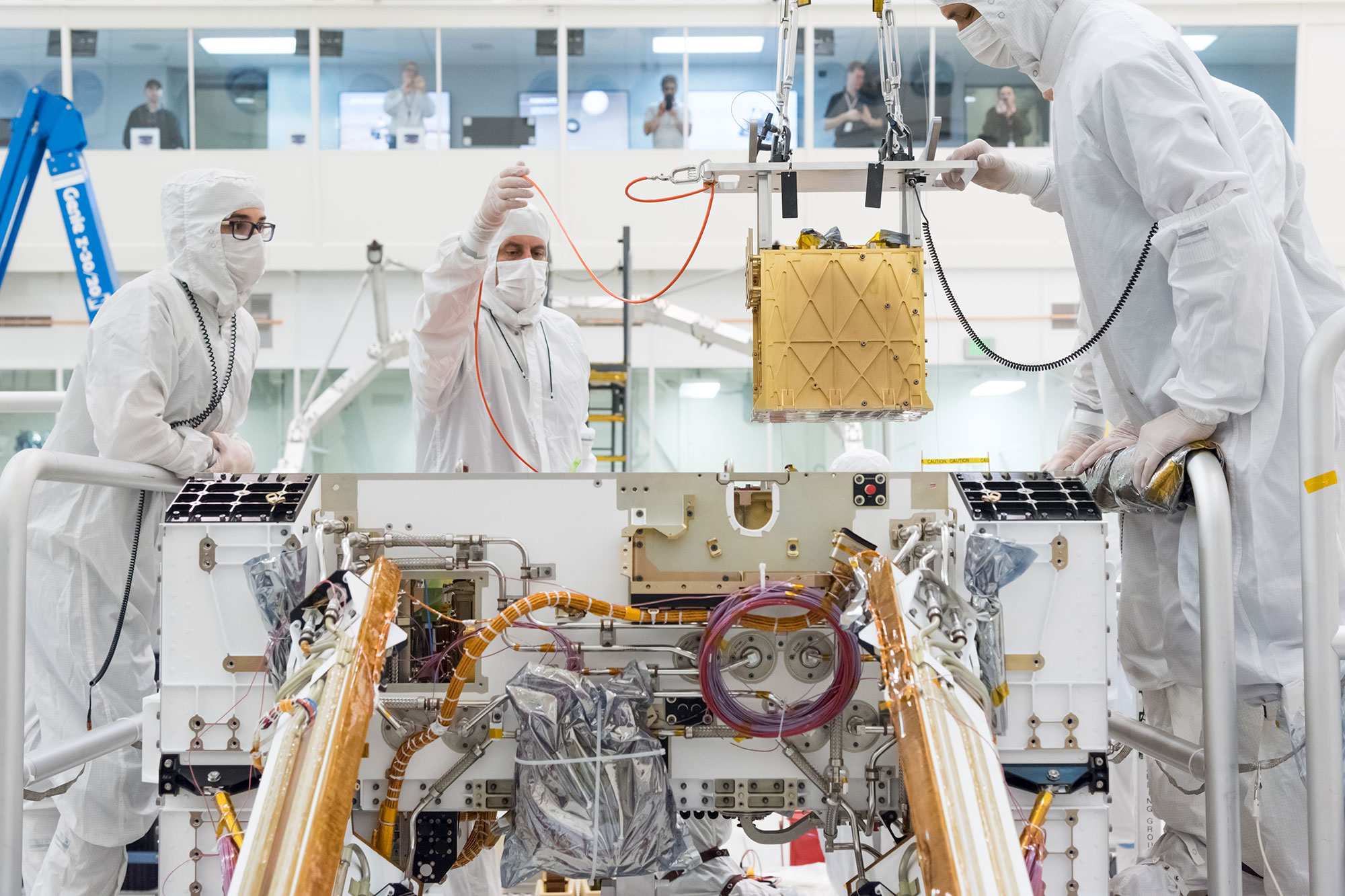
No such city exists. Some relevant technologies have operated on the International Space Station, and the MOXIE experiment has produced oxygen on Mars. Moving from those demonstrations to a settlement means connecting systems, replacing what is lost and keeping failures from spreading through the whole community.
What would make a home habitable?#
Mars has a thin atmosphere dominated by carbon dioxide. A human living space would need a pressure-retaining enclosure and a controlled internal atmosphere, rather than an ordinary building that exchanges air freely with its surroundings.
Existing spacecraft life support shows why supplying oxygen is only one job. Carbon dioxide and trace contaminants must be removed; air must circulate; pressure and water supplies must be monitored. A room can contain oxygen and still become unsafe if other conditions drift outside acceptable limits.
Radiation adds a separate design problem. Curiosity’s measurements near a Martian cliff showed that surrounding terrain can reduce exposure, but the reduction was partial. A wall that holds air is not automatically adequate radiation shielding. Habitat materials, layout and sheltered areas would need to be assessed for the actual radiation environment.
Could a city make oxygen from the atmosphere?#
MOXIE demonstrated that possibility aboard Perseverance. It drew in Martian air and used an electrochemical process to separate oxygen from carbon dioxide. Over 16 runs, it produced 122 grams of oxygen in total. Its best production rate reached 12 grams per hour, with purity of at least 98%.
Those results established a working process under Martian conditions. They did not establish an operating municipal oxygen supply. A larger installation would need to produce the required quantity reliably, handle the gas after production and remain maintainable over a much longer service life.
Oxygen also has two distinct uses in mission planning: people breathe it, and rockets can use it as an oxidiser. The latter can demand industrial quantities. A settlement’s oxygen budget would have to account for both planned uses rather than treating every kilogram produced as available to the living quarters.
Sources: [4]
Where would the water come from?#
Orbital observations identify promising regions of buried water ice. The SWIM mapping project combines evidence from several Mars missions, while fresh impacts that expose ice provide checks at particular locations. These maps can help narrow the search for a landing or settlement site.
A mapped resource is not yet a water supply. Engineers would still need to establish how much ice is accessible, reach it, extract water and make that water suitable for its intended use. A location with favourable ice evidence might have other disadvantages, including difficult terrain or poor conditions for equipment.
The practical chain runs from a surveyed deposit to extraction machinery, treatment and storage. Each stage needs power and maintenance. Our Mars water scenario examines that distinction between finding water and delivering usable water inside a habitat.
Sources: [5]
Would recycling remove the need for fresh water?#
Recycling can reduce the amount that must be supplied. In 2023, an ISS demonstration reached 98% total water recovery with the help of a brine processor. The system recovers moisture from cabin air and processes wastewater, with filters, further treatment and purity checks before reuse.
That result should not be read as a guarantee that every future settlement would permanently recover the same fraction. It describes a demonstrated spacecraft system. Mars would add different operating conditions and a different mix of uses.
Even at 98%, some water leaves the recoverable supply. In a simplified accounting example, processing 100 kilograms and recovering 98 leaves a two-kilogram shortfall to replace. The example says nothing about how often a city would process that amount; it shows why a high recovery percentage is not the same as a closed water budget. Supplies would also have to cover growth and reserves.
Sources: [6]
Could greenhouses feed everyone?#
Growing plants would be useful, but a crop is only one contribution to a diet. A city would need enough energy and nutrients in its food, reliable harvests, safe handling and provision for periods when production falls short.
NASA’s space-crop research addresses growth media, crop varieties, water, fertiliser, lighting and disease control. Those are operating requirements, not details that disappear once a greenhouse has been built. Plants also become part of the habitat’s water and air systems, so farming changes the demands placed on other equipment.
Fresh vegetables grown in an experiment do not by themselves demonstrate an independent food supply. A credible plan would state what fraction of food is grown locally, what remains imported and what stored food covers a failed harvest. Different combinations may be possible; no single crop demonstration answers all three questions.
Sources: [7]
What happens when power production drops?#
Electricity supports pumps, air processing, water treatment and resource production. A settlement could not assess its power system only by its output on a favourable day. The important test would include low-output periods and equipment outages.
Mars’s dust storms can reduce the sunlight available to solar arrays. Dust also affects equipment, and large storms can persist for long periods. NASA’s human-exploration work considers fission power because it does not depend on sunlight reaching a panel. That does not make any proposed generator an already proven city power plant.
Storage, backup supplies and decisions about which activities can pause would have to be designed together. As an illustrative case, oxygen production for a future rocket might be temporarily reduced while essential habitat services continue, provided stored oxygen and the mission plan allow it. The Mars power scenario explores this separation between routine production and keeping a crew alive.
Who would fix a failure before Earth could respond?#
Earth–Mars communications take minutes each way, with the delay changing as the planets move. A request for help and the reply therefore cannot provide immediate remote control of a fast-developing fault.
A settlement would need local fault detection, trained operators, repair procedures and appropriate replacement equipment. This follows directly from combining the communication delay with dependence on continuously operating machinery. A spare pump is useful only if someone can identify the fault, isolate the affected equipment and install it.
Larger populations add more users and more equipment to maintain. Multiplying the number of habitats does not automatically multiply the ability to repair them. Staffing, access to components and stocks of consumables would need to grow alongside the settlement’s capacity.
When could it be called self-sufficient?#
The term needs a boundary. Producing oxygen locally could reduce one imported supply while leaving the settlement dependent on imported electronics, seals or specialised machinery. Recycling water would not replace food production. A greenhouse would still depend on its own equipment and inputs.
One useful test is to ask what happens if a planned shipment does not arrive. Which service runs short first, how long can reserves last, and can the missing item be made or repaired locally? These are planning questions, not results already demonstrated by MOXIE or the ISS.
A city plan would need to answer them for the complete set of connected services. The evidence available from existing missions helps identify those services and test parts of them. It does not yet demonstrate a community able to continue indefinitely without support from Earth.
Keep exploring
Sources & further reading
Follow the original research, records, and explanations behind this story.
- Humans to Mars NASA
No human settlement; atmosphere and broad food/power challenges. No launch-date forecast is adopted.
- Environmental Control and Life Support Systems NASA Marshall Space Flight Center
Functions and interdependence of spacecraft life support. The separate 2023 milestone report supplies the recovery figure.
- How NASA’s Curiosity Rover Is Making Mars Safer for Astronauts NASA / JPL
Terrain offered partial shielding; this does not establish a safe habitat design.
- NASA’s Oxygen-Generating Experiment MOXIE Completes Mars Mission NASA / JPL
Demonstration performance, distinction between breathing and rocket oxidiser, and cover provenance.
- Distribution of Buried Ice on Mars NASA / JPL-Caltech / PSI
Orbital evidence and impact-crater confirmation; resource indication is distinct from extraction infrastructure.
- NASA Achieves Water Recovery Milestone on International Space Station NASA / Melissa L. Gaskill
98% demonstrated total recovery, not a permanent guarantee or a Mars operating result.
- Space Crops NASA Biological & Physical Sciences
Water, nutrients, light and disease management remain research and engineering requirements.
- 10 Things: Dust in the Wind (on Mars and Well Beyond) NASA Science
Dust affects solar energy and equipment. No wind-force movie scenario adopted.
- Space Communications: 7 Things You Need to Know NASA / Katherine Schauer
Finite light-time delays prevent immediate Earth response. No universal fixed latency claimed.
Follow the thread