
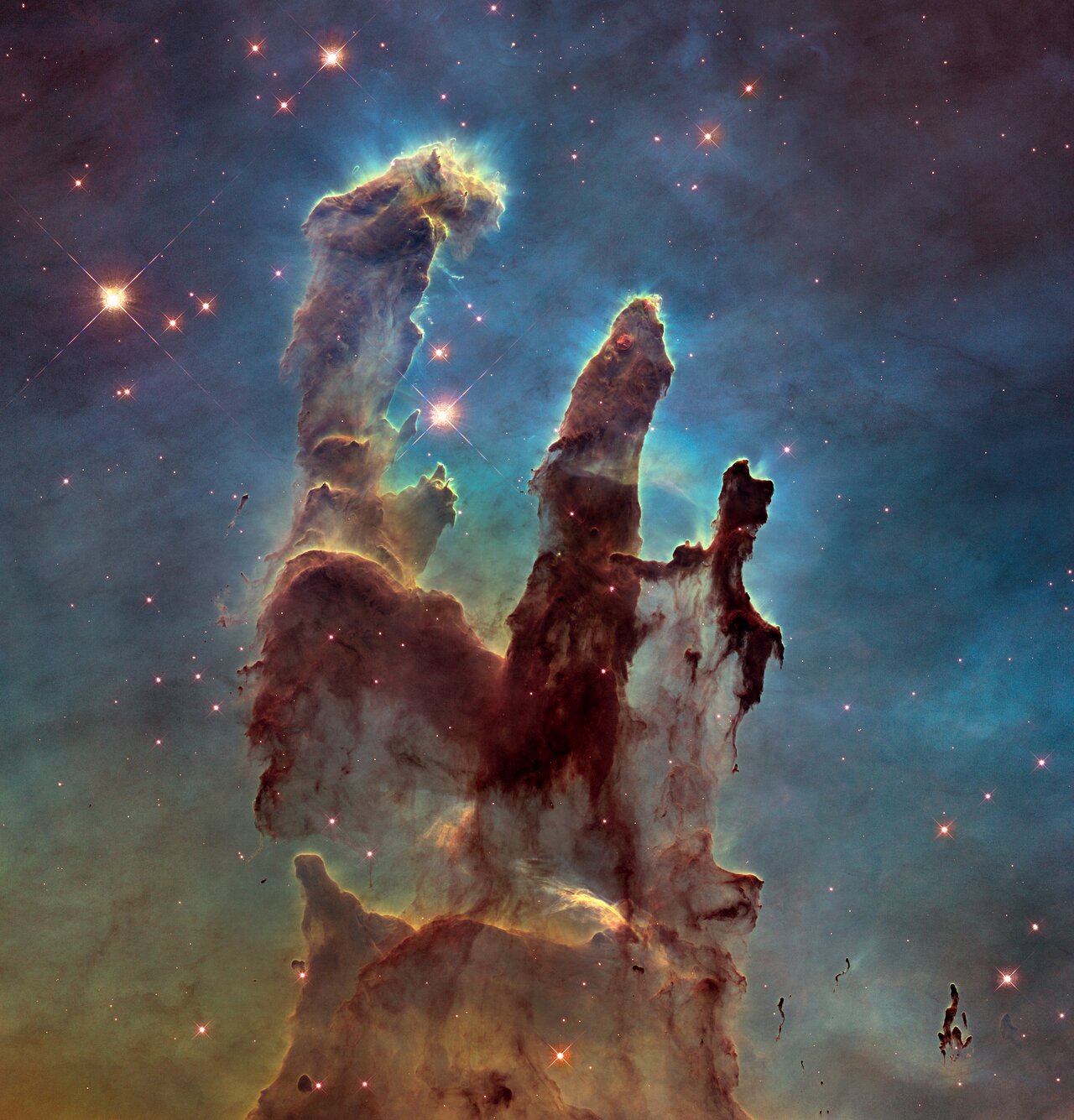
The Pillars of Creation show gas and dust in a region where stars form. Apollo 17’s Blue Marble shows our own planet during a journey to the Moon. The Crab Nebula shows the expanding aftermath of a stellar explosion. Their familiar colours and shapes come from very different subjects and methods of making an image.
Reading them means asking two questions together: what produced the light, and what did the camera and image processing preserve or emphasise? A space image can be both a striking picture and a record of measurements, without being the view an unaided human eye would see.
What are the Pillars of Creation?#
They are columns of gas and dust in the Eagle Nebula, also called Messier 16. The cover image is Hubble’s visible-light view released in 2015, a later observation of the structures made famous by its 1995 image.
Nearby massive stars help shape the columns. Radiation heats and erodes their material, while stellar winds disperse gas. Denser ends shelter material behind them, helping preserve the long shapes. The glowing boundaries therefore belong to an active environment, not a set of solid towers.
The name describes a connection with star formation, but it does not mean every bright speck is a newly born star or that all the dust will become one. Hubble’s accompanying infrared view penetrates much of the obscuring material and reveals stars hidden in the visible image. Comparing wavelengths changes what can be examined.
Why do the Pillars have such vivid colours?#
Hubble records exposures in grayscale through filters. A finished colour image combines those measurements, assigning display colours to the separate channels. Filters can isolate particular wavelength ranges, including light associated with different chemical elements.
That makes the colour key part of the evidence. A red patch cannot always be read as a surface that would look red nearby, or as a direct thermometer. Depending on the image, colour may distinguish gases or represent radiation outside human vision.
The processing does not mean the structures were invented. It means the displayed colours need an explanation. Before comparing a red area in one space image with a red area in another, check whether the same wavelengths and mapping were used. Two identical screen colours can stand for different measurements.
Sources: [3]
Who took the original Blue Marble, and when?#
The Apollo 17 crew photographed Earth on December 7, 1972, while travelling toward the Moon. This is the famous astronaut photograph, not a picture taken by Hubble. The crew were Eugene Cernan, Ronald Evans and Harrison Schmitt; NASA credits the image to the crew rather than requiring a claim about which person pressed the shutter.
The view includes Africa, the Arabian Peninsula, surrounding ocean, extensive clouds and the Antarctic ice cap. It shows a particular hemisphere under particular illumination. Even a nearly full Earth disk cannot show the whole planet’s surface at once: the far side remains out of view, and clouds conceal parts of the visible side.
That distinction matters when using the photograph as evidence. It records the planet at one moment and from one direction. It is not a cloud-free map, a weather average or a simultaneous survey of every continent.
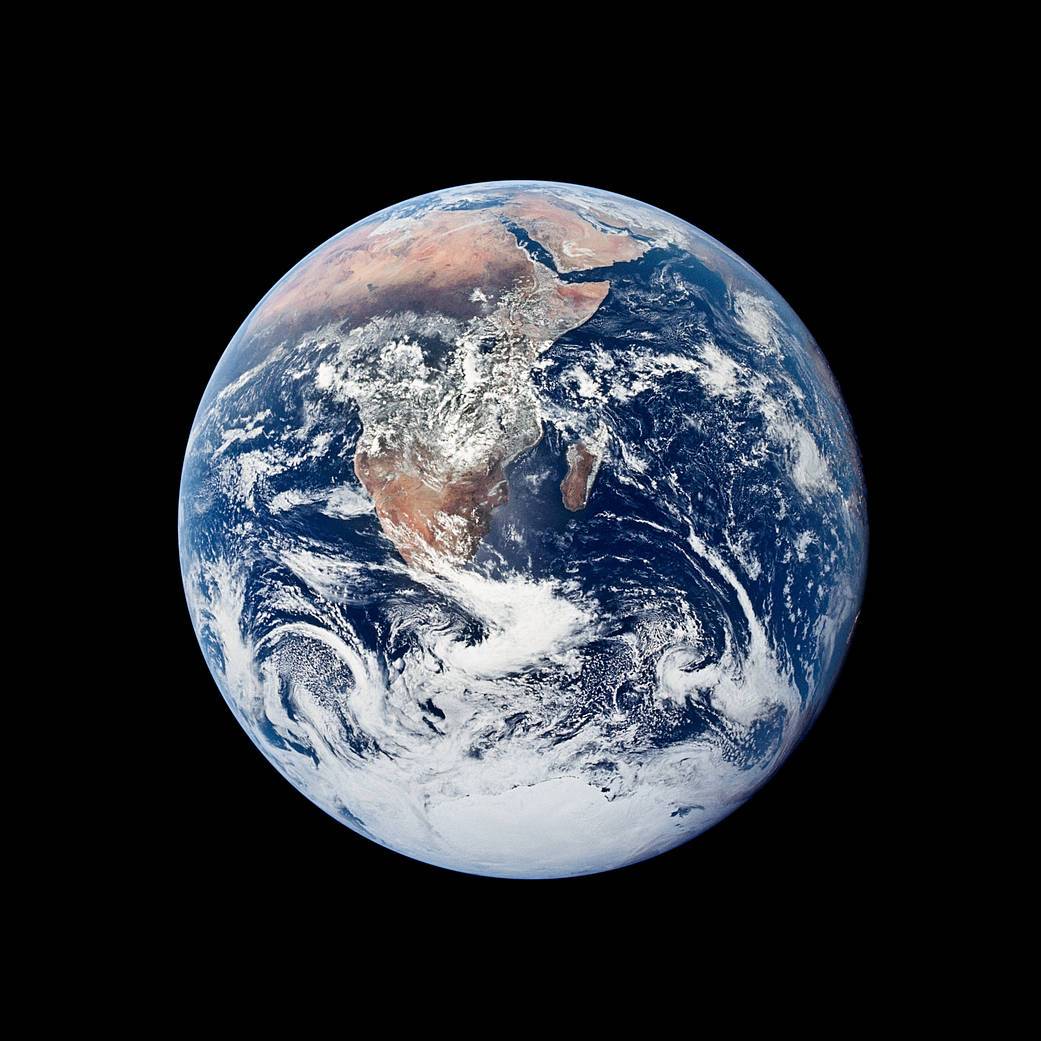
Image unavailable.
Earth’s illuminated disk shows Africa, the Arabian Peninsula, cloud-covered oceans and Antarctica against black space.
Is every image called Blue Marble a single photograph?#
No. The name also applies to later products assembled from satellite measurements. NASA’s 2002 Blue Marble combined months of observations into a global mosaic. The 2005 Blue Marble: Next Generation collection added a sequence of monthly views.
A mosaic answers a different question from the Apollo frame. Combining observations can fill gaps and provide broad coverage, but the resulting globe need not represent one instant. When a caption says a picture is a composite, the useful follow-up is what was combined and why.
For the image reproduced here, the answer is specific: it is a published version of the Apollo 17 photograph. The satellite mosaics are related products, not evidence that the astronaut photograph was assembled by the same method.
Sources: [6]
What does the Crab Nebula image show?#
The Crab is a supernova remnant: material associated with the stellar explosion observed in 1054. Its filaments spread through a nebula containing a rapidly rotating neutron star, the dense remnant of the star’s core.
The central pulsar supplies energy to its surroundings. Fast electrons moving in magnetic fields contribute to the interior glow. The filaments and the diffuse light therefore do not all represent the same physical process.
The 2005 image shown here combines 24 Hubble exposures, with ground-based Very Large Telescope imagery incorporated into the finished view. Its assigned colours distinguish emission from oxygen and sulphur. It is an observational composite, not an artist’s reconstruction of the explosion.
The pictured nebula is the aftermath. A photograph taken centuries after 1054 cannot show the original blast as though the camera had been there at that moment. It shows what the expanding system had become when the light we received left it.
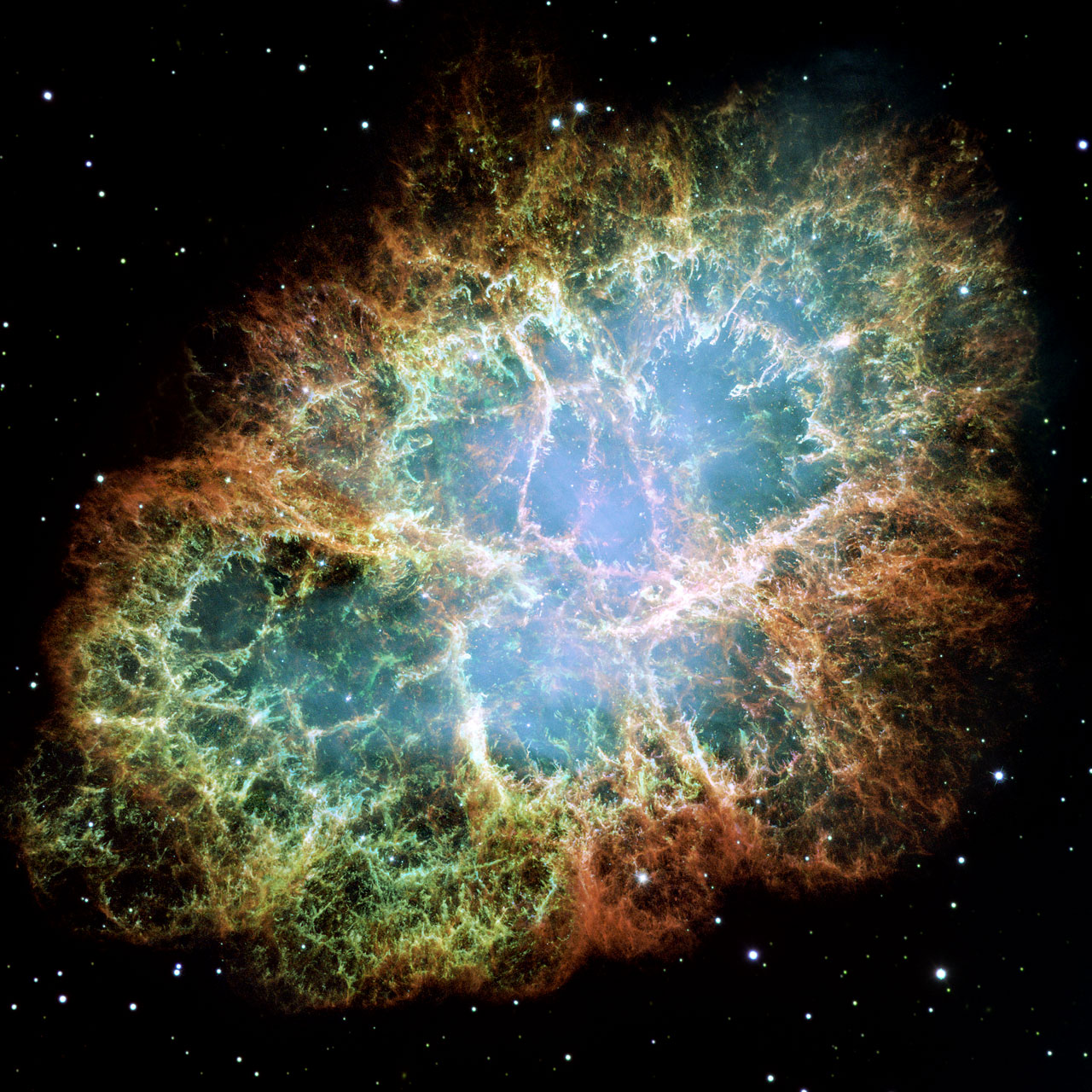
Image unavailable.
An oval web of orange filaments surrounds diffuse blue light in the Crab Nebula.
Do these pictures show one star’s life story?#
No. The Pillars and the Crab illustrate different astronomical environments; they are not before-and-after photographs of the same object. Earth adds a planetary viewpoint rather than another stage in that supposed sequence.
Putting the three together is useful because it makes the distinctions visible: a cloud shaped by young stars, a sunlit planet photographed by its inhabitants, and debris energised by a stellar remnant. Their physical scales, distances and observing methods differ. Equal-sized pictures on a screen do not make the objects equally large.
The distant nebulae also reach us through travelling light. For the relationship between distance and the age of the view, see why starlight shows the past.
What should you check in a space-image caption?#
Start with the object and the instrument. Then separate the observation date from the release date: a newly published picture can use older exposures. Check whether the image is one frame, a mosaic, a combination of wavelengths or an illustration.
Read the colour explanation before assigning a physical meaning to a hue. Look for a field of view or scale before comparing sizes. Finally, distinguish what is visible from what requires other observations: a still image alone cannot establish a rotation period, a full three-dimensional shape or a complete history.
A caption lets you connect the visible forms to their measurements and identify conclusions that depend on the wider investigation.
Keep exploring
Sources & further reading
Follow the original research, records, and explanations behind this story.
- Revisiting an icon ESA/Hubble
Gas, dust, radiation and the different information in visible and infrared observations.
- New view of the Pillars of Creation — visible NASA / ESA/Hubble / Hubble Heritage Team
The 2015 visible-light release; distance estimates are not used.
- Hubble FAQs NASA
Grayscale exposures, filters and assigned display colours.
- Apollo 17 Astronauts Capture Iconic Blue Marble 50 Years Ago NASA
The photograph dates to December 7, 1972.
- The Blue Marble From Apollo 17 NASA Scientific Visualization Studio
Published image version and visible geography.
- History of the Blue Marble NASA Earth Observatory
Distinguishes astronaut photography from satellite mosaics.
- Most detailed image of the Crab Nebula ESA/Hubble
Historical 2005 release; its superlative is not repeated as a current claim.
- Most detailed image of the Crab Nebula ESA/Hubble
Existing image and full attribution. The HTML was read through a direct public download.
Follow the thread