
Looking at a star means receiving light that left it earlier. Sirius is about 8.6 light-years away, so the light arriving from it tonight began its journey roughly eight and a half years ago. A telescope gathers that arriving light; it cannot show a distant star without the travel delay.
This is what astronomers mean by looking back in time. The view is a record carried by light, not a way to travel into the past or choose any historical moment to watch.
Is a light-year a distance or a time?#
A light-year is a distance: how far light travels through a vacuum in one year. The name includes a unit of time because it describes a journey at a known speed, about 300,000 kilometres per second.
For nearby stars, the travel-time calculation is straightforward: divide distance by the speed of light. Expressing the distance in light-years makes the answer especially convenient. A hypothetical star 20 light-years away sends us light that has travelled for about 20 years. That says nothing by itself about the star’s age.
Even sunlight arrives late. Its trip from the Sun to Earth takes about 8.3 minutes. We rarely notice such delays in daily life because the distances around a room are so much smaller.
Sources: [1]
What does the Hubble picture of Sirius actually show?#
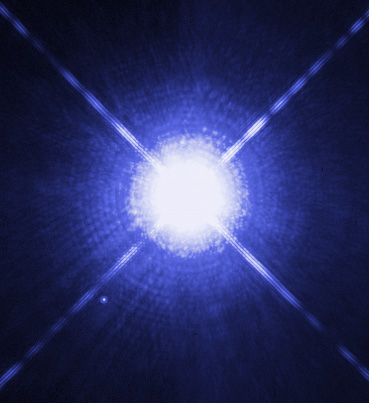
The bright object in the cover is Sirius A. Its faint companion, Sirius B, is the small point to the lower left. Hubble took the observation on October 15, 2003. The image therefore records light arriving at the telescope on that date, after its interstellar journey; publishing or reopening the image does not update the scene.
Sirius A was deliberately overexposed so the much fainter companion would appear. The spikes and rings are effects of the telescope’s imaging system. They are not giant arms or rings extending from the star. Sirius B is a white dwarf, a compact stellar remnant.
Two dates matter when reading an astronomical image: when the instrument received the light and approximately when the source emitted it. The second depends on the distance and the light-travel model.
Sources: [2]
How can we measure a distance without visiting the star?#
Nearby stellar distances can be measured by parallax. Observe a star from different positions as Earth travels around the Sun, and its apparent position shifts slightly against a more distant background. A closer star generally has a larger shift.
You can see the same geometry by holding up a finger and viewing it with one eye, then the other. The finger seems to move relative to the room behind it because your viewing position changes. Astronomers use a much larger baseline and carefully measured angles.
ESA’s Gaia mission used this approach while also accounting for stars’ own motion across the sky. Annual parallax repeats; proper motion is the continuing change associated with the star’s movement. Separating them requires repeated observations. Measurement uncertainty in the distance also becomes uncertainty in the inferred light-travel time.
Sources: [3]
Does brighter starlight mean a star is closer?#
Brightness alone cannot establish distance. A star may look bright because it emits a great deal of light, because it is nearby, or through a combination of both. Astronomers distinguish apparent brightness, the light we receive, from luminosity, the power the star emits.
Sirius is the brightest star in Earth’s night sky, but it is not the most luminous star known. Its relatively short distance helps it dominate our view. Comparing it with a much more distant star without allowing for distance would mix up the properties of the source and the journey of its light.
The same problem appears with lamps: a nearby modest lamp can look brighter than a powerful lamp far down a road. That analogy explains why astronomers need distance measurements as well as photographs.
Sources: [4]
Are the stars we see already dead?#
Some distant events can have happened without their light reaching us yet. But the travel delay alone does not tell us that a particular star has died. To estimate that possibility, astronomers also need information about the star’s evolutionary stage and likely remaining lifetime.
Stars commonly evolve over millions or billions of years. A delay of a few years is small beside those timescales, although the final stages of a particular star can change much faster. “We see the past” and “everything we see is already gone” are very different claims.
Our explanation of how stars use their fuel describes why mass affects the rate of evolution. Those models help interpret a delayed view; they do not give direct access to a distant star’s present condition.
Why do dark lanes cross the Milky Way?#
Many dark patches are foreground clouds that obscure light from behind them. A lack of visible stars in a patch does not necessarily mean the region contains no stars. Dust changes which parts of the Galaxy we can see.
Infrared observations can reveal objects hidden at visible wavelengths, and relatively cool dust can itself glow in infrared. Yet infrared does not penetrate every cloud at every wavelength. NASA’s WISE images include especially dense, cold regions that remain dark even against an infrared background.
A picture of the Milky Way is therefore shaped by both distance and intervening material. Changing the wavelength can reveal a different view of the same direction without changing when the original light was emitted.
Sources: [6]
Does the same simple calculation work for the most distant galaxies?#
At cosmological distances, expansion must be included. The Universe has expanded while the light was travelling, so a galaxy’s distance today and the distance inferred by multiplying travel time by light speed need not be the same.
Astronomers measure redshift using identifiable features in a spectrum. Expansion stretches the light to longer wavelengths. Converting that measurement into a distance or a lookback time requires a cosmological model, including assumptions about the expansion history.
This is why a report about a galaxy billions of years in the past needs more care than the nearby-Sirius example. The basic observation remains the same: the telescope records the light reaching it now. The interpretation of that light’s journey becomes more involved.
Sources: [7]
Keep exploring
Sources & further reading
Follow the original research, records, and explanations behind this story.
- How long does light from stars take to reach Earth? NASA Goddard — Ask an Astrophysicist
Light-year definition, approximate light speed and solar delay; historical farthest-object claims excluded.
- The Dog Star, Sirius A, and its tiny companion ESA/Hubble
8.6-light-year distance, image artifacts, Sirius B and October 15, 2003 observation.
- How does Gaia study the Milky Way? ESA
Parallax geometry, observing baseline and separation from stellar motion.
- Skywatching FAQ NASA Science
Apparent versus intrinsic brightness; Sirius is the brightest night-sky star, not the most luminous known.
- Stars NASA Science
Stellar evolutionary timescales; no individual star-death prediction.
- Dark Murky Clouds in the Bright Milky Way NASA/JPL-Caltech
Dust obscuration, infrared emission and dense clouds opaque to WISE wavelengths.
- Webb FAQs NASA Science
Redshift measured spectroscopically; distance conversion depends on expansion history and cosmology.
Follow the thread