
Stars shine because physical processes release energy inside them. In the Sun, hydrogen nuclei combine through a chain of nuclear reactions to make helium. Gravity holds the hot material together. A star has no need for sleep, although its activity and energy supply change over time.
The accompanying Draw Shelf story imagines an AI advice booth visited by a sleepy star, a Martian and the Sun. Its dialogue and self-care problem are fiction. The physics behind changes in a star’s brightness and lifetime is explained below.
What powers a star?#
For most of a star’s active life, the main energy source is hydrogen fusion in its core. The pressure and temperature there allow nuclear reactions that would not proceed at an appreciable rate in ordinary room-temperature gas. Astronomers call this long hydrogen-burning stage the main sequence.
“Burning” is astronomical shorthand. A candle needs a chemical reaction involving oxygen; stellar fusion rearranges atomic nuclei. A star therefore does not need a supply of breathable air. Before sustained fusion begins, a forming star can also shine using energy released as gravity draws its material inward.
Sources: [1]
Why does the Sun neither collapse nor explode?#
The Sun’s interior is a hot plasma: matter containing freely moving charged particles. Pressure is greater deeper inside, and that pressure difference provides outward support against gravity. In a stable star, the two effects are approximately balanced. This condition is called hydrostatic equilibrium.
Energy must also travel outward. In the Sun, radiation carries energy through one interior region; moving plasma carries it through the convection zone farther out. The visible photosphere is the layer from which much of the sunlight escapes. It is not a solid floor that an imagined visitor could stand on.
The core is roughly 15 million degrees Celsius, while the photosphere is about 5,500 degrees Celsius. A cool-looking patch in an image is still being compared with an extremely hot background.
Sources: [2]
Does solar minimum mean the Sun is switching off?#
No. Solar minimum describes a relatively quiet part of the Sun’s magnetic activity cycle. Sunspot numbers fall, and intense eruptions become less common. The cycle takes about 11 years, although individual cycles differ.
Measurements of total solar irradiance (the incoming solar power per unit area at Earth’s distance) show an average variation of roughly 0.1 percent over a cycle. That is measurable and relevant to the Earth’s energy supply, but it is nothing like a day without sunlight. A fictional Sun following advice to “take a break” should not be confused with this observed cycle.
A telescope may show a particular ultraviolet wavelength, making changes in the hot atmosphere especially conspicuous. To assess the total energy reaching Earth, scientists measure the combined radiant energy rather than judge how busy one image looks.
Sources: [3]
Why do some stars live longer than others?#
A more massive star has more fuel, but it also consumes that fuel much faster. The rate of use can outweigh the extra supply. Some massive stars last only millions of years, while low-mass stars can persist far longer.
Doubling a fuel tank will not double a vehicle’s range if its consumption increases much more than twofold. That is an analogy about supply and consumption, not a model of a stellar engine. Stellar temperatures, pressure and nuclear reaction rates determine the actual outcome.
A “sleepy” star is therefore a comic character, not a category of star needing rest. Low luminosity can be an ordinary physical property.
Sources: [1]
Will the Sun explode when its fuel runs out?#
The Sun is expected to become a red giant and eventually leave a white dwarf, rather than undergo the core-collapse supernova associated with massive stars. The transition out of its present main-sequence phase lies roughly five billion years ahead.
Running out of hydrogen in the core does not mean every hydrogen atom throughout a star has disappeared. Its internal structure changes, and fusion can continue in other regions or involve other nuclei. A white dwarf is the compact remnant left after the outer layers are lost; it gradually cools.
Our article on a planet orbiting the white dwarf WD 1856 explores what this kind of stellar transformation can mean for a planetary system. It does not provide a forecast for the fate of each planet around the Sun.
Sources: [4]
What can the colourful stars in the cover image tell us?#
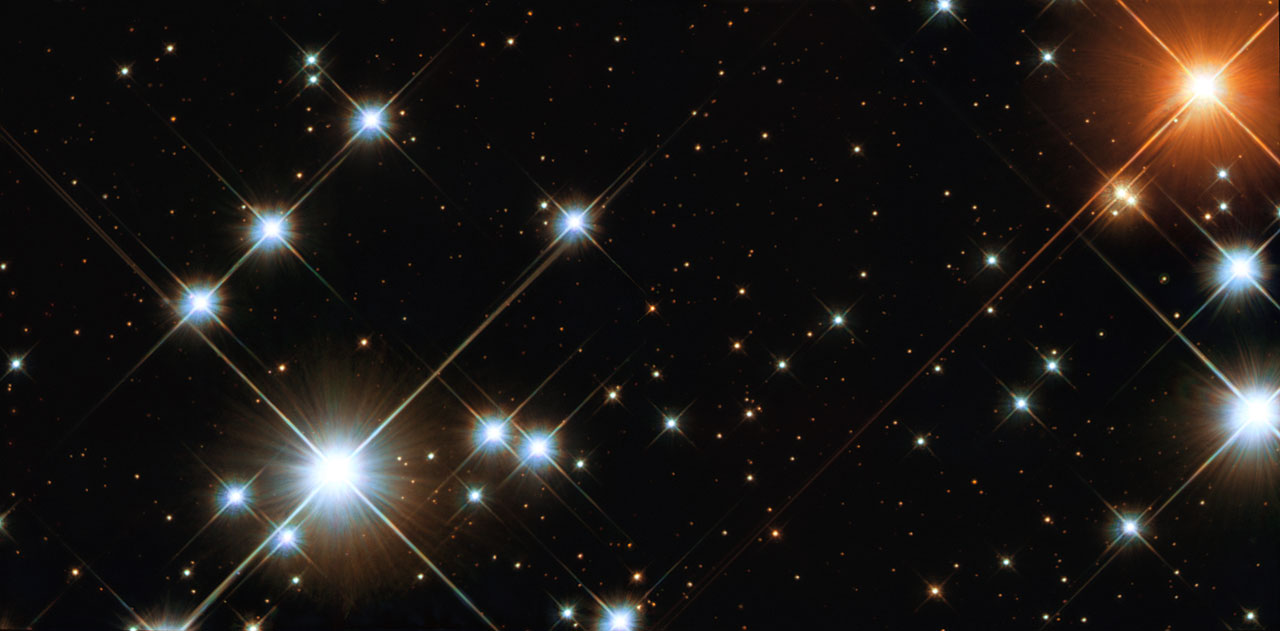
The cover is a Hubble observation of NGC 4755, the Jewel Box cluster. It contains bright blue supergiants, a red supergiant and many fainter stars. These are real telescope measurements, presented as a composite made from filters extending from ultraviolet through visible light to near-infrared.
The image therefore needs to be read with its filter information. It is not simply what an unaided eye would see from a spacecraft window. Nor can an individual star’s mass be read directly from the size of its bright patch: that patch is shaped by the imaging system and exposure as well as the arriving light.
The differences between these stars are observable; the personalities in the advice-booth story are invented.
Sources: [5]
Keep exploring
Sources & further reading
Follow the original research, records, and explanations behind this story.
- Stars NASA Science
Hydrogen fusion, formation, and the dependence of fuel consumption on stellar mass.
- Sun: Facts NASA Science
Solar plasma, pressure support, energy transport and temperatures.
- Four Decades and Counting: Measuring Solar Energy Input to Earth NASA Goddard
Approximately 11-year cycle, 0.1 percent irradiance variation and irradiance measurement.
- Types of Stars NASA Science
Solar red-giant future and cooling white-dwarf remnant; no precise white-dwarf formation date adopted.
- A Hubble gem: the Jewel Box ESA/Hubble
NGC 4755 observation, stellar variety and ultraviolet-to-infrared filters.
Follow the thread