
WD 1856 b is a giant planet orbiting a white dwarf, the compact remnant of a star. It completes an orbit in about 34 hours, much closer to the remnant than it could have safely remained while the star was a red giant. The leading explanation is that it survived farther out and moved inward later.
Webb observations published in 2026 strengthened that migration interpretation by measuring an atmosphere and unexpected warmth. The thermal story is still incomplete: an earlier Webb measurement gave a much lower temperature, and the newer paper discusses possible explanations rather than claiming that the disagreement has vanished.
What is unusual about this planet and its star?#
The planet is roughly Jupiter-sized, while the white dwarf is only a little larger than Earth. The planet can therefore be several times wider than the object it orbits. Width and mass are different properties: the compact stellar remnant contains far more mass despite its smaller diameter.
WD 1856+534 lies about 80 light-years away. TESS detected repeated decreases in its brightness, and observations with Spitzer helped investigate the transiting object. The discovery was announced in 2020, initially with caution about whether it was a planet or a more massive brown dwarf.
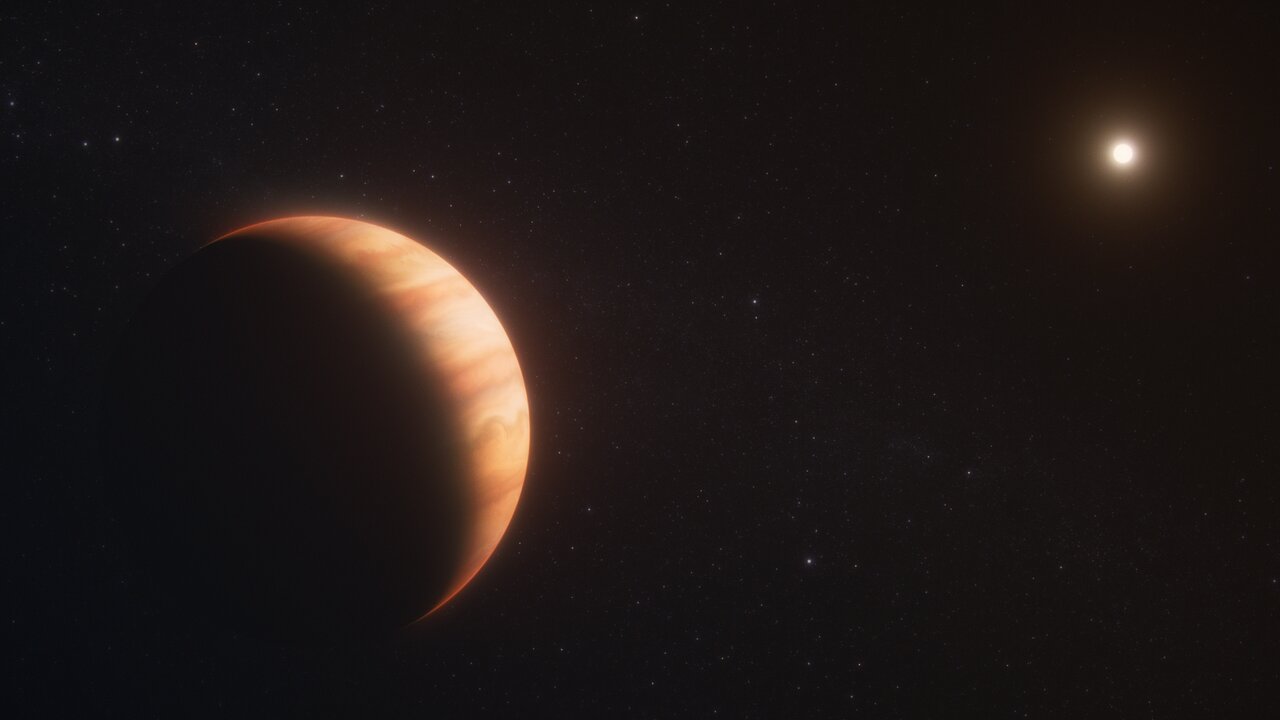
The cover is an existing artist's concept of the system. Its cloud bands and colors are an interpretation, not a resolved photograph of the planet's weather.
Why could it not simply stay in its present orbit?#
A Sun-like star changes greatly near the end of its life. Its outer layers expand during the red giant phase and are eventually lost, leaving a dense core. An orbit safely outside the final white dwarf can still lie deep inside the earlier giant star.
That is the difficulty for WD 1856 b. Its current orbit is only about 0.02 astronomical units from the remnant, with one astronomical unit defined by the average Earth–Sun separation. Explaining the present system requires a history of orbital change.
Researchers have considered survival through interaction with the giant star's envelope and inward migration after the white dwarf formed. These histories predict different times for strong heating, so the planet's thermal state can help distinguish them.
How can a transit reveal an atmosphere?#
During a transit, some starlight passes through the planet's atmospheric edge before reaching the telescope. Molecules absorb particular wavelengths. Comparing the amount of dimming across the spectrum can reveal those absorption patterns.
WD 1856 b presents an unusual geometry because the planet is larger than the star and passes across it in a grazing transit. The observation has to be modeled with that partial overlap in mind. A familiar diagram of a small planet crossing a broad stellar disk would give the wrong impression of this system.
The 2026 analysis found evidence for aerosols and hydrocarbons, with methane favored among the tested explanations. Aerosols are suspended particles that affect the light passing through an atmosphere. These results describe spectral signatures and model fits, rather than a directly viewed cloud map.
What did the 2026 study infer about mass and temperature?#
The spectral analysis constrained the mass to about 4.3–10.9 Jupiter masses and inferred an effective temperature of roughly 390–412 kelvin. These are results of the atmospheric analysis, not a spacecraft weighing the planet or inserting a thermometer into it.
The temperature is much higher than the roughly 160 kelvin expected from heating by the white dwarf alone. The planet contributes its own infrared emission to the measured light. Accounting for that extra contribution is necessary when interpreting how deep the transit looks at different wavelengths.
The word effective refers to a temperature associated with the planet's emitted energy. It should not be presented as a comfortable or uncomfortable temperature on a solid surface. WD 1856 b is a giant planet, and the measurement does not identify such a surface.
Why did an earlier Webb study find a colder planet?#
A 2025 study used Webb's Mid-Infrared Instrument, MIRI, to measure excess infrared emission from the system. It attributed that excess to the planet and reported a temperature of 186 kelvin, with an uncertainty of plus 6 and minus 7 kelvin. Its modeling constrained the mass to no more than about six Jupiter masses.
The 2026 paper explicitly discusses the tension with the earlier result. The observations used different instruments and sampled different circumstances. The authors suggest changing cloud-top pressures across hemispheres or over time as one possibility. An unidentified instrumental or calibration effect is another; they did not identify such an effect in either dataset.
These are possible resolutions, not a demonstrated explanation. Averaging the two temperatures would conceal the physical question. Each result needs to remain attached to its method until the disagreement is resolved.
How does warmth point toward a late inward journey?#
The 2026 team used cooling models to reconstruct when a heating episode could have occurred. In their favored scenario, the planet was reheated about 3–5.5 billion years after the star entered its white dwarf phase. That timing favors a late migration over heating during the much earlier giant-envelope episode.
The proposed process begins with a wide orbit. Gravitational interactions alter the planet's path, bringing it close to the white dwarf on an elongated orbit. Tidal deformation dissipates orbital energy as heat, and the orbit becomes tighter and more circular.
This reconstruction depends on the inferred temperature, mass and cooling history. It supplies evidence for a route to the present system; it does not provide an observed recording of the planet's journey. The temperature disagreement is therefore relevant to the history, not merely a discrepancy between two labels on a chart.
Does this predict what will happen to Jupiter?#
The system demonstrates that a giant planet can exist close to a stellar remnant after the host's main lifetime. It offers a test of the physics that governs surviving planetary systems. It does not specify a single future orbit for Jupiter.
A planet's fate depends on its initial orbit and interactions with other objects, as well as the changing star. Some systems may leave distant survivors; others can move planets inward or eject them. Our guide to rogue planets and their detection explains how astronomers investigate worlds without an identified host.
For WD 1856 b, the next useful observations are those that can test the atmosphere and reconcile the thermal measurements. A clearer account of its present state will make the reconstruction of its past more reliable.
Keep exploring
Sources & further reading
Follow the original research, records, and explanations behind this story.
- NASA Missions Spy First Possible Survivor Planet Hugging White Dwarf Star NASA
2020 discovery context and orbital puzzle
- Webb studies how a planet survived death of its star ESA/Webb
2026 thermal reconstruction and interpretation
- Aerosols and hydrocarbons in the atmosphere of a white dwarf planet MacDonald et al. / Nature
Primary evidence and unresolved thermal disagreement
- Thermal Emission and Confirmation of the Frigid White Dwarf Exoplanet WD 1856+534b Limbach et al. / ApJ Letters
Earlier MIRI result and model constraints
- Exoplanet WD 1856 b: Transmission Spectrum NASA Science
Transmission measurement and interpretation
- Exoplanet WD 1856 b: artist’s concept ESA/Webb
Existing illustration, not resolved planetary image
Follow the thread