
A satellite that stops doing its job does not necessarily need an astronaut with a toolbox. Ground engineers may restore useful operation by changing how it works. Other problems require new hardware, an added propulsion system or an entirely separate spacecraft. Whether servicing is possible depends on the fault, the satellite’s design and the ability to reach it safely.
Can engineers fix a satellite without visiting it?#
Sometimes they can restore service without physically repairing the failed component. In June 2024, NASA returned Hubble to science operations after changing its pointing system from three-gyroscope operation to a mode using one gyro. A problematic gyro had repeatedly supplied faulty readings and interrupted observations.
The change left another working gyro available for later use. It also introduced some observing limitations. This was an operational response to a hardware problem, not the installation of a replacement gyro through a radio link.
That distinction matters when a report says a spacecraft has been “fixed.” Restoring the mission’s useful function can mean working around a failure. The relevant questions are what the spacecraft can now do, what capability was lost and whether another failure would leave fewer options. A return to operation does not by itself show that the original component is healthy again.
Sources: [1]
What makes a satellite easier to repair physically?#
Hubble was designed with repeated servicing in mind. NASA describes interchangeable modules that allowed astronauts to replace instruments and other equipment. Keeping much of an instrument’s wiring inside a self-contained unit simplified the work of exchanging that unit in orbit.
A design like that turns an open-ended repair into a more defined operation: reach the unit, release its attachments, remove it and install a compatible replacement. Access and interfaces become part of the satellite’s engineering, rather than details left for a future visitor to improvise.
Hubble’s five servicing missions benefited from this approach. The correction of its early optical problem is described separately in the story of Hubble’s flawed mirror. Serviceability also supported later upgrades, showing that a visit can improve a functioning spacecraft as well as recover one with a fault.
Sources: [2]
Have astronauts really repaired a free-flying satellite?#
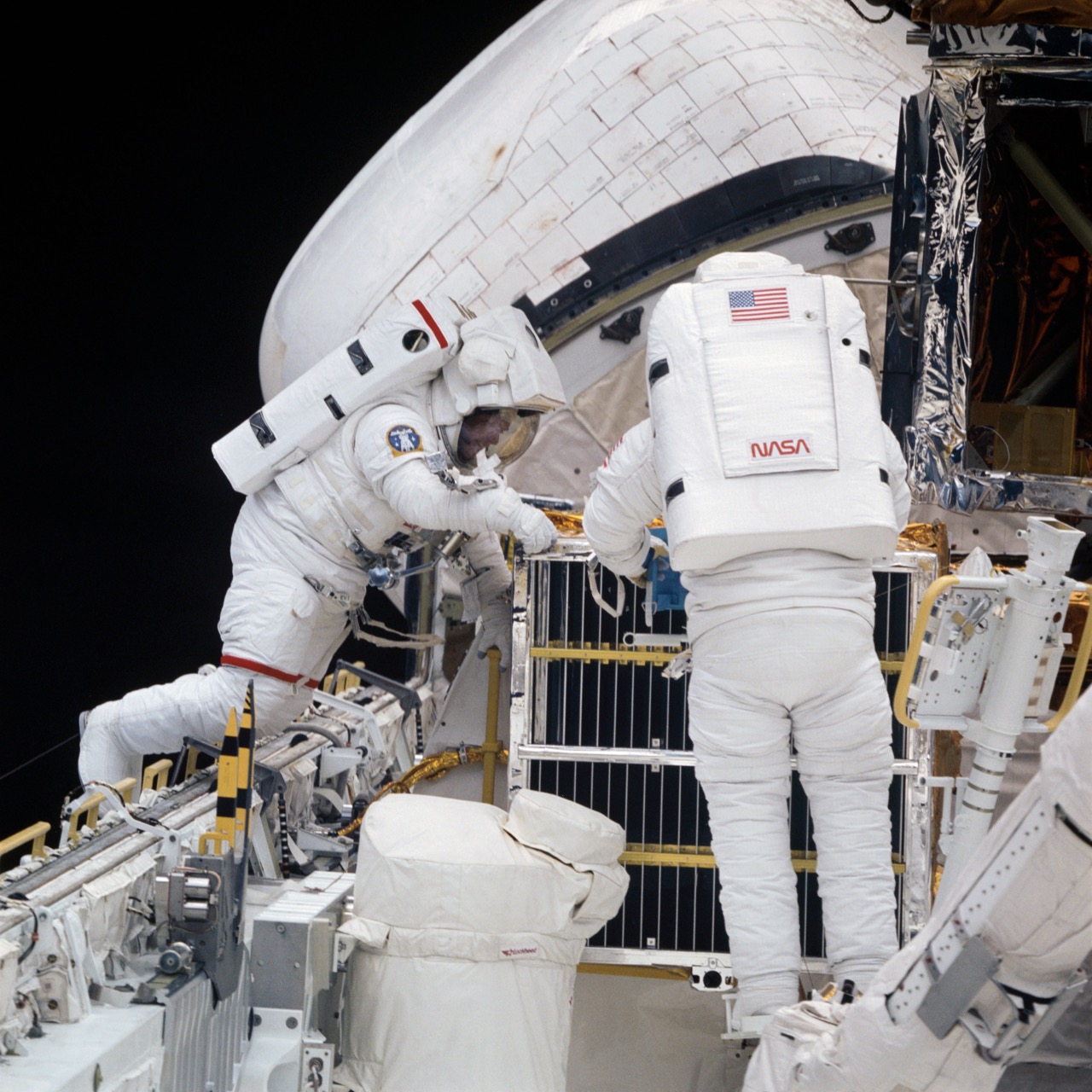
Yes. In April 1984, the Challenger crew captured the Solar Maximum Mission satellite and brought it into the shuttle’s payload bay for repairs. George Nelson and James van Hoften replaced its attitude-control module and worked on instrument hardware. The cover photograph records that repair operation.
Getting the satellite into a stable work position was itself difficult. Nelson’s first attempts to attach his manoeuvring unit failed, disturbing Solar Max’s rotation. Ground controllers helped bring the satellite under control, and Terry Hart subsequently captured it with the shuttle’s robotic arm.
NASA later identified a small protruding thermal button as the obstruction that prevented the initial attachment device from latching properly. The case illustrates how a successful servicing mission depends on the exact shape of hardware, not just the broad idea of bringing two spacecraft together. The repaired satellite was released and resumed scientific work.
Sources: [3]
Is extending a satellite’s life the same as refuelling it?#
No. A spacecraft can provide propulsion to another satellite while remaining attached to it. Northrop Grumman’s Mission Extension Vehicle uses this approach: its own propulsion helps maintain the combined spacecraft’s required orbit and pointing.
MEV-1 docked with Intelsat 901 in February 2020. MEV-2 docked with Intelsat 10-02 in April 2021, directly at the customer satellite’s operational geostationary location. The second mission’s announcement described a contract for five years of life-extension service. That was the stated service arrangement, not evidence that every satellite can receive the same extension.
The distinction from refuelling is physical. An attached propulsion vehicle supplies a capability from outside; a refuelling operation transfers propellant into the client’s own system. Neither operation automatically repairs an unrelated failed instrument. The remedy has to match the reason the spacecraft can no longer perform its mission.
Why is robotic refuelling difficult?#
A satellite’s fuel valve may have been sealed and covered before launch with no intention of opening it again in orbit. Reaching it can require removing protective material, cutting retaining wires and handling caps before a fluid connection is possible.
NASA’s Robotic Refueling Mission tested these kinds of tasks on equipment attached to the International Space Station. Ground controllers used the Canadian Dextre robot and specialised tools. In January 2013, the programme demonstrated fluid transfer through representative satellite servicing hardware.
The experiment used ethanol in a test module. It was not the refuelling of an independently orbiting commercial satellite. That qualification does not make the demonstration irrelevant: it tested difficult operations in microgravity. It defines what was demonstrated, leaving rendezvous with a client, secure attachment and the client’s actual fluid system as additional parts of a complete servicing mission.
What are newer robotic servicing missions trying to do?#
Robotic servicing can include inspection, attaching new equipment and manipulating components without a visiting astronaut. These are different tasks, so evidence that a spacecraft can perform one should not be treated as proof that it can do all of them.
NASA reported that the Mission Robotic Vehicle carrying the DARPA-funded Robotic Servicing of Geosynchronous Satellites payload launched on 21 July 2026. The payload uses two robotic arms developed by the U.S. Naval Research Laboratory. NASA’s account describes planned inspection and upgrades, including the installation of small propulsion modules called mission extension pods.
The launch is a reported event. The listed servicing capabilities are mission objectives in that account, not a claim here that every operation has already succeeded. DARPA also describes the programme as cooperative servicing: operations are undertaken with spacecraft operators, rather than as an unscheduled visit to an arbitrary object.
Why are some servicing projects cancelled?#
A technically interesting repair can still be too expensive, too risky or poorly matched to an operator’s needs. NASA’s OSAM-1 project was intended to demonstrate servicing of a spacecraft not originally prepared for it, but the agency decided to cancel the project after reviewing its technical, cost and schedule problems.
NASA’s cancellation explanation also identifies a lack of a committed transition partner and a shift in the wider community away from refuelling unprepared spacecraft. The programme therefore cannot be cited as a completed satellite-refuelling mission. Older future-tense descriptions of its intended work need to be read alongside the cancellation notice.
This is a practical constraint on servicing. Developing a tool is only part of supplying a useful service. Someone needs a compatible operation, a reachable client and enough expected benefit to justify the mission and its risks.
Sources: [10]
How do operators decide whether a satellite is worth servicing?#
The examples suggest a sequence of questions. Can useful operation be restored from the ground? If a visit is required, can the failed function be reached or supplemented? Does the rest of the spacecraft retain enough useful capability to make the intervention worthwhile?
An instrument replacement, an attached propulsion unit and a change in operating mode solve different problems. Their value also depends on what the satellite provides, whether that is scientific observations or one of the satellite services used on Earth.
There is no universal orbital repair shop that can fix any spacecraft. Each intervention needs a workable combination of access, compatible hardware, control and a useful result. Solar Max’s obstructed attachment point and Hubble’s replaceable modules show why those details can determine the outcome before the repair itself begins.
Keep exploring
Sources & further reading
Follow the original research, records, and explanations behind this story.
- NASA’s Hubble Restarts Science in New Pointing Mode NASA
Dated one-gyro operational workaround, spare gyro and limitations.
- Hubble Celebrates 25 Years Since First Repair Mission in Space NASA
Interchangeable modules and five servicing missions; old age/productivity claims omitted.
- 40 Years Ago: STS-41C, the Solar Max Repair Mission NASA
Capture obstacle, module replacement and resumed science; image41C-38-1852.
- Digital Engineering Triumph Northrop Grumman
Attached vehicle provides propulsion and pointing; manufacturer account.
- Northrop Grumman and Intelsat Make History with Docking of Second Mission Extension Vehicle Northrop Grumman
Historical docking and stated five-year contract; obsolete2024MRV target omitted.
- RRM 1 & 2 NASA
ISS-mounted test hardware, ethanol and ground-controlled Dextre.
- NASA’s Refueling Demonstration Proves Viability of Satellite-Servicing Technologies NASA
January2013 demonstration, not free-flying commercial client refuelling.
- Robotic Servicing Mission Launches with NASA Support NASA
Launch distinguished from planned servicing demonstrations.
- Robotic Servicing of Geosynchronous Satellites DARPA
Cooperative inspection and servicing with spacecraft operators.
- On-orbit Servicing, Assembly, and Manufacturing 1 NASA
Cancellation statement overrides stale Active Mission label and future-tense body.
Follow the thread