
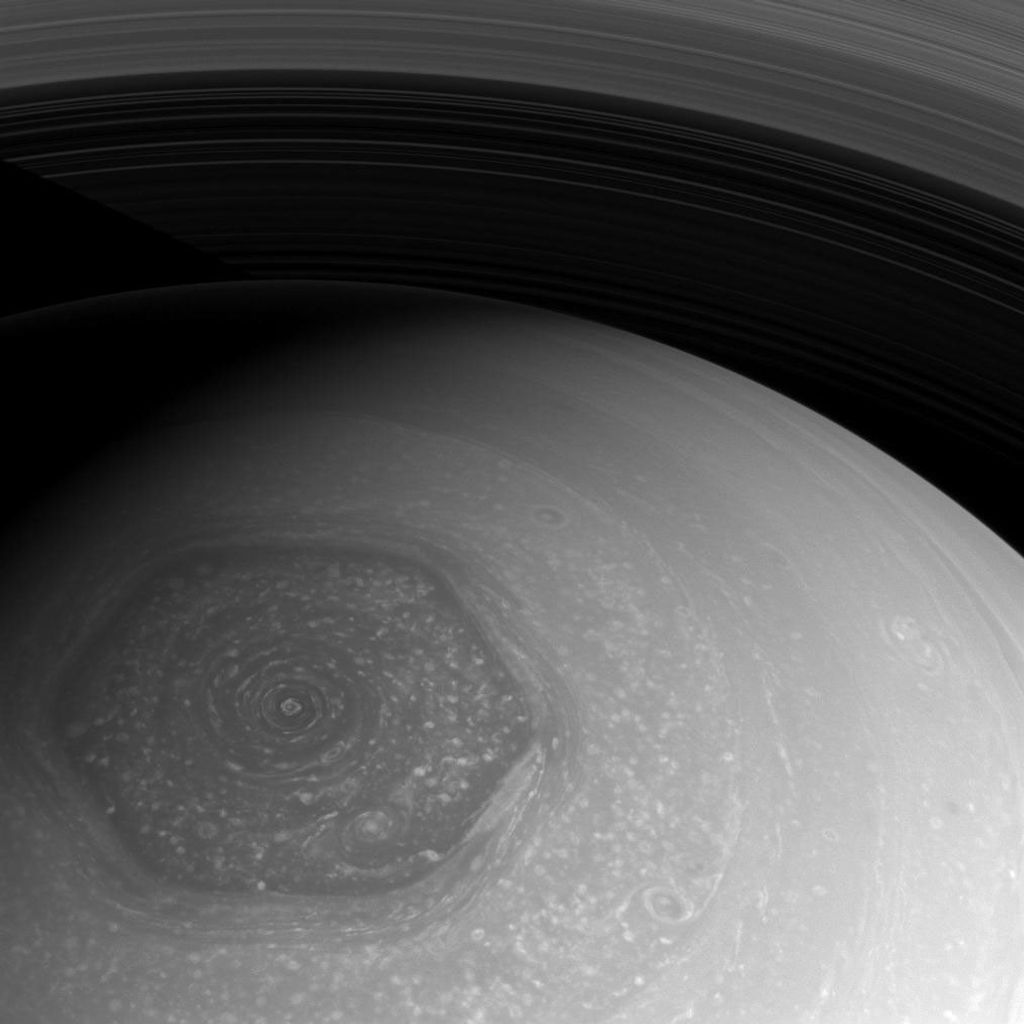
Saturn’s north-polar hexagon is a persistent wave in a fast atmospheric jet. The gas follows a path with six broad bends around the pole. Rotating-fluid experiments and computer models can produce polygonal flows, but reproducing Saturn’s shape, stability and vertical structure together remains a harder problem.
The feature is part of the planet’s weather. Its straight-looking sides do not require a rigid boundary or a hexagonal object beneath the clouds. They are the visible geometry of a moving fluid.
What is the hexagon, and how large is it?#
A jet stream is a relatively narrow band of fast-moving gas. Saturn’s northern jet traces a wavy path around the pole, with six repeating bends giving the whole pattern its familiar outline. NASA describes the feature as roughly 30,000 kilometres across, more than twice Earth’s diameter.
Inside it lies a separate, concentrated polar vortex. The central vortex and the surrounding hexagonal jet are related parts of the circulation, but they are not interchangeable names for one storm. Smaller vortices and cloud structures occupy the region between them.
The width is an approximate scale for an atmospheric pattern, not a survey of six fixed walls. A cloud marking can move through a pattern whose overall shape changes much more slowly. Keeping the movement of the gas separate from the movement of the wave is essential when interpreting successive images.
Sources: [2]
Why does the flow have six sides rather than a circle?#
Fast flow next to slower flow creates shear. Under suitable conditions, a small disturbance in a rotating jet can grow into a repeating meander. The number of bends depends on the flow and its surroundings; rotation by itself does not dictate that every planet must produce a hexagon.
A 2010 laboratory study investigated jets and shear layers in a rotating cylindrical tank. Differentially rotating parts drove the flow, and the experiments produced several wave patterns, including sixfold forms. Six bends were possible over a range of conditions, while other settings produced different numbers.
This gives a physical route from a roughly circular flow to a polygonal pattern. It does not turn the tank into a scale replica of Saturn. The laboratory isolates particular balances and instabilities, while a planetary atmosphere has stratification, convection and varying conditions with depth. A successful shape is one test of a mechanism, not the only test.
Sources: [3]
Could motions deep inside Saturn maintain the pattern?#
A 2020 study by Rakesh Kumar Yadav and Jeremy Bloxham simulated deep thermal convection in a rotating shell. Its turbulent flow organized into jets and large vortices. The vortices deformed neighbouring jets into polygonal paths, offering a way to generate both the circulation and the shape within one model.
The reported calculations included patterns with nine and seven edges rather than an exact six-sided match, and their drift was faster than the observed hexagon’s. The authors presented the mechanism as a candidate and identified further parameter studies as necessary.
This model explains how deeper motions might influence what appears near the clouds. It does not establish a measured depth for every part of the real hexagon. A simulation generates consequences from chosen assumptions; observations decide which consequences match Saturn.
Sources: [4]
Has the same cloud survived since Voyager?#
No single cloud needs to survive for the pattern to persist. The hexagon was identified in Voyager-era observations and was seen again by Cassini decades later. That history establishes a long-lived circulation feature, rather than the survival of the same parcel of gas.
Cassini arrived while the north was in winter darkness. Infrared observations could investigate the region before returning sunlight made detailed visible-light views possible. The spacecraft therefore extended the evidence beyond a few photographs taken under one lighting condition.
Saturn’s weather also develops under different boundary conditions from Earth’s. Our mountains, continents and oceans disrupt and reshape atmospheric flows. Saturn has no comparable solid landscape at its visible cloud level. That helps explain why direct comparisons with a week-long terrestrial hurricane are limited, although it does not by itself solve the hexagon’s longevity.
Sources: [1]
How far above the clouds does the hexagonal structure reach?#
A 2018 study used Cassini infrared spectroscopy to follow a warm northern stratospheric vortex developing toward summer. Its boundary had a hexagonal shape at altitudes about 300 kilometres above the clouds.
The authors interpreted this as evidence that the wave associated with the lower hexagon could influence temperatures much higher in the atmosphere than previously expected. The measured feature was a thermal pattern in an upper atmospheric layer, not a photograph of a solid six-sided tower.
This distinction prevents two different depth questions from being merged. Evidence for a related structure above the clouds does not tell us directly how far the driving flow extends below them. The upper atmosphere, visible cloud region and deeper circulation require different measurements and may respond differently to the changing season.
Sources: [5]
Why did the region inside the hexagon change colour?#
Cassini’s natural-colour images showed the northern polar region changing from a bluish appearance in 2012 toward a more golden one in 2016. NASA’s account linked the change provisionally to increasing sunlight and the production of photochemical haze as northern summer approached.
Photochemical means that light helps drive the chemical reactions. The resulting particles alter how the atmosphere scatters and absorbs light. Circulation may also matter: a strong jet can restrict the exchange of particles between the region inside it and the atmosphere outside.
Colour, shape and wind speed are different observables. A change in haze can alter the colour of a persistent circulation feature without requiring its six-sided outline to disappear. Conversely, a false-colour image can show a different palette because of its processing, even when no seasonal colour change is being compared.
Sources: [6]
What does the Cassini photograph above show?#
The image was taken on 23 July 2013 through a filter centred at 752 nanometres, in the near infrared. It is displayed in greyscale. Brightness therefore represents the recorded light in that band, rather than the colours a person would see.
The viewing angle is oblique: Cassini looked toward the north pole from about 53 degrees above the ring plane. The perspective helps place the polar weather in relation to Saturn and its rings, but it distorts the outline compared with a directly overhead view. The small central vortex and the much larger surrounding jet can both be distinguished.
Sources: [7]
What would count as a convincing explanation?#
A model should account for several observations together: the sixfold shape, slow movement of the overall pattern, rapid flow within it, persistence across seasons and evidence from different heights. Matching only the outline leaves those other constraints untested.
The laboratory work demonstrates that rotating fluids can organize into polygonal jets. The deep-convection study investigates how such flows might be generated within a planet. Cassini’s thermal observations add a vertical constraint that either kind of explanation must accommodate.
The mission’s observations remain useful after the spacecraft’s destruction. Our account of Cassini’s Grand Finale explains how the mission ended; the continuing comparison of its measurements with atmospheric models is a different, ongoing part of that work.
Keep exploring
Sources & further reading
Follow the original research, records, and explanations behind this story.
- Saturn’s Hexagon in Motion NASA Cassini
Voyager and Cassini history, winter infrared observations and atmospheric boundaries.
- NASA’s Cassini Spacecraft Obtains Best Views of Saturn Hexagon NASA
Approximate 30,000-kilometre scale and central vortex distinct from jet.
- A laboratory model of Saturn’s North Polar Hexagon Barbosa Aguiar et al., Icarus 206 (2010)
Rotating tank, shear instabilities and multiple possible wave numbers.
- Deep rotating convection generates the polar hexagon on Saturn Yadav and Bloxham, PNAS 117 (2020)
Deep convection mechanism, seven- and nine-sided model patterns and excessive drift.
- A Hexagon in Saturn’s Northern Stratosphere Surrounding the Emerging Summertime Polar Vortex Fletcher et al., Nature Communications 9 (2018)
Infrared thermal structure approximately 300 km above clouds.
- Changing Colors in Saturn’s North NASA/JPL-Caltech/Space Science Institute/Hampton University
Seasonal photochemical haze proposed; circulation also possible.
- Saturn’s Polar Jet NASA/JPL-Caltech/Space Science Institute
23 July 2013 near-infrared 752 nm image at 53 degrees above ring plane.
Follow the thread