
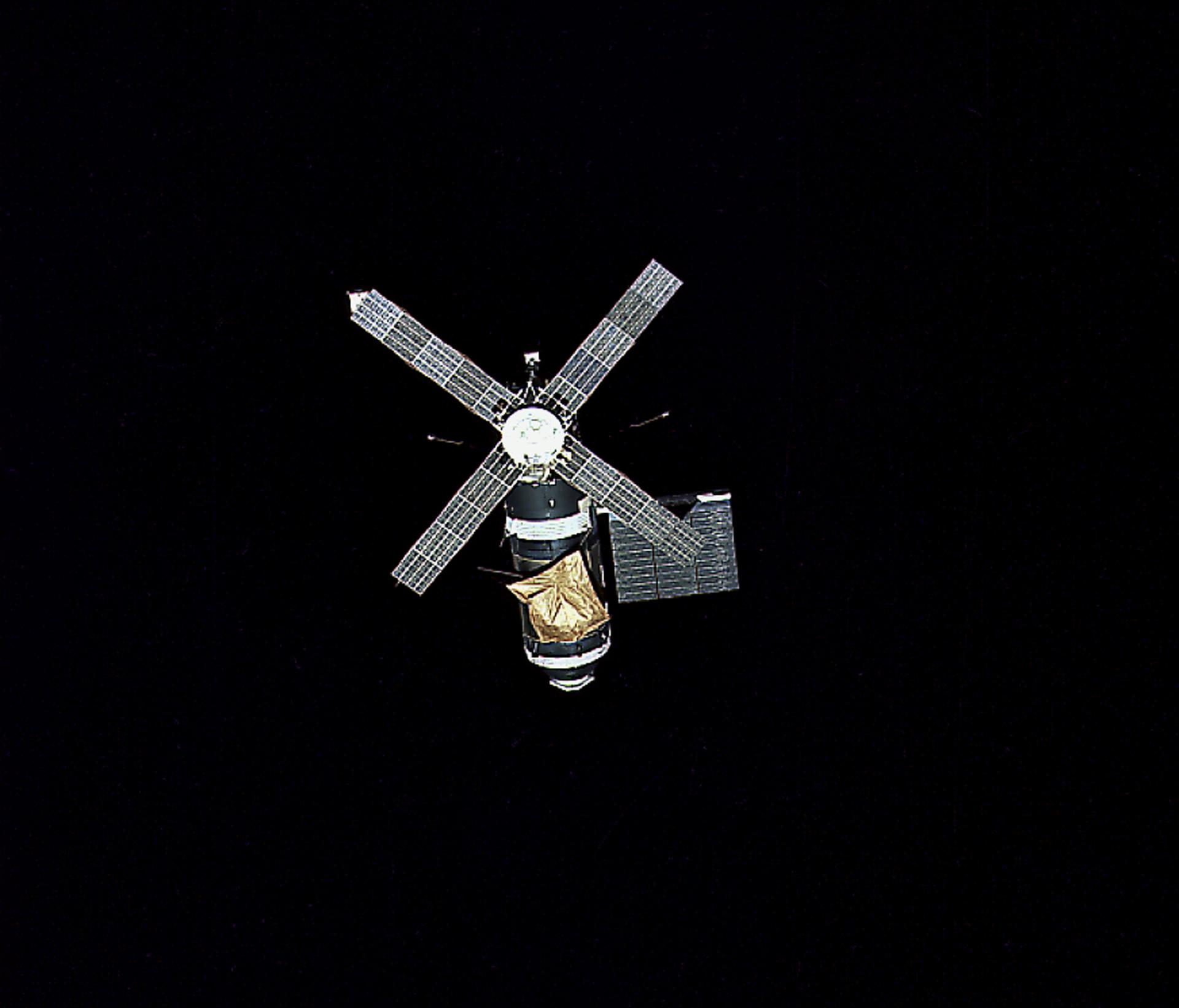
The first Skylab crew cooled their damaged space station by pushing a folded sunshade through a small scientific airlock and opening it outside. Deployed on 26 May 1973, the parasol shaded the exposed workshop so that the astronauts could begin living and working there.
The shade solved an urgent thermal problem, but the station still needed electrical repairs. Understanding the rescue means separating the missing protective shield, the two damaged workshop solar wings and the later work that restored enough power for science.
What went wrong during Skylab’s launch?#
Skylab launched without a crew on 14 May 1973. During ascent, its micrometeoroid shield tore away. That shield also provided thermal protection, so losing it exposed the workshop to much greater solar heating. One workshop solar wing was lost and the other became trapped by debris.
The station was not completely without solar power. The Apollo Telescope Mount deployed its own four smaller arrays. Controllers could change Skylab’s orientation to manage sunlight on the exposed workshop, but an orientation that reduced heating could also reduce the electrical power available from the surviving arrays.
This was therefore a connected set of failures. Keeping the hull cooler, generating electricity and preserving equipment all had to be considered together while engineers prepared repair hardware on Earth.
Why can a spacecraft overheat in the vacuum of space?#
Sunlight transfers energy across a vacuum. A spacecraft absorbs some of that energy, produces heat in its equipment and loses energy by emitting thermal radiation. Its temperature depends on the balance of those flows, not simply on whether the surrounding space is described as cold.
Outside the vehicle there is no surrounding air to carry heat away by convection. Heat can move through solid structures by conduction, but it must ultimately leave the spacecraft through radiation. A sunshade reduces one source of incoming energy before that energy reaches the protected surface.
This explains why a thin sheet can make a substantial difference without functioning like an air conditioner. The material’s optical properties and the area it shades matter. The general principle appears in NASA’s thermal-control guidance; calculating Skylab’s exact temperatures would also require its geometry, materials, internal heat loads and orbital conditions.
Sources: [4]
Who designed the parasol, and why choose that approach?#
Jack Kinzler and the Technical Services Division at Johnson Space Center developed the parasol solution. The covering combined nylon, Mylar and aluminum with a folding support structure. It had to be manufactured and tested quickly, fit inside the Apollo spacecraft and be manageable by the crew after docking.
NASA considered several ways to put a shade over the station. The parasol’s practical advantage was that the astronauts could deploy it from inside the workshop through an existing scientific airlock. That avoided making a new, complicated spacewalk the first step in cooling the station.
The narrow opening imposed a very concrete design constraint: a broad cover had to travel as a compact folded package and expand only after it was outside. The umbrella comparison describes that deployment geometry; the flown item was purpose-built spacecraft repair equipment.
Sources: [2]
How did the crew put a large shade through a small airlock?#
NASA’s detailed mission history describes the folded parasol in a container with an eight-inch-square cross-section, about 20 centimetres across. Segments of pole advanced the assembly through the Sun-facing scientific airlock. Outside, the supports spread the fabric, after which the crew drew it back toward the workshop.
Charles “Pete” Conrad, Joseph Kerwin and Paul Weitz worked in a very hot interior and took breaks in their Apollo command module. The small scientific airlock was a controlled passage for equipment; the process did not involve opening the whole cabin directly to vacuum.
Using the port had a scientific cost. Experiments that depended on that airlock could no longer use it. The decision traded access to one facility for conditions in which the wider station could operate.
How did engineers know the parasol was working?#
The relevant evidence was the change in internal temperature and the crew’s ability to activate the workshop. NASA’s account describes temperatures falling after deployment and reaching a comfortable range over the following days. A shade could be visibly open yet still cover too little area, so its appearance alone was not the complete test.
Historical summaries give different temperatures at different stages of the recovery. An initial reading in an overheated workshop, a later stabilized value and conditions after an additional sunshade are not interchangeable measurements. The important sequence is that reduced solar heating allowed the interior to cool enough for work.
The original parasol was also imperfectly positioned. NASA’s program history describes less coverage than intended. Its usefulness came from the thermal improvement it actually delivered, even though it did not restore the original external structure.
Why was a separate spacewalk needed for the solar array?#
The parasol did not free the jammed workshop wing or replace the missing one. Limited electrical power continued to restrict activity after the station had cooled. Ground teams practised methods for releasing the trapped array and sent the crew instructions for another attempt.
On 7 June 1973, Conrad and Kerwin went outside. They used a cable cutter on a long pole to sever the strap holding the wing. Further pulling was needed before it opened fully, after which Mission Control confirmed power generation.
The repair involved both tool operation and body restraint. Pulling on hardware in free fall moves the astronaut as well as loading the hardware, so handholds and tethers are part of the work. Our explanation of free fall and everyday space physics covers why an orbiting crew still has mass and inertia.
Sources: [6]
Was the first parasol the final sunshade?#
No. The second crew installed a different, twin-pole sunshade over the existing parasol. Owen Garriott and Jack Lousma carried out that work on 6 August 1973 during a spacewalk. This was a later operation with different hardware, not another description of the first crew’s airlock deployment.
The additional shield improved the station’s thermal conditions. It had been developed at Marshall Space Flight Center, while the first crew’s parasol came from Johnson. Distinguishing the two avoids attributing every photograph of a covered Skylab to the same repair.
The sequence shows how recovery can proceed in stages: reduce the immediate heating problem, restore a damaged power source and then improve the temporary thermal protection. Each stage had its own equipment, operating procedure and observable result.
Sources: [7]
Keep exploring
Sources & further reading
Follow the original research, records, and explanations behind this story.
- Skylab 2 NASA
Launch date, damage and archival image provenance.
- Skylab 2: We can fix anything! NASA / John Uri
Parasol design constraints, crew heat breaks and cooling sequence.
- 50 Years Ago: Skylab 2, The We Fix Anything Crew NASA / John Uri
Container cross-section, extension mechanism and loss of experiment access.
- 7.0 Thermal Control NASA Small Spacecraft Systems Virtual Institute
Energy balance, radiation, conduction and sunshield function.
- The Human Touch: The History of the Skylab Program NASA / Donald C. Elder
Orientation versus power tradeoff and incomplete coverage; staged temperatures.
- Skylab 2: First Repair Spacewalk NASA / John Uri
Conrad and Kerwin release the trapped array; confirmed power.
- Skylab 3: Spacewalks and Science NASA / John Uri
Separate later twin-pole sunshade installed over the first parasol.
Follow the thread