
A flash from an explosion can cross the gap between two spacecraft and reach a camera. If the gap is effectively empty, a microphone beside the camera has no stream of pressure changes to detect. Light crosses a vacuum by itself. A sound wave needs material whose parts can push on one another.
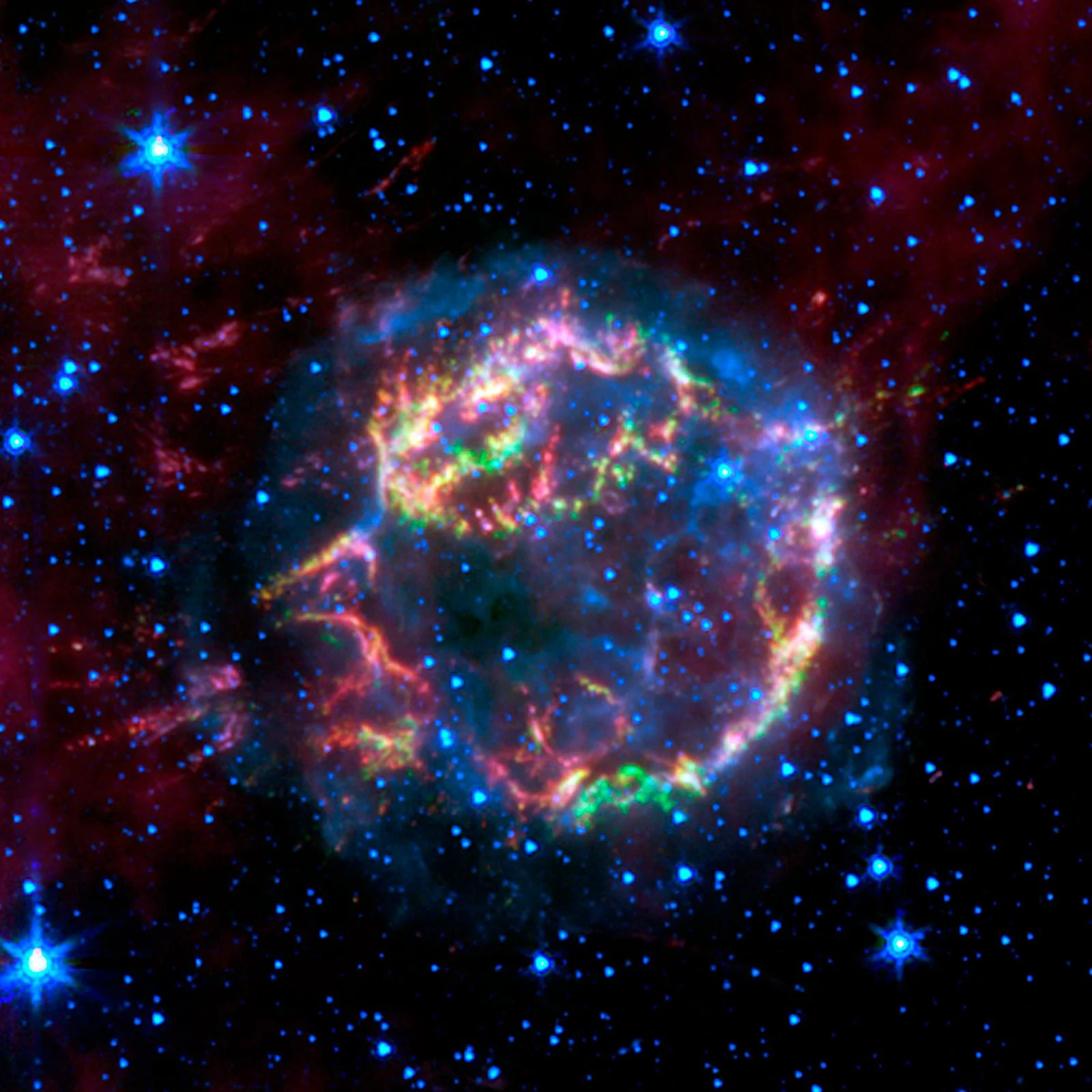
Astronomers can record light from the initial flash and return later to see where the debris has run into gas. There, a shock can leave a shell of glowing material. The remnant Cassiopeia A shows how the two signals are related.
Why can a camera record the flash across the gap?#
A hot object can emit light. A camera detects a small part of that radiation when it reaches a sensor. The electromagnetic wave can carry energy across empty space, whether its wavelength falls in the range our eyes see or in a band such as infrared.
In air, a sound wave travels as a chain of small compressions and expansions. Air near the source moves back and forth and transfers that motion to the air beside it. A different patch of air moves when the wave arrives. Remove the air from the path and that ordinary pressure wave loses the material it needs to travel. The camera and the microphone would therefore receive different evidence about the same event.
Could a nearby spacecraft still register a jolt?#
Vibration can travel through a solid structure. A struck outer panel could shake the hull, and that movement could disturb the cabin air. An astronaut might then hear a sound produced inside the spacecraft. That is a continuous mechanical path through matter, starting when material reaches or shakes the hull.
A cloud of debris or escaping gas is matter too. Within a sufficiently dense part of a cloud, pressure changes can move through the gas. Across an effectively empty stretch, scattered particles may reach a spacecraft individually. The gap still provides no continuous path for an ordinary airborne boom.
Sources: [2]
What happens when a stellar explosion runs into gas?#
A star can throw its outer layers into gas already around it. Where the ejecta move faster than pressure changes can travel ahead of them, the disturbance piles up into a shock. Temperature, density and pressure change sharply across that front. In a supernova remnant, the forward shock pushes into the surrounding gas. Pressure behind it also drives a reverse shock through material thrown out by the star.
In the Spitzer image of Cassiopeia A, the edge of a faint blue glow marks the forward shock. Green, yellow and red pick out much of the ejecta heated by the reverse shock. Spitzer measured infrared light, and visible colors were assigned to the bands in the image. Light from the gases and dust lets us study the aftermath across a vast gap.
Can a telescope reconstruct a real pressure wave?#
The Perseus galaxy cluster contains hot gas across much of the region around its galaxies. Astronomers using the Chandra X-ray Observatory found ripples in that gas near the central black hole. They interpreted the ripples as pressure waves. Chandra detected X-rays from the gas. The spacing and structure in the image supplied evidence for the disturbance.
For a later audio release, the Chandra team extracted patterns along lines extending outward from the center. It raised their frequencies by 57 and 58 octaves to bring them within human hearing. The result lets listeners hear a representation of the observed ripples. A speaker finally creates sound in the air around the listener, far from the original gas.
Sources: [5]
Keep exploring
Sources & further reading
Follow the original research, records, and explanations behind this story.
- Spectrum Overview NASA Space Communications and Navigation
Electromagnetic waves transport energy through a vacuum.
- 17.1 Sound Waves OpenStax, Rice University
Pressure disturbances in air and mechanical waves in solids.
- Supernovas and Remnants (Illustrations) NASA Chandra X-ray Center
Physical description of the forward and reverse shock in remnant gas.
- Lighting up a Dead Star’s Layers NASA Photojournal
PIA01903 Spitzer image, infrared color assignment and shock identification.
- Sonification Collection NASA Chandra X-ray Center
Hot cluster gas, pressure ripples in X-ray images and conversion of inferred frequencies into audible sound.
Follow the thread