
A clock can tick steadily and still run at the wrong rate. To test an exceptionally precise one, researchers need both a careful accounting of what can shift its frequency and another reference to compare it with.
In Singapore, researchers built two independent trapped-ion references and compared them for a total of 200 hours. Their comparison separates the precision of a measurement from uncertainty in each reference’s rate.
What is actually ticking?#
An oscillator is something that repeats: a pendulum swings, and the electric field in laser light oscillates. Counting repetitions produces a measure of elapsed time, provided the oscillation rate is known and stable.
An atomic clock uses an atom as a reference for that rate. An electron in an atom can occupy different energy states. The energy difference between two states corresponds to a particular frequency of light. By probing this transition and observing the atom’s response, the experiment can tell whether a laser is tuned near the reference. Feedback then adjusts the laser toward the transition; its oscillations supply the fast ticks to count.
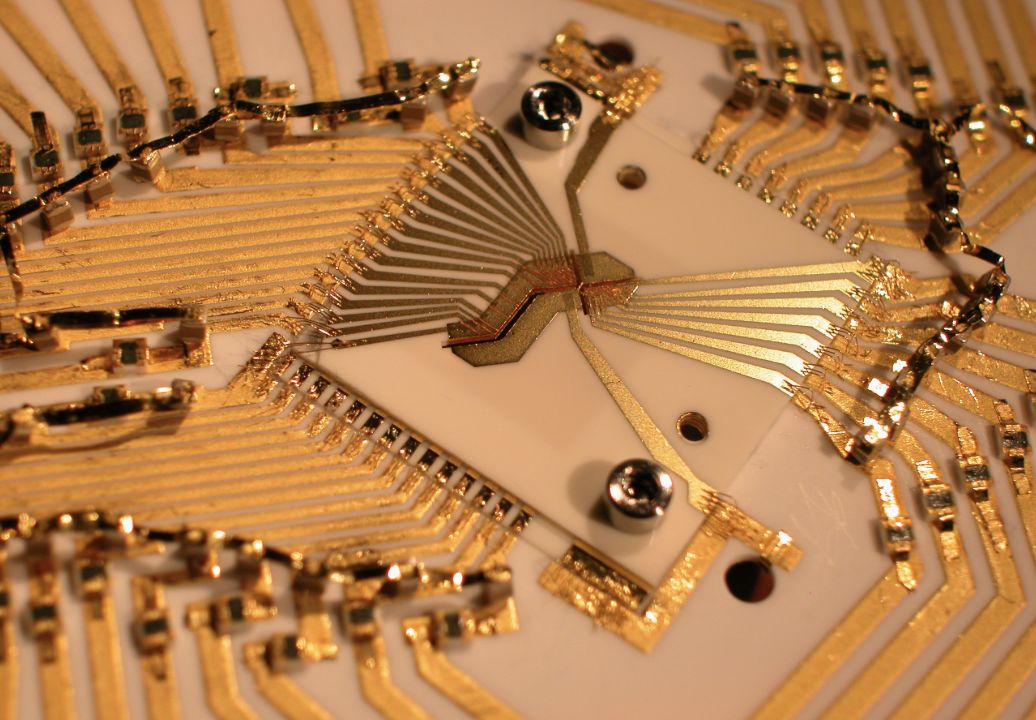
Each Singapore reference holds one electrically charged lutetium-176 atom, or ion, in a trap. The researchers use light with a wavelength of 848 nanometres for the clock transition, together with microwave pulses. Their averaging procedure combines information from several closely related atomic states to suppress sensitivity to external fields. The feedback description is a simplified account of a clock; their comparison used a shared laser and a specialised measurement sequence.
How can two clocks check each other?#
The team compared two independently trapped ions. Both were interrogated with light from the same laser, so the laser’s fluctuations affected both measurements. Correlation spectroscopy extracts their difference while rejecting that shared laser noise. The independent references are the two ion systems; their probe laser was shared.
The researchers reported 11 measurements totalling 200 hours. The weighted average frequency difference was −0.1 × 10⁻¹⁹, with statistical uncertainty of 5.7 × 10⁻¹⁹ and systematic uncertainty of 1.0 × 10⁻¹⁹ in the comparison. These are fractional quantities: they express a difference or uncertainty relative to the clock frequency. The result is consistent with agreement at the comparison’s statistical precision.
A comparison can expose a difference, but two devices could share an unrecognised bias. The paper stresses that a hypothetical unknown effect common to both systems could escape the test. This is the same reason that independent checks matter in the story of Hubble’s mirror flaw: a measurement is only as revealing as the assumptions and equipment behind it.
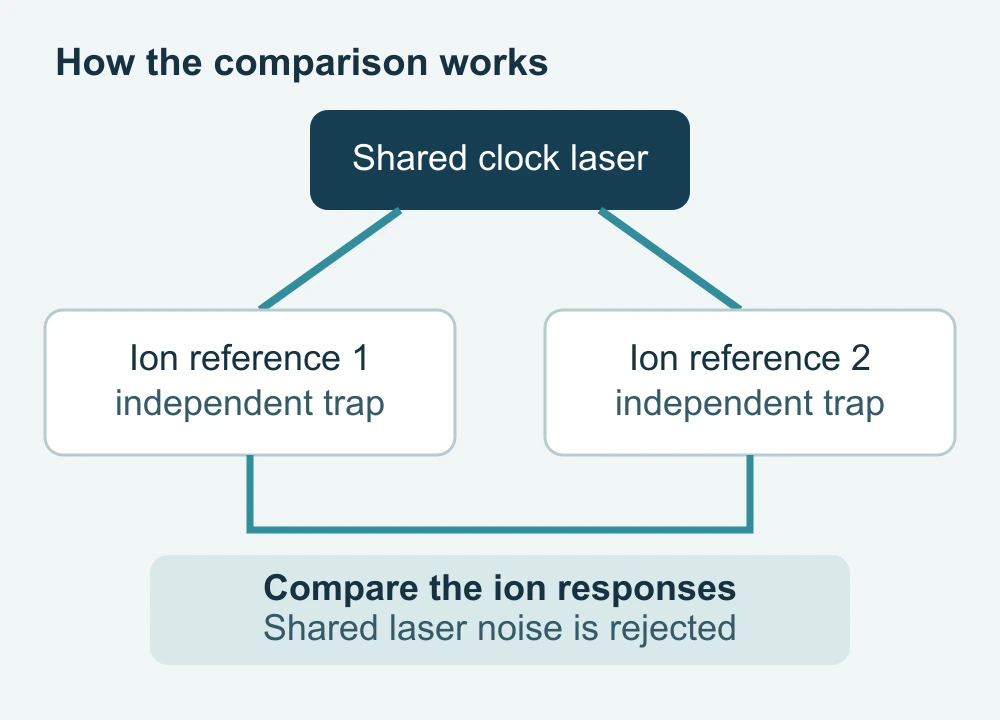
Image unavailable.
A shared laser probes two independent trapped-ion references; their responses are compared to reject shared laser noise.
What does “one second in billions of years” mean?#
It is a way to picture a tiny fractional frequency uncertainty, not a measurement made over that span. If a clock’s rate had a constant fractional offset of about 1.2 × 10⁻¹⁹, a simple extrapolation would accumulate roughly one second in 260 billion years. This is a scale analogy: the researchers did not watch a clock drift for that long, and the evaluated uncertainty is not a guaranteed error bound.
The distinction between two uncertainties matters. Statistical uncertainty describes the scatter in a finite set of measurements; collecting more independent data can reduce it. Systematic uncertainty concerns imperfect knowledge of effects that can shift a reference, such as thermal radiation or magnetic fields. Averaging longer does not automatically remove a shared shift.
The paper evaluated systematic uncertainties of 1.2 × 10⁻¹⁹ and 1.3 × 10⁻¹⁹ for the individual references. The 5.7 × 10⁻¹⁹ statistical precision of their comparison does not independently prove every smaller contribution in those budgets. The researchers also deliberately varied a magnetic-field effect and checked its predicted response, a separate stress test of a major systematic shift.
Why can height matter to a clock?#
General relativity predicts that clocks at different gravitational potentials run at different rates. Near Earth, a small difference in height can therefore affect an exceptionally sensitive comparison. The Singapore team independently measured the height difference between their ions to below a millimetre so that it would not limit their test.
That sensitivity could become a tool: comparing sufficiently well-characterised clocks at different places may help measure differences in gravitational potential, a technique called chronometric levelling. Millimetre-scale sensitivity is a research prospect, not a claim that this experiment mapped the Earth at that resolution. Moving a clock and comparing distant locations introduce further challenges.
Does this change the length of a second?#
The SI second remains defined using a transition in caesium. Optical clocks such as these can contribute evidence toward a future redefinition, but a single laboratory result does not change the definition. Agreement between independently operated references and comparisons between institutions are part of building confidence in a future standard.
Keep exploring
Sources & further reading
Follow the original research, records, and explanations behind this story.
- Lu+ optical frequency references with accuracy verified at the 19th digit Nature
Experimental setup, uncertainty budget, comparison, and limits.
- Singapore scientists build world’s most accurate atomic clock National University of Singapore
Explanation of optical clock operation, comparison, and ion-height measurement.
See the story in motion
Watch our illustrated video, then explore another question below.
Watch on YouTubeFollow the thread