

In February 2008, the United States destroyed a satellite that was already falling toward Earth. The announced reason was a tank of hazardous fuel: officials wanted to break it open in space before it could reach the ground intact. The operation also demonstrated the ability of a ship-launched missile to destroy a satellite.
Those two facts can coexist. Understanding Operation Burnt Frost means separating the predicted ground hazard, the observed breakup, and the conclusions officials drew afterward. The debris record adds another lesson: a successful intercept does not make every fragment disappear immediately.
Why was USA-193 coming down?#
USA-193 was a National Reconnaissance Office spacecraft launched on December 14, 2006. It malfunctioned soon afterward and stopped responding to ground control. By early 2008, officials expected an uncontrolled return in February or March. It could no longer be directed to a chosen disposal area.
A failed satellite does not need a downward push to return from a low orbit. Even hundreds of kilometers above Earth, thin air exerts drag. Drag removes orbital energy; the orbit shrinks into denser air, which increases the drag further. An unresponsive spacecraft cannot command the maneuvers that might otherwise change that outcome. The precise hardware failure and classified mission details are unnecessary to explain this chain, and the public NASA fragmentation history lists much of the spacecraft's physical configuration as unknown.
What made the fuel tank a concern?#
Officials described roughly 450 kilograms of hydrazine aboard the spacecraft. Hydrazine is a propellant and a toxic chemical. NIOSH lists breathing it, skin absorption, and eye or skin contact among its exposure routes. A tank arriving near people could therefore present a chemical hazard as well as the familiar danger of falling hardware.
The important question was whether the fuel would survive the atmospheric passage. NASA's later fragmentation history says its standard reentry hazard analysis indicated a high probability that frozen or slushy hydrazine would reach the ground intact if the tank remained intact. This was an engineering assessment of a possible reentry, rather than an observation of a tank actually landing.
Atmospheric heating does not guarantee that every component of a spacecraft burns away. ESA notes that parts of large spacecraft can survive reentry. Whether this particular tank and its contents would survive depended on their thermal and structural behavior during descent. A cold mass of fuel inside a tank is a different reentry problem from fuel already released into the surrounding flow.
Survival alone would still not establish casualties. The tank would have to reach a location where fuel could escape and people could be exposed. Dose and duration would affect the harm, as ATSDR explains for hydrazine exposure generally. The public evidence supports a potential ground hazard; it cannot give us an observed number of lives saved by preventing a reentry that never happened.
What happened on February 20—or February 21?#
USS Lake Erie fired a modified Standard Missile-3 during the operation. The launch was reported at about 10:26 p.m. Eastern Standard Time on February 20, 2008. That is about 03:26 UTC on February 21: the two dates describe the same event across time zones.
NASA's fragmentation history records the breakup at about 248 kilometers above Earth over the Pacific. Roughly 250 kilometers is an appropriate rounded description. The missile was modified for this mission; the event should not be described as an ordinary launch of an unchanged defensive system.
The stated aim was to breach the tank before atmospheric reentry. The collision fragmented the spacecraft. That observation established that the satellite had been hit, but a broken spacecraft and a broken fuel tank were separate questions for the analysts examining the aftermath.
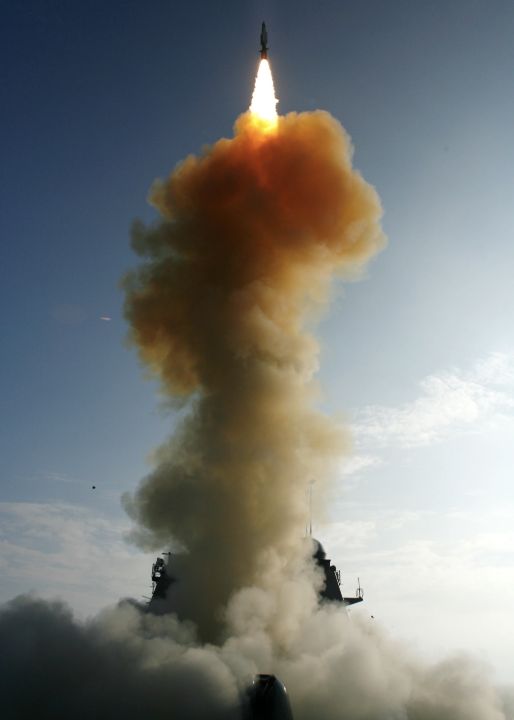
Image unavailable.
A missile rises above USS Lake Erie amid a large orange launch cloud.
How did officials judge whether the tank was destroyed?#
The initial assessment used imagery and surveillance of the debris. On February 21, General James Cartwright said the visible plume and the imagery near the tank supported the view that it had been breached. He also said analysts needed another 24 to 48 hours to become comfortable with that conclusion.
On February 25, the Defense Department announced high confidence, based on debris analysis, that the fuel tank had been destroyed and the hydrazine dispersed. That is a reported official assessment, with a stated evidential basis. It is stronger than simply observing the launch or the collision flash, while remaining different from recovering the tank and directly inspecting it.
The announcement also reported no debris landings to that date. Neither that statement nor the successful hit supplies a measured tally of avoided injuries. The claimed success concerned breaking the tank and reducing the anticipated ground risk.
Why did low altitude matter for the debris?#
At the breakup altitude, atmospheric drag could remove fragments relatively quickly. The same thin air already shortening the satellite's life continued to act on the debris. A breakup scatters pieces into different trajectories, so the pieces do not all return together.
NASA's July 2010 presentation gives a useful dated retrospective: it reports a maximum of 175 cataloged objects associated with the event, more than 1,600 tracked objects, and 95 percent of the cataloged debris reentering within three months. It reports none remaining in orbit on June 1, 2010. These are different measures: tracking an object is not the same as assigning it a persistent catalog identity, and neither number counts every tiny fragment produced.
The distinction matters when reading early reports. A February 25 announcement described fewer than 3,000 pieces then being tracked. That was an early surveillance report, rather than a final inventory to compare directly with the later catalog figure. NASA also explains that the low breakup altitude prevented cataloging all large debris. Rapid removal can make the final catalog smaller than the population initially present.
Low altitude therefore limited persistence; it did not make deliberate fragmentation harmless. Until reentry, fragments were still objects moving through orbital space. For an earlier American satellite intercept with a different orbital setting, see the F-15 and Solwind.

Image unavailable.
Four cards distinguish 175 cataloged objects, more than 1,600 tracked objects, 95 percent reentered within three months, and none remaining on June 1, 2010.
Does the safety explanation settle the question of motive?#
The shot demonstrated an anti-satellite capability in the straightforward sense that a missile launched from a ship destroyed a satellite. The official explanation was to reduce a hydrazine hazard. One statement concerns an observed capability; the other concerns the reason officials gave for using it.
The strategic context was already public. At a March 5, 2008 congressional hearing, subcommittee chair Ellen Tauscher contrasted the American intercept with China's January 2007 anti-satellite test and discussed the vulnerability of space systems. That record shows that the operation was being interpreted within a space-security debate as well as a reentry-safety debate.
It does not establish a concealed purpose behind the decision. The NASA hazard assessment gives the safety rationale a specific technical basis, while the intercept itself demonstrates military capability. Neither fact lets an observer read every intention behind the operation. The defensible conclusion is that officials acted on a stated chemical-risk assessment, reported evidence that the tank was destroyed, and carried out an event whose strategic significance extended beyond that immediate hazard.
Keep exploring
Sources & further reading
Follow the original research, records, and explanations behind this story.
- History of On-orbit Satellite Fragmentations, 16th Edition NASA Orbital Debris Program Office
USA 193 entry, printed p.496 (PDF p.512); debris-cloud caption p.497. Launch, breakup altitude/date, unknown configuration, modeled hydrazine survival.
- Navy Missile Likely Hit Fuel Tank on Disabled Satellite American Forces Press Service / DVIDS
February 21, 2008 report; paragraphs beginning Preliminary reports, Video shown, However, The SM-3 missile, and The National Reconnaissance Office. The altitude unit in this report is inconsistent; use NASA for altitude.
- Officials Declare Satellite Mission Successful American Forces Press Service / DVIDS
February 25, 2008 report; opening four paragraphs and To date. Official confidence, hydrazine and dated tracking report.
- Deliberate Satellite Fragmentations and their Effects on the Long-Term Space Environment NASA / Nicholas L. Johnson
Slide 12 (PDF p.12), Negation of Reentry Risk Hazard. Dated June 1, 2010 debris measures and three-month reentry fraction; slide 16 catalog limitations.
- Space Debris FAQ: Frequently asked questions European Space Agency
Q6 explains drag, energy loss and reentry survivors. USA-193 Q5 summary is not used for its end-2008 final-debris date.
- Hydrazine: NIOSH Pocket Guide to Chemical Hazards CDC / NIOSH
Physical Description; Exposure Routes; Symptoms. Toxicity only, no mission-specific risk estimate.
- Public Health Statement for Hydrazines CDC / ATSDR
Opening paragraphs on release versus exposure and dose, duration, pathway. General toxicology, not a casualty model for USA-193.
- Budget Request and Status of Space Activities, hearing held March 5, 2008 U.S. House of Representatives, Strategic Forces Subcommittee
Opening statement of Ellen Tauscher, printed pp.1–2 (PDF pp.5–6). Public strategic framing, not proof of decision-makers hidden intentions.
- The USS Lake Erie (CG 70) launches a Standard Missile-3. U.S. Department of Defense archive
Caption identifies February 20, 2008 launch, vessel and approximately453kg hydrazine. Text source only; its image was rejected in favor of the independently rights-cleared DVIDS photograph.
- The USS Lake Erie (CG 70) launches a Standard Missile-3. DVIDS / U.S. Navy
DVIDS image 9216988: PUBLIC DOMAIN and DoD photo by U.S. Navy (Released). Exact origin of included DVIDS launch image; not the same photograph as war.gov 2001246611.
- Copyright Information DVIDS
Public Use Notice of Limitations; official-duty works, historic/news use, nonendorsement disclaimer.
Follow the thread