

In July 1967, American satellites built to help detect nuclear explosions recorded a flash that would become the first recognized cosmic gamma-ray burst. The important discovery was still ahead: showing that such flashes were real, finding enough of them to compare, and establishing that Earth and the Sun could not explain them.
How could instruments watching for human weapons distinguish an astronomical event? The answer lies in what the detectors counted, the time a signal needed to cross a satellite constellation, and the investigators' willingness to keep unexplained records. Those measurements opened a new field without yet revealing what powered the bursts.
Why were nuclear-test satellites watching gamma rays?#
Radiation offered a way to detect an explosion at a distance. The 1963 Limited Test Ban Treaty prohibited nuclear explosions in the atmosphere, outer space and under water. It entered into force on October 10, 1963; it did not impose a complete ban on underground testing. The first Vela pair launched that October.
Vela carried X-ray, gamma-ray and neutron detectors. A nuclear explosion in space would release a strong X-ray flash, with other radiation helping investigators identify its nature. There was also a problem of concealment: the initial flash could be hidden behind shielding or the Moon. The gamma-ray recording system was designed to catch delayed radiation from radioactive debris expanding into view. That ability to follow radiation over time would prove useful for astronomy.
The satellites were radiation monitors, rather than cameras photographing secret facilities. For the wider context of nuclear activity in space, see Starfish Prime.
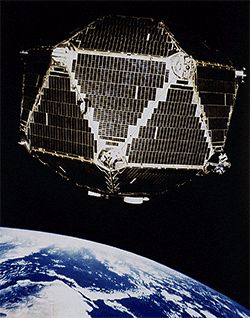
Image unavailable.
Archival illustration of a many-sided Vela 5B satellite above Earth, with its panel-covered body and projecting booms visible.
What did a detector actually record?#
A gamma ray is a high-energy photon: the same kind of messenger as visible light, carrying much more energy per photon. Detecting a burst meant registering an increase in arriving radiation, rather than taking a picture of an exploding star.
The Vela 5 and 6 instruments used cesium iodide scintillation counters. Incoming radiation produced flashes within the detector material that could be counted electronically. Six counters distributed around each spacecraft provided sensitivity in many directions. When the count rate rose rapidly above the background, circuitry recorded the changing rate and associated a time with the record.
Individual triggers could have other explanations. Energetic charged particles also stimulated the instruments, so a trigger alone was weak evidence for a new celestial phenomenon. The researchers needed independent spacecraft to agree.
How can arrival times reveal a direction without a photograph?#
Light reaches separated observers at slightly different times. A distant flash approaching along the line joining two spacecraft reaches one first; a flash approaching at right angles to that line can reach both together. Knowing the spacecraft positions and measuring the delay therefore constrains the direction of the incoming light.
One pair does not normally yield a unique point in the sky. Several directions can produce the same delay, forming a circle on an imagined sphere around the observers. Another pair supplies another constraint. The original analysis could still leave two candidate directions mirrored across the spacecraft orbital plane.
The Vela constellation provided a large baseline: a separation across its orbit of roughly a quarter of a million kilometres. Light takes a little under a second to cross that distance. Improved timing in the later satellites was fine enough to measure a useful fraction of that travel time. The resulting directions were coarse, yet sufficient to exclude the Sun. They did not provide the precise positions needed to identify individual stars or galaxies.
This is why distance between detectors helped. An array spread across space turned tiny timing differences into evidence about where to look.
Why do 1967, 1969 and 1973 all appear in the discovery story?#
They refer to different steps. The July 2, 1967 event was recorded by Vela 4 satellites and also triggered operating Vela 3 instruments. According to the later account coauthored by Ray Klebesadel, he and Roy Olson found it while examining older records in 1969. Its timing was inadequate for a good directional determination. The stronger collection announced in 1973 came from later spacecraft and did not include that 1967 event.
The reason for the delay needs care. NASA's Swift learning page attributes the wait until publication to security concerns. Bonnell and Klebesadel's 1996 historical account explicitly says that neither the data nor the discovery was classified, and that confirmation amid false triggers largely explains the interval from recognition in 1969 to publication. These accounts disagree. The participant account supports a history of prolonged verification; it does not support describing the discovery as a secret held until declassification.
The paper appeared on June 1, 1973. Recording a signal, recognizing its significance and publishing a defensible result were separate achievements.
What did “cosmic origin” still leave unanswered?#
Excluding Earth and the Sun did not measure a galaxy's distance or identify a burst's engine. A direction tells us which way a signal travelled. Along that direction, a relatively weak nearby source and a much more powerful distant one can produce similar brightness at the detector.
Later work supplied the missing evidence. The BATSE instrument on the Compton Gamma Ray Observatory, launched in 1991, found bursts scattered across the sky rather than concentrated along the Milky Way's disk. That pattern favored distant populations, but was not itself a distance measurement. In 1997, BeppoSAX observations located fading X-ray afterglows well enough for other telescopes to follow them. Optical observations and redshift measurements then established enormous distances for bursts. Redshift measures how much light's spectrum has shifted toward longer wavelengths; interpreting it in an expanding universe gives a distance scale.
Modern observations associate many long bursts with massive-star collapse and many short bursts with mergers involving neutron stars. Jets of material moving near light speed produce the radiation we detect when suitably directed toward us. Duration is a useful classification clue, not a reliable birth certificate for every event. None of this identifies the particular object responsible for the first 1967 flash.
Is this the same event as the disputed 1979 Vela flash?#
No. The September 22, 1979 event involved a light signal recorded by a Vela satellite over the South Atlantic. A January 1980 State Department telegram described a scientific panel unable to determine whether that signal came from a nuclear explosion or another phenomenon. That document reports the panel's contemporary conclusion; it does not settle every later argument about the event.
The gamma-ray-burst discovery concerns a different set of measurements, beginning years earlier and announced in 1973. Keeping the two histories separate preserves what made the astronomy result persuasive: multiple instruments, repeated events and a directional test that excluded familiar sources. An unexplained detector record became a scientific discovery through that chain of evidence.
Keep exploring
Sources & further reading
Follow the original research, records, and explanations behind this story.
- Observations of Gamma-Ray Bursts of Cosmic Origin The Astrophysical Journal / Klebesadel, Strong and Olson
pp. L85–L88: instrumentation, sample selection, photon evidence, timing, distance limits and interpretation.
- A brief history of the discovery of cosmic gamma-ray bursts AIP Conference Proceedings / J. T. Bonnell and R. W. Klebesadel
pp. 977–979: purpose, delayed radiation, timing, retrospective 1967 detection, explicit unclassified-status account.
- NASA Looks Back at 50 Years of Gamma-Ray Burst Science NASA / Francis Reddy
Nuke Watchers; Breakthroughs: BATSE & BeppoSAX; 1973 publication, later distance evidence.
- Gamma-Ray Bursts NASA Goddard / Neil Gehrels Swift Learning Center
First Discovery and Early Observations: security explanation conflicts with participant history; direction versus distance. Its incorrect 1990 Compton launch date is not used.
- Test Ban Treaty (1963) U.S. National Archives
Opening summary and treaty transcript Article I: environments prohibited and conditional underground restriction.
- Gamma-ray Bursts: Harvesting Knowledge From the Universe’s Most Powerful Explosions NASA / Jenna Ahart
The Long and Short of GRBs; Afterglows Shedding New Light: engines, jets and classification limits.
- 370. Telegram From the Department of State to the Consulate in Cape Town U.S. Department of State, Office of the Historian
January 12, 1980 telegram, paragraph 3: panel uncertainty about September 22, 1979 light signal.
- Vela 5A/B and 6A/B NASA Goddard / HEASARC
Satellite images and credits; illustration caption low-orbit claim conflicts with original orbital dimensions and is not used.
Follow the thread