
Astronauts aboard the International Space Station operate experiments, maintain their spacecraft and manage deliveries. They also exercise and take part in studies of their own bodies. Spacewalks and launches are only part of the job. Much of a working day takes place inside the laboratories, following procedures prepared with teams on Earth.
Who decides what an astronaut does each day?#
Station planners coordinate research with maintenance, exercise, meals and sleep. A task needs more than a free slot on a calendar: the right person, equipment and supporting ground team must be available together. If a spacecraft arrives late, its experiments and supplies may arrive late too, changing what the crew can do next.
NASA's account of Expedition 63 planning in 2020 describes an average schedule with six and a half hours assigned to science and maintenance, two hours for exercise and eight and a half hours reserved for sleep. Planning conferences connected the crew with controllers, and alternative schedules covered possible launch delays.
Those figures describe a planning example, rather than a promise that every day follows the same clock. A spacewalk or urgent repair changes the workload. Even a routine experiment can require a new plan if a cable, sample or piece of equipment is unavailable.
Sources: [1]
What does doing science in orbit involve?#
Researchers on Earth design investigations, while the station crew carries out work that needs a person's hands or observations. The astronaut may prepare an apparatus, move samples, photograph an unexpected result or make an adjustment requested by the research team. Careful records allow people who were never in the cabin to interpret what happened there.
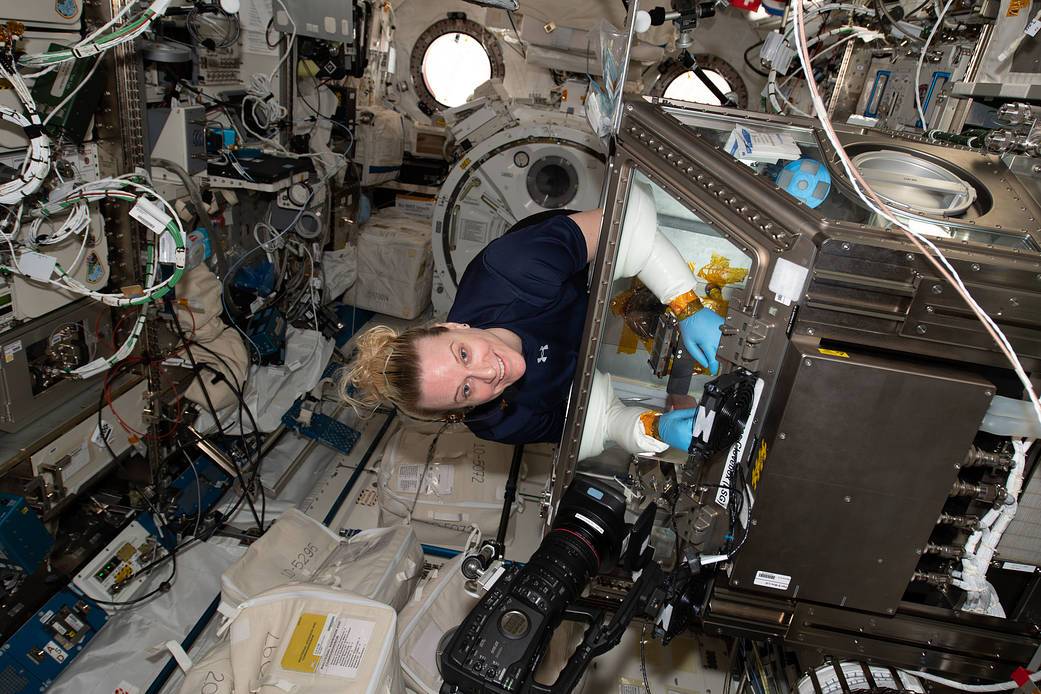
The photograph shows Kate Rubins servicing microbial samples in Kibo's Life Sciences Glovebox on 7 January 2021. That investigation concerned microbial risks to the spacecraft environment. The enclosure gives the work a defined, contained space within the much larger shared cabin.
Containment is practical in microgravity. NASA's description of Rubins using a separate portable glovebox explains that it limits accidental spills and exposure of the station environment to biological samples. A floating droplet or loose sample must be kept where the experiment expects it. Preparing and cleaning the work area are part of producing a usable result.
Why do astronauts also become research participants?#
Some questions require measurements of people who have lived in orbit. An astronaut can operate laboratory equipment in one task and provide data about their own response to spaceflight in another.
The Canadian Vascular studies illustrate the distinction. Participants supplied blood samples and underwent ultrasound examinations at specified times before, during and after their missions. Vascular Echo also included simple exercises while a device on the thigh measured changes in blood flow. Researchers compared observations across the mission, rather than treating one scan in orbit as a complete answer.
This makes the schedule of a measurement part of the experiment. A result taken before launch establishes a baseline; later measurements can show changes and recovery. The participating astronaut supplies a carefully documented case, while the research team evaluates the wider pattern. Such studies investigate particular body systems and countermeasures, rather than proving that every person will respond identically to spaceflight.
Sources: [4]
Why is exercise part of the working day?#
On Earth, standing and walking repeatedly load the muscles and skeleton. Floating around the station removes much of that ordinary loading, so the crew deliberately adds exercise that resists their movements.
The Advanced Resistive Exercise Device uses vacuum cylinders to provide resistance through a bar or cable. Astronauts can perform movements such as squats without relying on the downward weight of a stack of metal plates. On the treadmill, a harness applies force through the shoulders and hips, keeping the runner loaded against the belt. A stationary bicycle provides another form of exercise.
The Canadian Space Agency describes approximately two hours of daily exercise for long ISS missions. It also cautions that results vary between astronauts. Exercise is a planned countermeasure, supported by specialists and adjusted to the individual; a workout photograph alone cannot show how well someone's muscles, bones or cardiovascular system are adapting.
Sources: [5]
How much of the job is repair and cleaning?#
The station cannot visit a workshop on Earth. Its residents inspect equipment and replace parts where they live. The Canadian Space Agency separates preventive maintenance, including cleaning and scheduled replacement, from corrective work that diagnoses and fixes a fault.
A repair can affect basic habitability. During his station mission, Robert Thirsk replaced the Water Orbital Replacement Unit to restore the Oxygen Generation Assembly. Other jobs are less conspicuous: cleaning air vents, disinfecting equipment and keeping the food and bathroom areas usable.
Small loose objects follow cabin air currents and can collect at ventilation grilles. Cleaning those areas helps maintain the environment and can even recover missing tools. NASA photographed Serena Auñón-Chancellor and Anne McClain cleaning Kibo's vents in December 2018 specifically to maintain air circulation. That task belongs to spacecraft operations as much as an equipment upgrade does.
Do astronauts control every robot and visiting spacecraft?#
Responsibility is divided between the crew, ground controllers and automated systems. The Canadian Space Agency says its ground team handles most Canadarm2 and Dextre operations. Astronauts take control for time-critical tasks such as capturing certain cargo vehicles or supporting colleagues outside on a spacewalk.
During a robotic-arm capture, a cargo spacecraft first approaches and holds a controlled position relative to the station. The astronaut grapples it with Canadarm2. Ground controllers can then use the arm to move it to a station port, a process called berthing. The task requires controlled relative motion; the arm does not simply snatch a ship racing past.
Other vehicles dock themselves using their own approach and docking systems. Cargo Dragon uses that route. Once a vehicle is safely connected, the crew still has to unload it, locate its contents and prepare items for storage or use. Automation changes who performs each step, but leaves substantial work inside the station.
What do astronauts do between space missions?#
Astronauts support missions on the ground as well as preparing for their own flights. NASA describes duties that include checking procedures, helping verify vehicle software, developing tools for spacewalks and working with scientists on experiments. Some serve as the voice communicating with a crew from Mission Control.
Their experience matters when a written instruction meets physical hardware. A sequence that looks straightforward at a desk may be awkward with gloves, restrained feet or limited access behind a panel. Testing that sequence before flight can expose the difficulty while there is still time to change the tool or procedure.
The separate account of ISS crew mission training explains how these skills are rehearsed for an assigned flight. Daily astronaut work puts them to use in small, specific jobs: prepare the sample, check the connection, record the result and leave the equipment ready for whoever uses it next.
Sources: [10]
Keep exploring
Sources & further reading
Follow the original research, records, and explanations behind this story.
- More Hands Make Light Work: Crew Dragon Duo Increases Science Tempo on Space Station NASA
Scheduling, backup plans and dated example of time allocations.
- NASA astronaut Kate Rubins works in the Life Sciences Glovebox NASA
Microbial samples in Kibo; photograph identity and credit.
- Astronaut Kate Rubins conducts research inside the portable glovebox NASA
Purpose of containment; distinct apparatus from the cover photograph.
- The Vascular series: Studying heart health in space Canadian Space Agency
Timing of blood tests, ultrasound and exercise measurements; no general medical prediction.
- Physical activity in space Canadian Space Agency
Loading mechanisms, approximate exercise allocation and individual variation.
- Maintenance of the International Space Station Canadian Space Agency
Preventive and corrective tasks, oxygen-system component replacement and cleaning.
- NASA astronauts Serena Auñón-Chancellor and Anne McClain NASA
Documented Kibo ventilation cleaning.
- Robotics Mission Control Centre Canadian Space Agency
Ground control and crew responsibility for time-critical manoeuvres.
- Canadarm2’s cosmic catches Canadian Space Agency
Capture versus berthing and autonomous Dragon docking; generic maximum stay not used.
- NASA Spaceflight Q&A NASA Robotics Alliance Project
Astronaut ground duties in procedures, tools, mission control and science support.
Follow the thread