
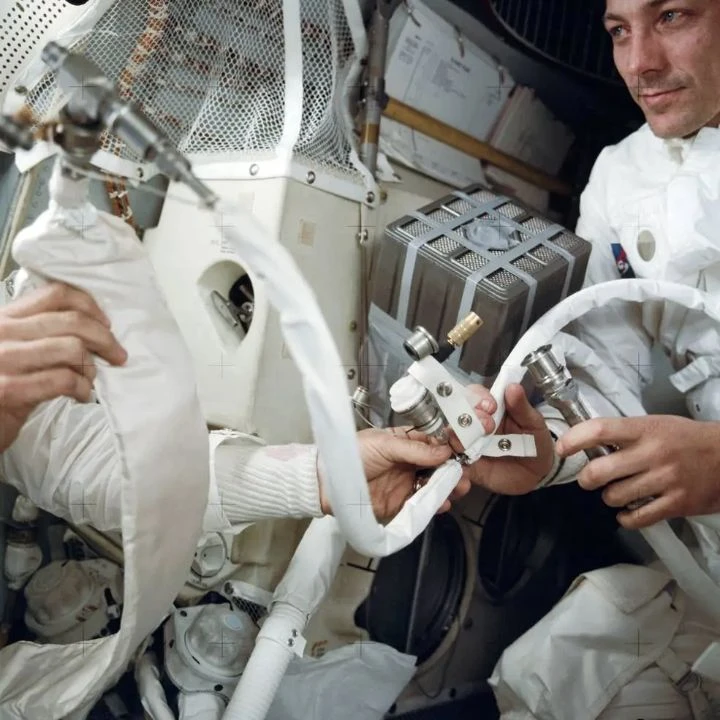
Apollo 13 carried spare carbon-dioxide absorbent that its astronauts could not immediately use. The cartridges belonged to one spacecraft; the working life-support system belonged to another. The rescue required a way to make air pass through the spare chemicals without fitting those cartridges into their normal sockets.
The familiar “square peg in a round hole” story describes the mismatch. The more revealing question is how a plastic bag, a hose and a stiff card became a working part of a spacecraft’s air circulation system.
Why were three astronauts relying on the lunar module?#
Aquarius became their refuge because the service module was losing the oxygen that supplied both breathing gas and electrical power. After the failure at about 56 hours into the mission, two fuel cells stopped supplying power and the remaining oxygen supply continued to fall. The Moon landing was abandoned.
James Lovell, Jack Swigert and Fred Haise activated the lunar module and shut down most of the command module, Odyssey, preserving it for reentry. Aquarius had its own oxygen, batteries and environmental-control equipment. Its new job stretched well beyond supporting two people during a lunar landing: it now had to help sustain all three on the journey home.
That change made carbon-dioxide removal a pressing consumables problem. The astronauts kept producing exhaled gas, while the lunar module’s available absorbent had a limited capacity. Moving into a spacecraft with oxygen did not remove the need to clean its air.
Sources: [1]
Why did they need a chemical scrubber if they had oxygen?#
Supplying oxygen and removing carbon dioxide solve two different parts of breathing in an enclosed cabin. The crew consumed oxygen and exhaled carbon dioxide. Replacing the consumed oxygen alone would leave the exhaled carbon dioxide accumulating in the circulating atmosphere.
The canisters contained lithium hydroxide, a chemical that reacts with carbon dioxide to form lithium carbonate and water. In the balanced reaction, two formula units of lithium hydroxide react with one molecule of carbon dioxide. Carbon ends up bound in the carbonate rather than remaining in the cabin gas.
This is chemical absorption. A dust filter catches suspended particles; the absorbent removes a gas by reaction as air passes through the cartridge. Its capacity is finite because the lithium hydroxide is consumed. The adapter made existing absorbent usable. It did not manufacture fresh absorbent or release a replacement supply of oxygen.
What exactly did not fit?#
The command module’s canisters were approximately square, whereas the lunar module used round cartridges in a different installation. Spare command-module canisters could therefore contain useful lithium hydroxide without being interchangeable with the lunar module’s hardware.
A cartridge needs more than a place to sit. Its installation must connect the intended air passages, maintain seals and make air flow through the absorbent. Putting a square container near a round receptacle would not make that happen. Air could take an easier route around the chemicals.
The team’s solution left the command-module canisters outside the lunar module’s normal cartridge housing. Each initial adapter used one canister connected to a suit hose through a taped plastic enclosure. The radio instructions explicitly began with one unit, then told the crew to repeat the work for the second. The useful connection was an air path, rather than a newly reshaped cartridge.
How did the bag and card control the airflow?#
The bag made a sealed collecting space over one face of a canister, and the card kept that space open under suction. The materials were chosen for those functions, not because tape itself could remove carbon dioxide.
The equipment list radioed from Houston included command-module lithium hydroxide canisters, gray tape, plastic bags from the liquid-cooled garments, and a stiff lunar-module cue card. The garments were the water-cooled clothing intended for use inside spacesuits; here their packaging supplied the plastic. A piece of towel was used to plug the canister’s central bypass opening.
The card formed an arch above the canister’s top screens. Kerwin explained that this would prevent the bag from being sucked down against them. Tape held the bag around the canister and sealed the point where the red suit hose entered it. The other screened face remained exposed to cabin air. Closing the bypass opening discouraged air from skipping the absorbent.
These details explain why a loose bag around a cartridge would have been insufficient. A collapsed bag could obstruct the passage; a leak or open bypass could let air avoid the chemicals. The improvised structure had to preserve an open passage while directing the moving gas through the absorbent.
What moved the air, and where did it go afterward?#
The lunar module’s existing suit fans provided the suction. Cabin air entered the exposed face of each command-module canister, passed through its absorbent, reached the space under the bag, and entered a red suit return hose. The hose carried it back into the environmental-control system.
The crew removed the lunar module’s secondary lithium hydroxide cartridge and selected that now-empty compartment as part of the circuit. Air from the adapted cartridges could pass through this route to the fans and water separator. It then emerged through the blue suit supply hoses into the cabin and toward the command module. The apparatus recirculated cabin atmosphere; it did not vent each breath into space.
Changing the circuit also changed its resistance to airflow. At 93:27:39 mission elapsed time, Kerwin explained that removing the secondary cartridge left too little restriction to keep the water separator from overspeeding. The procedure therefore included partially restricting the blue outlets. When Haise asked whether this included a red hose, Kerwin corrected him: the outlets in question were the two blue hoses.
Houston also asked the crew to separate those outlets from the canister inlets. Otherwise, recently cleaned air might circulate over a short local path while other parts of the cabin received less ventilation. The hose locations helped carry the benefit through the connected spacecraft.
Sources: [3]
Who turned the idea into something the crew could use?#
A ground team developed and tested the arrangement, and the astronauts assembled and configured it through a two-way radio procedure. John Uri’s mission history credits a team led by Crew Systems Division chief Ed Smylie, his deputy James Correale and test director Jim LeBlanc. They worked with replicas of materials available aboard and tested the setup in an altitude chamber.
Capsule communicator Joe Kerwin talked the astronauts through the work. Swigert and Lovell built the adapters; Haise participated in the later installation and circuit configuration. At 90:08:43 mission elapsed time, Kerwin proposed talking them through the procedure as they worked, rather than having them copy the whole sequence and carry it out afterward.
The transcript shows why that mattered. The crew repeated instructions, asked which way tape should face, and clarified the hose arrangement. Swigert reported that the red hose inlet ended up sideways rather than pointing down; Kerwin accepted that orientation. The communication link carried observations back to the people who had devised the procedure, allowing them to judge an actual assembly rather than assume every detail matched the ground prototype.
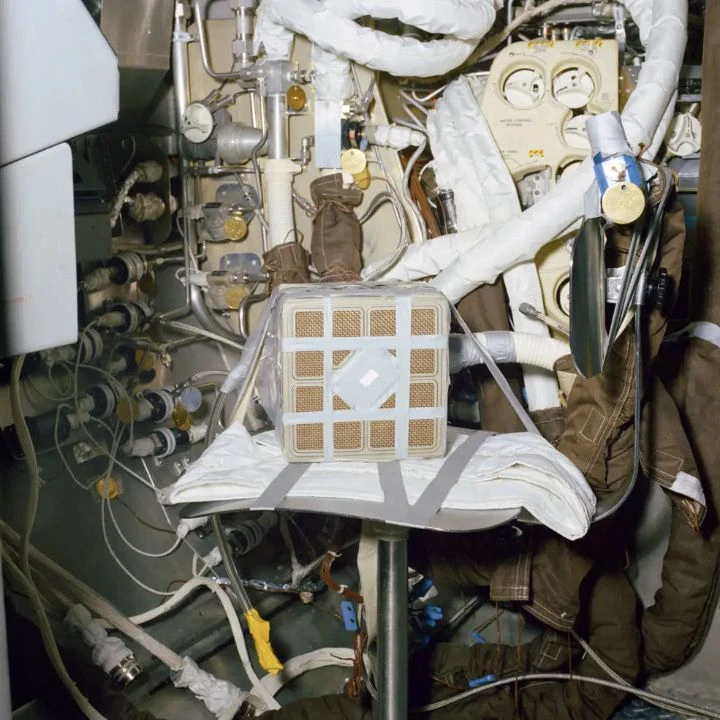
Image unavailable.
A square lithium hydroxide canister and connected hoses in a ground test installation.
What do the carbon-dioxide readings actually show?#
The recorded fall in ground readings supports the adapter’s performance; the earlier values also reveal differences between the ground and onboard gauges. Construction and activation were separate events. At 91:12:30, Houston reported 4.7 millimeters of mercury and advised waiting until 7.6 before using the new arrangement. Those numbers are a present reading and a switching instruction, not a before-and-after demonstration of the adapter’s performance.
Millimeters of mercury, abbreviated mmHg, are units of pressure. Here they describe carbon dioxide’s partial pressure: its contribution to the total pressure of the cabin’s gas mixture. They are not a percentage of the atmosphere.
The instruments also disagreed before the changeover. At 93:23:29, Houston reported a reading of 6.6 mmHg; nine seconds later Haise reported about 12.5 on the onboard gauge and raised the possibility of a gauge problem. It would be misleading to combine those readings into one smooth, precise curve.
The final instruction to select the empty secondary compartment came at 94:00:03, followed by Swigert’s readback and Kerwin’s confirmation. At 94:33:21, roughly 33 minutes after that changeover, Kerwin reported a ground reading of 0.2 mmHg and said the system appeared to be working well. This gives a documented post-activation result without mixing the higher onboard gauge reading with the ground instrument’s values.
These times count hours, minutes and seconds since launch, rather than time of day on Earth. The radio record establishes the configuration and reported pressure; the photographs establish the appearance of hardware. A photograph alone cannot establish the pressure change.
What did the adapter solve, and what remained?#
The adapter unlocked absorbent the crew already had, giving them a usable route for carbon-dioxide removal during the return. That was one necessary part of survival. They still had to conserve electrical power and water, endure cold cabins, make trajectory corrections and prepare Odyssey for reentry.
The engineering lesson is about usable reserves. Extra cartridges are valuable only if a working system can move air through them. Apollo 13’s crew and ground teams supplied the missing interface with materials, testing, clear procedures and feedback from the spacecraft.
Their success depended on understanding the whole circuit: the chemical bed, the seals, the fan, the separator and the positions of the inlet and outlet hoses. The square shape was the visible obstacle. Controlled circulation was the solution.
Keep exploring
Sources & further reading
Follow the original research, records, and explanations behind this story.
- “Houston, We’ve Had a Problem” NASA
John Uri’s history supports the lifeboat context, ground-team attribution, chamber testing and reported CO2 improvement; its photo-activity caption and hose terminology require the qualifications recorded in research.
- Building an Apollo 13 LiOH Canister Adapter Apollo Lunar Surface Journal
Compiled technical air-to-ground procedure: materials, initial one-canister units, arch, bypass closure and hose attachment. Later replica images are not flight photographs.
- Apollo 13 Flight Journal — Day 4, part 4: Building The CO2 Adapter Apollo Flight Journal
Air-to-ground transcript and editorial commentary establish airflow configuration, initial assembly, gauge discrepancy and activation time; identifies the cover photograph as later water-hose work.
- The Air Up There: Making Space Breathable NASA Jet Propulsion Laboratory Education
Background and Assessment give the lithium hydroxide–carbon dioxide reaction. Outdated ISS/MOXIE context and oxygen-production language in the teaching activity are not adopted.
- Apollo 13 Flight Journal — Day 4, part 5: Checking Odyssey Apollo Flight Journal
094:33:21 air-to-ground exchange reports ground CO2 reading0.2 after activation; units established by preceding procedure context.
See the story in motion
Watch our illustrated video, then explore another question below.
Watch on YouTubeFollow the thread