
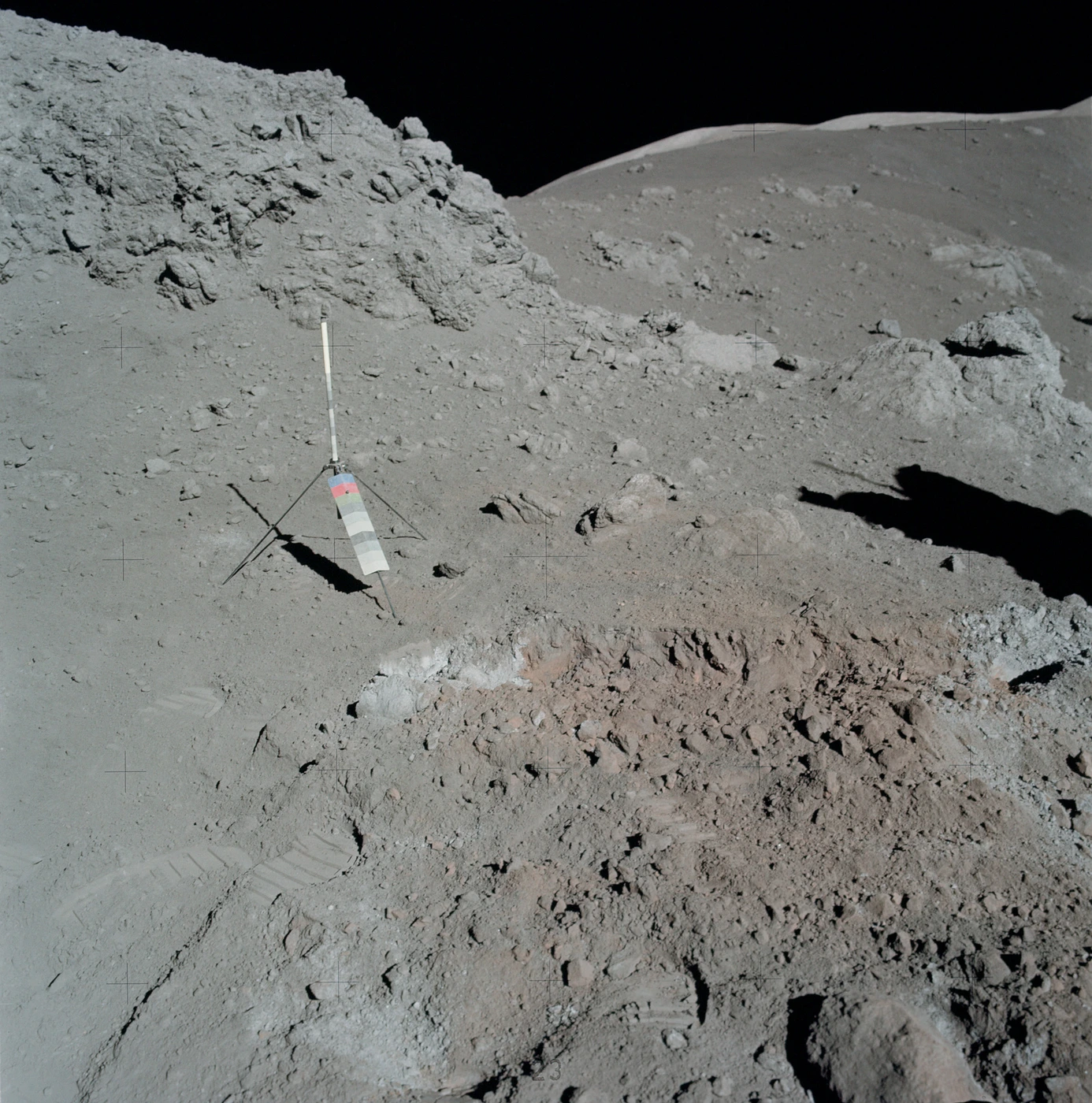
Harrison Schmitt spotted orange material on the rim of Shorty Crater during Apollo 17's second moonwalk. The color came from tiny glass beads and fragments. They formed around 3.6 billion years ago, when gas sprayed molten rock above the Moon's surface and many of the droplets cooled into glass.
The astronauts found the deposit beside a crater. In the laboratory, the grains told a story about an ancient eruption. Understanding how the grains got there takes a second line of evidence, drawn from the crater and the layers the crew sampled.
What did the astronauts find at Shorty Crater?#
In December 1972, Schmitt and Eugene Cernan stopped at Shorty, a small crater in the Taurus–Littrow valley. Schmitt called attention to color in the ground. Cernan checked the patch with him, and the crew photographed it and collected material by scooping the surface, opening a trench and driving a sampling tube into the ground.
These operations preserved different information. A scoop collected loose orange grains at the surface. The trench revealed the colored material in place, where the crew could record its relation to darker ground. The drive tube held a vertical sample of the deposit. Each record helps relate a laboratory specimen to a particular place and depth. The orange patch in the trench photograph shows where to look, while the labeled containers tell researchers which material they are examining.
What did sample 74220 look like under a microscope?#
Sample 74220 was a surface sample rich in orange glass. Magnification showed rounded grains along with fragments. Some of the nearby samples contained a greater mixture of ordinary lunar soil, orange glass and dark beads. That variation matters because a bag of mixed material can show a different shade from a nearly pure patch of the orange grains.
Color helped researchers distinguish between the textures left by different cooling histories. NASA's sample compendium describes some of the black beads as having essentially the same chemical composition as the orange glass. Fine crystals of minerals including olivine and ilmenite formed inside them. In the orange beads more of the material remained glass. The difference between the beads can therefore record cooling and crystallization, even where the starting material was similar.
Sources: [2]
How does lava turn into tiny glass spheres?#
Molten rock can contain gases that separate from the melt as pressure drops. Expanding gas can break the liquid into a spray. Each free droplet tends toward a rounded shape as surface tension draws it together. Researchers use the shapes and textures of these particles, along with the rock chemistry and setting, to reconstruct the eruption as a volcanic fire fountain.
Small droplets can lose heat quickly. If a droplet cools before enough crystals grow, part or all of it solidifies as glass. Some drops crystallize more extensively on the way down or while cooling in the deposit. The grains then accumulate as particles thrown out by the eruption. Geologists call such a deposit pyroclastic. Here the particles are largely droplets of lunar melt preserved as beads or their fragments.
Does the orange soil make Shorty Crater a volcanic vent?#
The evidence for an eruption is strongest in the sample. Its tiny rounded grains, glass and related crystalline material are consistent with droplets of magma. The age of the material places that episode billions of years in the past. Those findings establish what made the beads without identifying the exact vent where the spray began.
Shorty is interpreted as an impact crater. A later impact can excavate material that was already underground and leave it accessible at the rim. For a geologist studying an old deposit, the location where it can be sampled and the location where it originally formed need separate evidence. Apollo 17's photographs, notes and samples preserve enough of the setting to keep those questions apart.
What can the glasses tell us about the early Moon?#
Glass traps a portion of the chemistry of the melt from which it formed. It also preserves textures that change if the material cools slowly or is reheated. Comparing the glassy orange beads with their partly crystallized dark relatives gives researchers several ways to read the same deposit. Its formation required a Moon with molten rock rising toward the surface and enough gas to tear that rock into droplets.
The material has survived long after the eruption and the original deposit were disturbed. A colored patch was easy to see in a photograph. Its significance came from being able to trace the patch through the collection record to individual grains, and then test ideas about how those grains formed.
Sources: [2]
Keep exploring
Sources & further reading
Follow the original research, records, and explanations behind this story.
- Orange Soil Apollo 17 Lunar Surface Journal
Identification of the patch, the sampling sequence and the distinction between impact crater and volcanics.
- Lunar Sample Compendium: 74220 Charles Meyer, NASA; LPI archive
Sample identity, context, composition, devitrification and volcanic origin.
- Revisiting the petrogenesis of pyroclastic glass bead deposits at the Apollo 15 and 17 sites McIntosh et al., Journal of Petrology; NASA Technical Reports Server
Volcanic glass bead origin and gas-rich eruptive processes.
- Apollo 17 Image Library Apollo 17 Lunar Surface Journal
Identifies the archival frame showing the trench at Shorty.
Follow the thread