
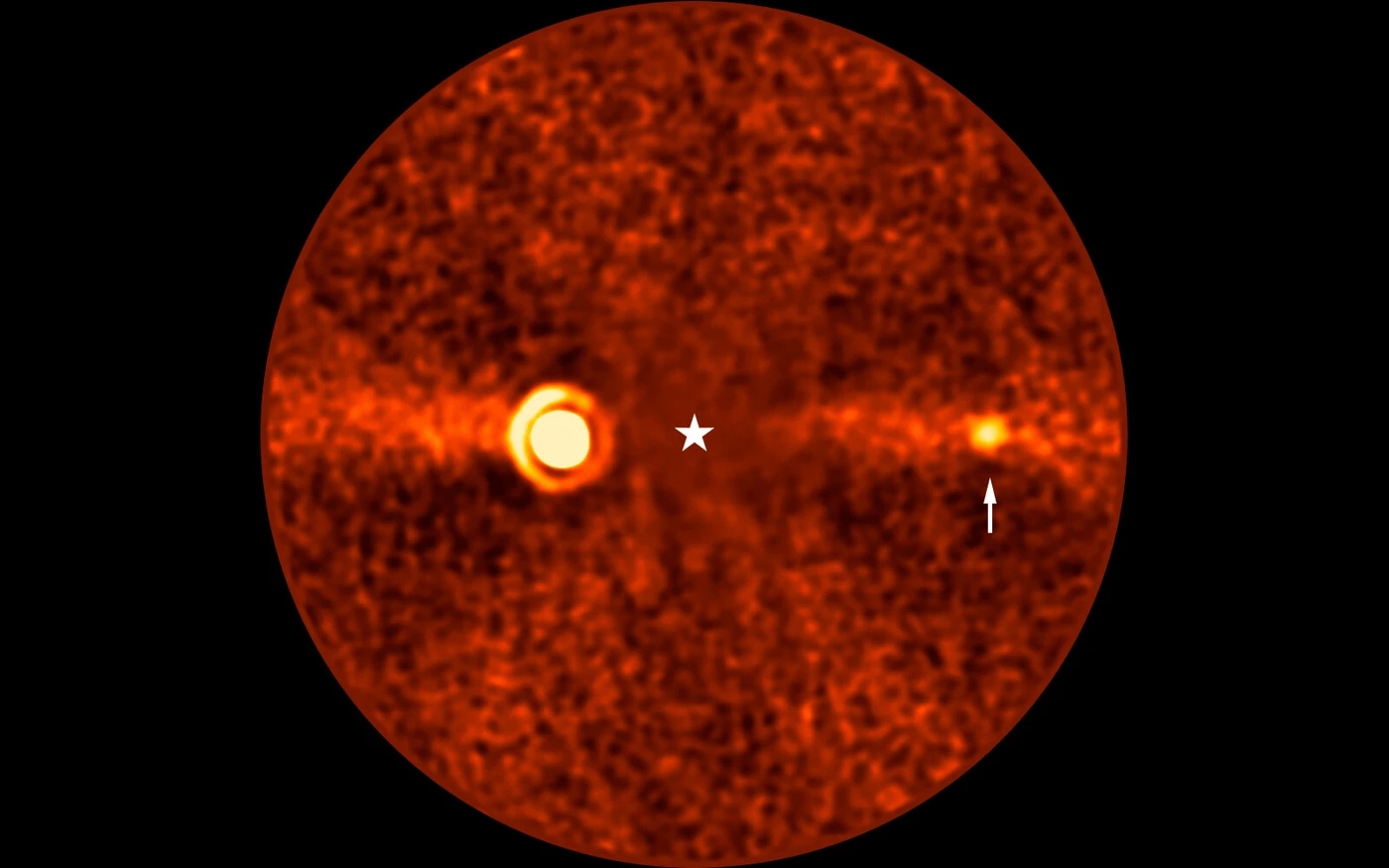
Astronomers were studying a planet they already knew when Webb picked up a second signal. In one patch of the dusty disk around Beta Pictoris, the light carried a pattern of carbon monoxide absorption lines. The lines were shifted by an amount consistent with a source orbiting the star. Astronomers named the planet Beta Pictoris d. An independent imaging team found the same object using the Very Large Telescope and archival observations.
The discovery began with a practical problem. A faint point inside a bright disk could be a planet, a knot of dust or a leftover trace of the star in the processed image. Webb measured the spectrum of that faint spot and gave the team a precise location to compare with other observations.
How did a spectrograph pick the planet out of the disk?#
Webb's Near-Infrared Spectrograph used an integral field unit. An ordinary image gives a brightness or color for each position. An integral field observation gives each small patch of the scene a spectrum, a record of brightness across many wavelengths. Astronomers can ask where in the scene a particular pattern of wavelengths is strongest.
Dust illuminated by the star contributes a relatively smooth background across the carbon monoxide lines the team used. A cool planet's atmosphere can imprint a series of dips at the wavelengths where carbon monoxide absorbs light. The team looked for the arrangement of dips across many independent wavelength channels. One accidental dip would make weak evidence. A cluster at the expected spacings, concentrated in one patch of sky, is much harder for smooth background light to mimic.
The analysis works even when the image cannot resolve the planet's disk. The pixels locate a point source, and the spectrum gives information about its atmosphere. Cloud bands in an artist's impression are a visual interpretation, beyond what these observations resolve.
What did the planet's motion add to the evidence?#
A spectrum also records motion along the line of sight. When a source is moving away, its lines shift toward longer wavelengths. Motion toward us shifts them the other way. Carbon monoxide provided a set of known line positions against which the team could measure that shift.
A shifted spectrum on its own gives a velocity along one direction, and other cool objects can also contain carbon monoxide. The researchers compared the velocity with the candidate's position and the expected motion for an orbit aligned with the Beta Pictoris system. Follow-up Webb spectra and measurements at another epoch supported the interpretation. The full orbit takes far longer than the observing interval, so an orbit inferred from those measurements still has room to change.
Sources: [2]
How did a second team find it in older images?#
The independent imaging team identified the planet in observations with ERIS, an infrared instrument on ESO's Very Large Telescope. Once the team had a convincing detection, it could look for a source whose position changed consistently in older images from VLT/SPHERE and Webb/NIRCam. This gave the researchers observations in several filters and at widely separated times.
The instruments dealt with glare in different ways. The ERIS image shown here has the central star subtracted during processing. The team also used archival observations taken with instruments that blocked much of the star's light before it reached the detector. Each approach leaves its own residual features. A source that keeps appearing in plausible places across dates and instruments has a stronger case than a single bright pixel in one reduction.
How big is Beta Pictoris d, and could it shape the disk?#
Webb's discovery team estimated a mass of roughly two to four Jupiters by combining models of the atmosphere and planet evolution. The imaging team's brightness and color estimate of about 2.4 Jupiter masses lies within that range. The planet's light is measured. Its mass depends on models linking that light to a young giant planet's age, temperature and cooling history.
Both studies put d outside the orbits of the two previously known planets. Their fits give different values for the size of d's orbit, around 26 Earth–Sun distances in the imaging study and greater than about 30 in the Webb team's analysis. The studies use different measurements and assumptions, and neither watched a complete orbit. Both find that the planet's orbit could be relevant to the disk's inner edge. Its location gives astronomers a specific candidate to test against the shape of the dust.
Keep exploring
Sources & further reading
Follow the original research, records, and explanations behind this story.
- NASA’s Webb Discovers Hidden Planet in Famous Star System NASA Science
Discovery context, spectrum, velocity and Webb follow-up.
- Discovery of an Exterior Third Planet Orbiting β Pictoris Gibbs et al., The Astrophysical Journal Letters
Spectral identification, radial velocity, atmospheric fits and orbital stability analysis.
- Direct Imaging Discovery of Giant Exoplanet β Pictoris d: A Decade-Long Game of Hide-and-Seek Sutlieff et al., The Astrophysical Journal Letters
Multi-epoch imaging, contrast and fitted orbit.
- VLT image of the Beta Pictoris d exoplanet European Southern Observatory
ERIS view, processed starlight and orientation of the debris disk.
Follow the thread