
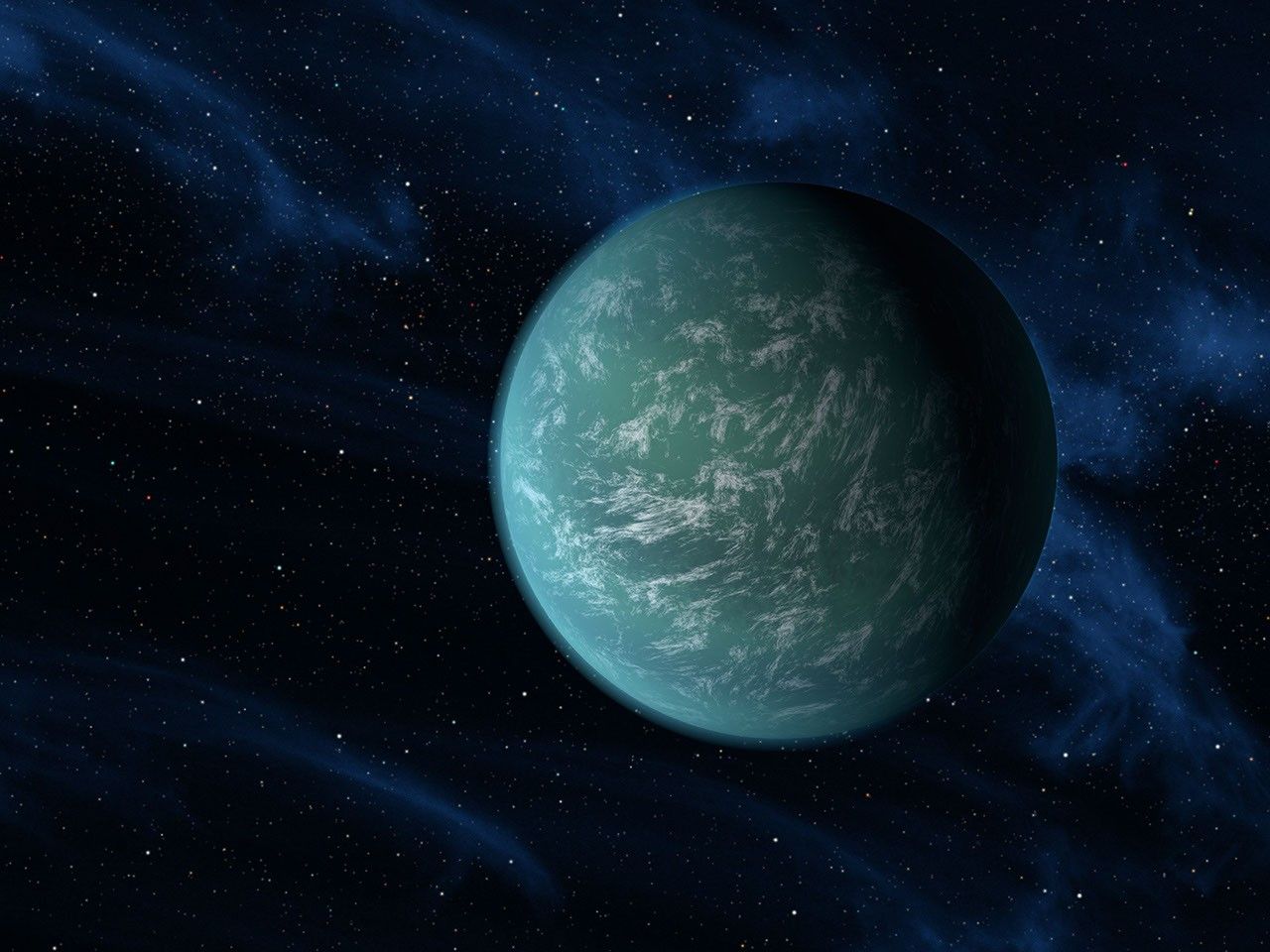
Kepler-22b is a confirmed planet orbiting a Sun-like star about once every 290 days. It is larger than Earth and became famous as the first planet confirmed by NASA's Kepler mission in its star's habitable zone. That discovery established a planet in an interesting orbit. It did not establish an ocean, a breathable atmosphere or life.
The familiar blue-green pictures are artist's concepts. To understand this world, it helps to separate what the telescope measured, what a model inferred, and what an illustration imagines.
How was Kepler-22b discovered?#
Kepler monitored stellar brightness, looking for repeated dips caused by planets crossing their stars from our viewpoint. Such a crossing is called a transit. Repetition helps distinguish an orbiting object from an isolated fluctuation or an instrumental problem.
The mission recorded the first Kepler-22b transit shortly after science operations began. A third transit arrived during the 2010 holiday season, and the confirmation was announced on December 5, 2011. Follow-up observations helped assess whether other objects could imitate the signal.
The telescope did not resolve the planet into a disk with visible continents. It recorded a small change in the combined light arriving from the direction of the star. That is enough to establish a repeating orbital signal when alternative explanations have been tested.
Sources: [1]
How does dimming reveal a planet's size?#
A transiting planet hides part of the stellar disk. In a simplified picture, the fraction of light blocked depends on the planet's projected area relative to the star's. A deeper dip generally means a larger planet relative to that particular star, although the path across the disk and variations in stellar brightness also matter.
Turning that ratio into kilometers or Earth radii requires an estimate of the star's size. The discovery study used stellar spectroscopy and asteroseismology, the study of oscillations detected in the star's light, to constrain the host. Better stellar measurements can therefore change the inferred planetary radius without changing the fact that the transit exists.
This dependency explains why discovery announcements and later catalogues can give different size estimates. They are results of particular analyses, not direct measurements with a ruler placed beside the planet.
Sources: [2]
How big is it, and do we know its mass?#
The original announcement described a radius about 2.4 times Earth's. The NASA Exoplanet Archive solution attributed to Bonomo and colleagues in 2023 gives 2.10 plus or minus 0.12 Earth radii. Both place it well above Earth's size.
The same archive solution lists a mass below 9.1 Earth masses. The less-than sign matters: this is an upper limit. NASA's shorter outreach card displays “9.1 Earths” without that qualification, so the scientific table is the appropriate reference for interpreting the number.
An upper limit cannot be used as though it were an exact mass to calculate a unique density, surface gravity or weight for a visitor. Those quantities would inherit the uncertainty. The archive also preserves older solutions, which is why numbers copied from different dates may disagree.
Why is the habitable zone not a guarantee of an ocean?#
The habitable zone describes a range of stellar irradiation where liquid water could persist on a planet's surface under suitable atmospheric conditions. The atmosphere is part of the condition, not an optional detail. It affects pressure, heat retention and the temperatures water experiences.
A planet's orbit provides information about incoming energy. It does not tell us whether that planet has a solid surface, how much water it contains, or how its atmosphere moves and traps heat. A planet can occupy an interesting range of distances without offering an Earth-like environment.
The zone's boundaries also depend on the climate assumptions used to define them. It is a useful way to select targets for further investigation, rather than a certificate of habitability. Detecting organisms would require another set of observations beyond establishing conditions that might support them.
Sources: [5]
Is Kepler-22b a rocky super-Earth or a water world?#
The discovery paper explicitly stated that there was no evidence establishing Kepler-22b as rocky. A radius alone cannot uniquely determine how much of a planet is rock, water or gas. Different combinations can produce similar overall sizes.
“Super-Earth” is a size or mass category in common exoplanet usage. It does not mean an enlarged Earth with the same oceans, atmosphere and surface. NASA's outreach catalogue calls Kepler-22b a possible ocean world; the word possible carries the uncertainty.
An artist may choose water and clouds to depict one plausible scenario. That choice does not eliminate other interiors or atmospheric structures. The scientific question is what additional measurement would distinguish those possibilities, especially a stronger mass constraint or reliable atmospheric information.
Do its blue-green pictures show algae or clouds?#
No. The cover image was published by NASA as an artist's concept in 2011. Its source description says the planet's composition was unknown and identifies the clouds as an interpretation. The colors are not a measured map of the planet.
A green patch in an illustration cannot be evidence of algae. Even a measured color would need interpretation: atmospheric absorption, cloud particles, illumination and surface materials can all affect reflected light. A biological explanation must be tested against nonbiological ones.
Reading an image's credit and caption is therefore part of reading the science. An illustration can communicate a possibility clearly while providing no observation of the details it depicts. Kepler's brightness measurements remain the basis of the discovery.
Sources: [7]
Has anyone found a moon around it?#
A 2013 study by the Hunt for Exomoons with Kepler project searched for a companion using transit data, radial velocities and information about the star. It found no evidence for an exomoon and excluded moons above about half an Earth mass at 95 percent confidence within its analysis.
That is a constrained nondetection, not proof that every possible moon is absent. The study asked whether the available observations contained the signal expected from particular planet-moon systems. Smaller or harder-to-detect companions are a different question.
The same study showed how the adopted habitable-zone definition changes the interpretation of this orbit. Its distinction between empirical and conservative boundaries is another reason to avoid treating the phrase “in the habitable zone” as a complete description of conditions.
Sources: [6]
What would turn a possible world into a better-known one?#
A more precise mass would narrow the possible bulk compositions. Atmospheric measurements could constrain gases and cloud behavior. Neither would automatically demonstrate life, but each would replace some freedom in the models with observational limits.
Other systems show why those steps matter. Webb's investigation of WD 1856 b and its atmosphere connects spectra to atmospheric models while exposing an unresolved temperature disagreement. For planets too faint to see directly, microlensing offers a different route to mass constraints.
Repeated dimming revealed Kepler-22b as a planet larger than Earth on a roughly year-long orbit around a Sun-like star. Its ocean, weather and biology remain questions, not details that can be read from a painted globe.
Keep exploring
Sources & further reading
Follow the original research, records, and explanations behind this story.
- NASA’s Kepler Confirms Its First Planet In Habitable Zone NASA/JPL
2011 discovery announcement
- Kepler-22b: A 2.4 Earth-radius Planet in the Habitable Zone of a Sun-like Star Borucki et al. / IPAC
Stellar inference and lack of established rocky composition
- Kepler-22 planetary parameters NASA Exoplanet Archive
Radius: 2.10 ± 0.12 Earth radii; mass: less than 9.1 Earth masses.
- Kepler-22 b NASA Science
Possible ocean world; short card omits mass-limit sign
- What Is the Habitable Zone? NASA Science
Surface-water criterion depends on atmosphere
- The Hunt for Exomoons with Kepler III Kipping et al. / ApJ
Moon nondetection and habitable-zone definition dependence
- Closer to Finding an Earth: Artist’s Concept NASA Photojournal
Clouds and surface are illustrative
Follow the thread