
Black holes can have brilliantly luminous surroundings while remaining dark themselves. They can bend the paths of light, disrupt a passing star and allow other objects to orbit for long periods. These statements describe different regions and different circumstances.
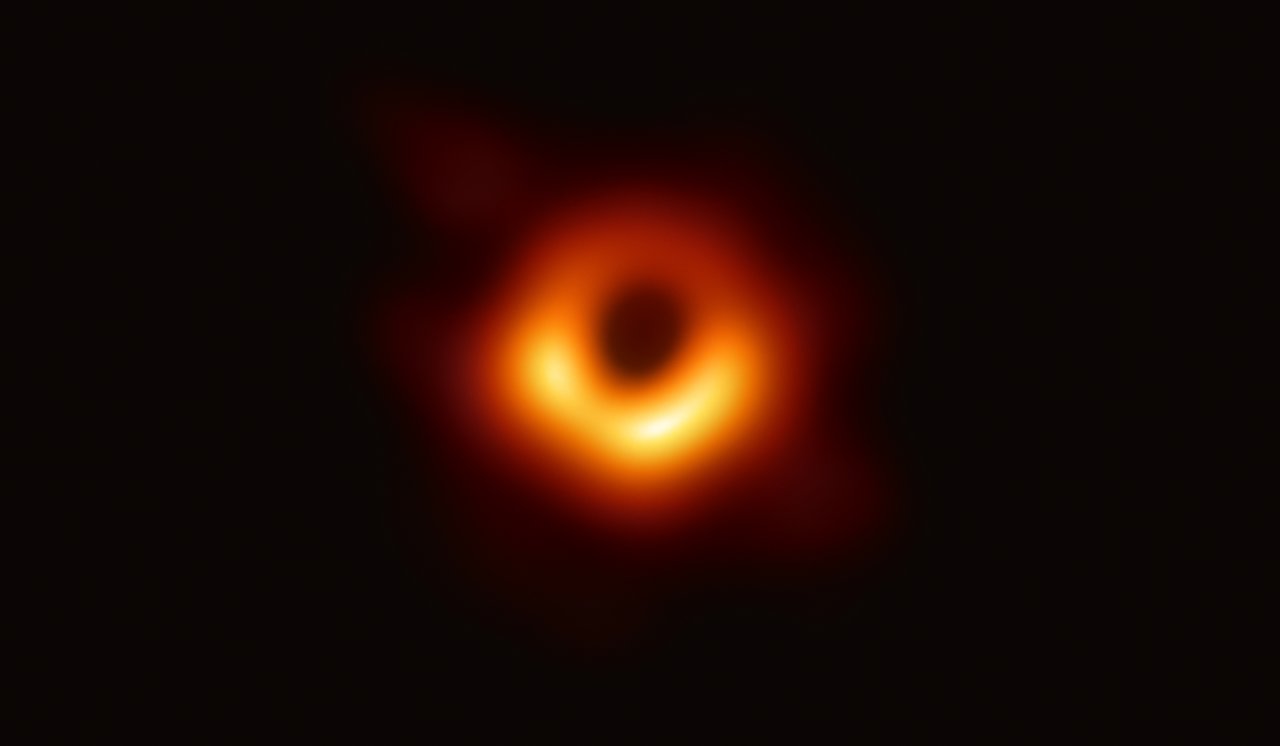
Much of the confusion comes from treating a black hole, its event horizon and the matter around it as one object with one set of properties. Separating them makes the observations easier to interpret, including the famous orange ring around M87*.
What does the event horizon actually mark?#
The event horizon is the boundary beyond which a signal cannot escape to the distant outside universe. It is not a solid crust. A spacecraft would not strike it as it would strike the surface of a planet.
In general relativity, the restriction is part of the geometry of spacetime. In the idealised, nonrotating black-hole model, future-directed paths inside the horizon lead farther inward. A more powerful engine does not open an outward route that light itself lacks.
That boundary also limits what observations can tell us. Light received from the region around a black hole was emitted outside the horizon. Descriptions of the interior rely on physical theory rather than photographs sent back from within it. The horizon and the central singularity of the classical model are distinct concepts; uncertainty about the latter should not be confused with an image of the former.
Sources: [1]
Why can the area around a black hole shine?#
Gas approaching a black hole can form an accretion disk. Energy released as material moves inward heats the gas, which can emit intense radiation before it crosses the horizon. That light can reach a telescope because it originates outside the region from which escape is impossible.
An active accretion disk is therefore a way to find a black hole, but it is not an unavoidable feature of every black hole. An isolated object with little nearby matter may be much harder to detect.
The geometry can make a disk look unfamiliar. Light from its far side follows curved paths around the black hole and can reach an observer from unexpected directions. A view that appears to show glowing material above and below a dark centre can include bent images of the same disk. The appearance depends on the viewing angle as well as the emitting material.
Sources: [2]
What does the orange image of M87* show?#
The Event Horizon Telescope image released in April 2019 was reconstructed from radio observations collected in 2017. Telescopes at different sites recorded signals at a wavelength of 1.3 millimetres, and the collaboration combined their data to recover structure on an exceptionally small angular scale.
The bright ring traces emission around the black hole. The darker central region is its shadow, produced by the capture and bending of light. The shadow is larger than the event horizon, so measuring the dark patch is not the same as tracing a material surface.
The displayed colours make the radio emission visible to human eyes. They are not a naked-eye photograph of orange flames. Likewise, the blurred ring is not evidence that a spacecraft flew close enough to take a conventional picture. It is a scientific image assembled from coordinated measurements, whose interpretation was checked with multiple imaging and calibration methods.
Does a black hole stop time?#
A clock carried by a falling observer keeps measuring that observer’s own elapsed time. In the classical nonrotating model, an observer can cross the horizon after a finite amount of time on that clock.
Someone far away receives a different sequence of signals. Light emitted increasingly close to the horizon arrives with increasing delay and redshift, and the source becomes fainter. The familiar description of an object appearing to freeze near the horizon refers to this distant view. It does not mean the falling observer experiences a permanently stopped watch.
There is also a real difference in elapsed time between suitable journeys through different gravitational environments. It must be defined by specifying the observers and their paths. A claim such as one minute near a black hole equals a year elsewhere has no single universal value: the mass, spin, trajectory and comparison being made matter. The simple falling-observer example cannot supply a ready-made travel itinerary.
Why do tidal forces stretch objects?#
Gravity does not pull equally on every part of an extended object near a black hole. If one end lies closer than the other, the difference can stretch the object along the direction of the pull while compressing it sideways. This is the tidal effect often called spaghettification.
The relevant quantity is the change in gravity across the object, not just the fact that it is near something massive. Horizon size also grows with black-hole mass. As a result, a small stellar black hole can produce severe tides outside its horizon, while the tides at a much larger black hole’s horizon can be weaker.
That distinction does not make crossing a large horizon a safe escape route: the inability to return still applies, and surrounding gas may introduce other hazards. Tidal disruption can also reveal black holes from afar. Our wandering black-hole article follows a case in which a disrupted star helped expose an otherwise difficult-to-find object.
Would Earth fall in if the Sun became a black hole?#
In the deliberately artificial example where the Sun is replaced by a black hole of the same mass, Earth’s orbit would remain essentially the same. The central mass has not increased, and Earth remains far outside the compact object. Becoming a black hole does not create an additional long-range suction force.
Sunlight would disappear, making the situation disastrous for life even though the orbital argument remains unchanged. A planet continuing to orbit and a planet remaining habitable are separate questions.
This is a thought experiment about gravity, not a forecast for the Sun. The Sun lacks the mass needed to end its normal stellar evolution as a black hole; its eventual remnant will be a white dwarf. The example is useful precisely because it holds mass fixed while changing how tightly that mass is concentrated.
How do we test ideas about something so dark?#
Different observations constrain different properties. Stars moving around a dark, compact source can reveal its gravitational influence. Radiation from nearby gas probes the environment outside the horizon. Horizon-scale radio imaging adds information about the shape and size of the emitting region and its central shadow.
Gravitational waves provide another test. The first signal detected directly by LIGO, in September 2015, matched the predicted pattern of two black holes spiralling together, merging and settling into a remnant. That result used changes in spacetime recorded by detectors, rather than light escaping from inside a black hole.
These measurements test specific predictions about gravity and the material outside black holes. They leave questions about the interior unresolved: agreement between an observed signal and a model is not a direct view beyond the horizon.
Keep exploring
Sources & further reading
Follow the original research, records, and explanations behind this story.
- Changing places: space and time inside a black hole Einstein Online / Markus Pössel
Causal geometry, compulsory inward future motion and distinction between horizon and singularity.
- Anatomy of a Black Hole NASA Science
Radiation outside the horizon, accretion and gravitationally bent disk images.
- First Image of a Black Hole ESO / EHT Collaboration
M87 observation provenance; shadow differs from event horizon.
- Astronomers Capture First Image of a Black Hole ESO / EHT Collaboration
Radio observations reconstructed into an image; independent imaging checks.
- Frequently Asked Questions on Black Holes NASA APOD / Matt McIrvin
Used for classical nonrotating model only;1995 text is not a current inventory of discoveries.
- New NASA Black Hole Visualization Takes Viewers Beyond the Brink NASA / Francis Reddy
Written physical explanation only; no video played. Simulation-specific durations are not universal.
- Black Holes NASA Goddard Imagine the Universe
Only the fixed-mass orbit thought experiment used; old population and object-mass estimates omitted.
- 10 Questions You Might Have About Black Holes NASA Science
Stellar motion as evidence, tidal disruption and the Sun’s white-dwarf fate. Other broad simplifications not adopted.
- Observation of Gravitational Waves from a Binary Black Hole Merger LIGO Scientific Collaboration and Virgo Collaboration
Independent gravitational-wave evidence; no source-parameter recalculation.
Follow the thread