
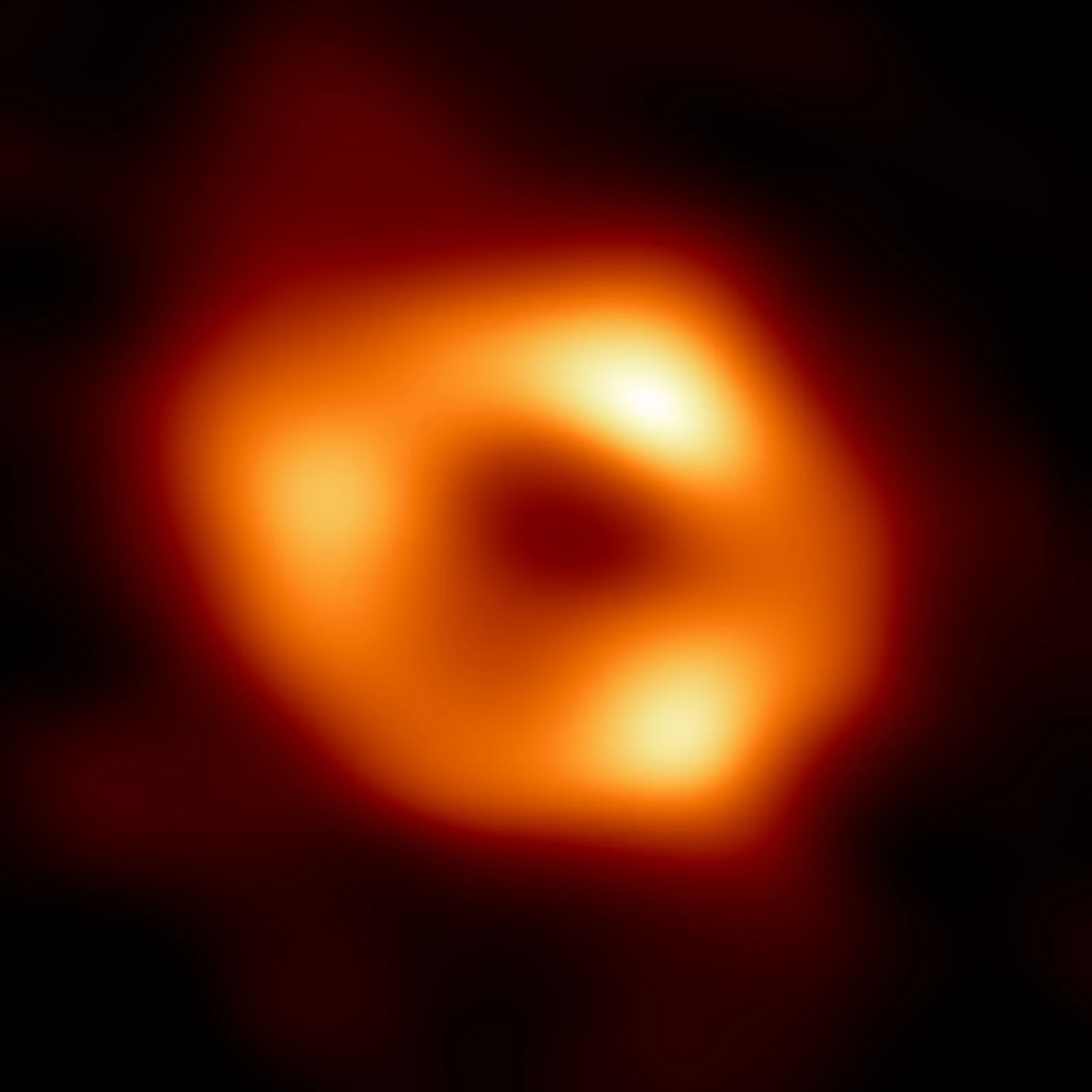
Imagine a falling probe sending a flash every second by its own clock. A distant telescope could record the flashes arriving with wider gaps. Their light would shift to longer wavelengths and become harder to detect. The record would end without an image transmitted from the moment the probe crossed the horizon.
The probe’s clock and the telescope’s clock both keep ticking. To understand what the telescope sees, it helps to work out which flashes are emitted, how they travel and which ones still reach the receiver.
What does “one second” mean for the falling probe?#
One second here is the elapsed time measured inside the probe. Physicists call it proper time. In the simplest model, an ideal clock carried by a falling probe reaches and crosses the event horizon after a finite amount of that time. Its behavior depends on local conditions. A strong tidal stretch could destroy the probe well before the last planned flash.
The distant observer measures the arrival of the flashes on another clock. The gap between arrivals depends on when the probe sent each flash and how long each flash took to reach the telescope. Watching the stream of arrivals is an experiment with light signals, even when the main thing being tracked is what a clock near the black hole is doing.
How can two identical pulses arrive farther apart?#
First consider a lamp held in place above a nonrotating black hole. Suppose it sends one pulse per second on its own clock and a receiver sits far away. Hold the lamp at twice the radius of the horizon, measured from the center, and the receiver gets the pulses about 1.4 seconds apart. Hold it at 1.01 times the horizon radius and the interval is about 10 seconds. These values come from the gravitational redshift for a stationary source.
The second position would be very hard to maintain. A real lamp would need support or thrust to hover there. A freely falling emitter adds motion to the calculation. For outward flashes from a falling emitter, the source recedes from the distant receiver as it drops. There is a Doppler shift as well as gravitational redshift. The hovering example isolates the gravitational part so the change in signal spacing is easier to see.
Why does the received picture eventually disappear?#
A flash emitted close to the horizon can be received much later and at a much lower frequency. Each received photon carries less energy when its frequency is lower. The widening gaps also mean fewer photons arrive per unit of time. A real telescope has a limited range of wavelengths and a finite sensitivity. In practice, the fading signal eventually falls below the instrument’s detection limit.
A probe that emits only a discrete series of flashes may send its last escaping flash before it reaches the horizon. Which flash is the last detectable one depends on the original timing, brightness and receiver. A flash sent from the horizon or farther inward cannot carry news of the crossing out to a distant telescope.
Would the probe survive close enough to send those flashes?#
For a small object, the tidal stretch depends on how quickly gravity changes across its length. At the same distance from the center a larger black hole produces stronger tides. Comparing different black holes at their horizons changes the distance as well. A nonrotating black hole’s horizon radius grows in proportion to its mass. Across a small object the radial tidal strength scales with mass divided by the cube of distance. Doubling the mass therefore gives about a quarter of the tidal stretch at the larger horizon.
That is how a small stellar black hole can tear a probe apart outside its horizon, while the local tidal difference at a much larger horizon can be weaker. The signal calculation still has a boundary even in the case where the instrument survives to cross it.
Can astronomers measure anything like this?#
Astronomers have measured a related effect using S2, a star that swings around the black hole at the Milky Way’s center. When S2 made its 2018 close pass, the GRAVITY collaboration compared its measured spectral shifts with its orbit. The additional shift was consistent with the gravitational and velocity effects predicted by relativity.
S2 remained far outside the horizon. Its spectrum gives astronomers a way to test parts of the calculation using light they can receive. A probe experiment would push the same distinction much further. The data available on the outside would always be the sequence of signals that made it out.
Keep exploring
Sources & further reading
Follow the original research, records, and explanations behind this story.
- General Relativity, Black Holes, and Cosmology Andrew J. S. Hamilton; JILA, University of Colorado Boulder
Schwarzschild proper time, stationary redshift formula, distant view and tidal geometry.
- New NASA Black Hole Visualization Takes Viewers Beyond the Brink NASA Goddard Space Flight Center
Infall and distant views, finite crossing time, redshift and mass-dependent tidal stretching.
- Frequently Asked Questions (FAQs) on Black Holes NASA Science / APOD; astronomy explainer by Ted Bunn
Signal reception, limited photons and ideal eternal Schwarzschild horizon.
- Detection of the gravitational redshift in the orbit of the star S2 near the Galactic centre massive black hole GRAVITY Collaboration, Astronomy & Astrophysics; author manuscript
S2 orbital spectroscopy and combined relativistic effects at closest approach.
- First Successful Test of Einstein’s General Relativity Near Supermassive Black Hole European Southern Observatory
The 2018 closest approach and the star’s observed spectral redshift.
- First image of our black hole ESO and Event Horizon Telescope Collaboration
Published image of the radio brightness around Sagittarius A*.
Follow the thread