
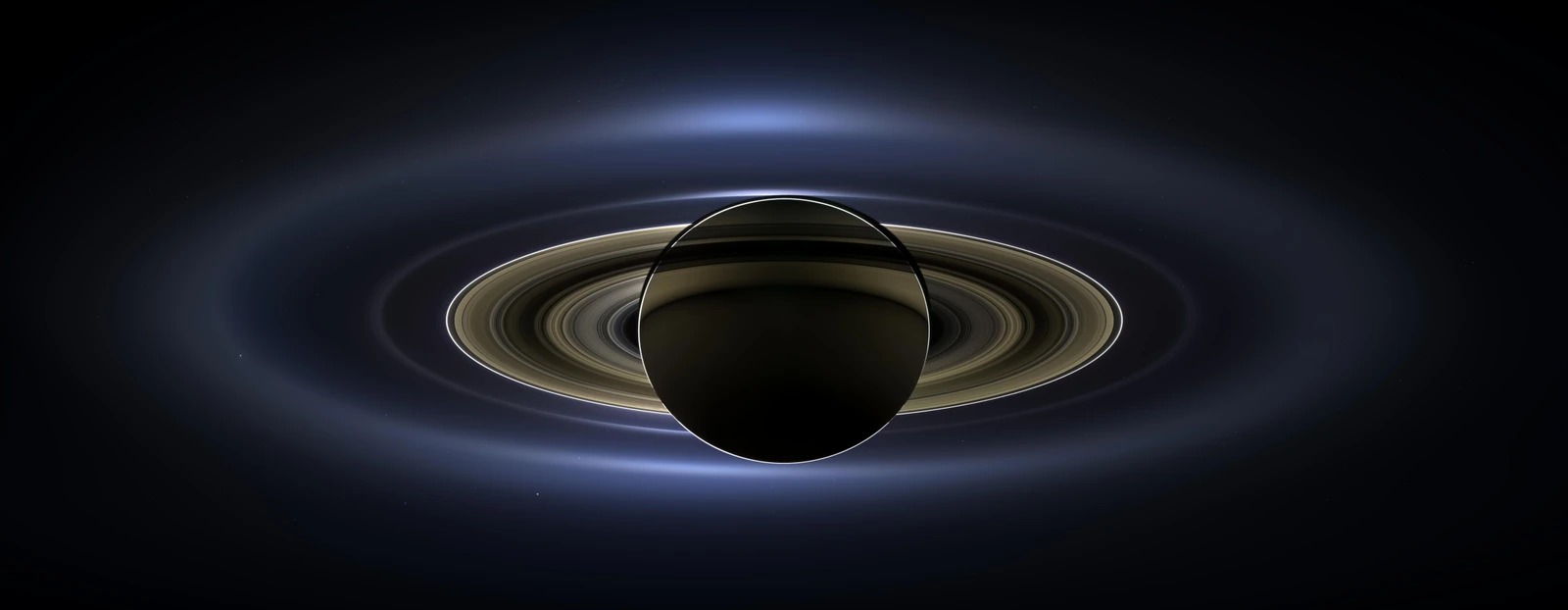
Cassini photographed Earth on July 19, 2013, from about 1.45 billion kilometers away. Saturn blocked direct sunlight from reaching the spacecraft while Earth remained visible beside the planet. The same alignment lit the rings from behind, so the camera team could image faint ring material as well as the small point of light from home.
The familiar panorama and the close view of Earth and the Moon came from different cameras in the same observing sequence. One puts Earth in the Saturn system. The other isolates two objects that were too small for Cassini to resolve as disks.
Why did Cassini have to hide from the Sun?#
Viewed from Saturn, Earth stays close to the Sun in the sky because Earth's orbit is much smaller than Saturn's. This makes Earth awkward to photograph with a camera designed for faint planetary details. A bright source just outside the intended frame can scatter light into the optics, and directly exposing the cameras to the Sun may damage them.
Cassini moved into a position where Saturn could shield the cameras. From a point inside Saturn's shadow, the Sun was behind the planet's globe. Earth was in a slightly different direction, with enough separation that it appeared past the outline rather than behind it. The spacecraft could point toward the scene while Saturn blocked the strongest direct light.
Sources: [1]
Why did the rings become so bright from behind?#
The side of Saturn facing Cassini was mostly on the night side. The thin rings extended far beyond the globe and received sunlight from the other direction. Grains of ice and dust scattered some of that light toward the camera. Fine grains can stand out in this geometry in the same way that particles in the air become easier to see when light enters from behind them.
One structure in the panorama is the broad, diffuse E ring. The small moon Enceladus supplies ice particles to that ring through plumes from its south polar region. Backlighting makes tenuous material visible alongside the bright main rings. This was a useful observation of Saturn in its own right, and Earth was visible through part of that same diffuse ring system.
Why did the panorama take 141 images?#
Cassini's wide-angle camera could cover a larger area at once than the narrow-angle camera. The Saturn panorama was still wider than a single frame. The team used a sequence of overlapping views through red, green and blue filters. Aligning frames across the scene records the shape of the rings, and combining filters gives the natural-color view.
Both cameras took 323 exposures over just over four hours. The team used 141 wide-angle exposures for the final panorama. The 323 includes images with distinct purposes, among them the narrow-angle views intended to isolate Earth and the Moon. The finished wide-angle mosaic spans about 650,000 kilometers at Saturn. A separate composite shows Earth beside the Moon.
What did the close-up actually resolve?#
For the separate Earth and Moon view, NASA gives an image scale at Earth of approximately 8,662 kilometers per pixel. Earth's full diameter is about 12,750 kilometers, so dividing gives fewer than one and a half pixels across at that scale. The visible illuminated region was smaller still. The camera could detect light from Earth without tracing its continents, and the Moon could appear as a second spot because it was far enough to one side.
The published close view adjusts the brightness of Earth, the Moon and the E ring so readers can see them on the same page. NASA also increased the Moon's brightness relative to Earth's. That makes the picture easier to inspect, while the displayed sizes and brightness of the dots remain a poor way to calculate the physical sizes and reflectivity of the two objects.

Image unavailable.
Two points against the faint rings of Saturn, one bright and bluish on the left and one fainter and white on the right.
What were people doing when Cassini took the photograph?#
NASA announced the observing event in advance and invited people on Earth to wave in Saturn's direction. The distance gives that invitation a peculiar scale. Taking 1.45 billion kilometers and dividing by light speed gives a one-way travel time of about 80 minutes. Earthlight in Cassini's frame had already spent that time on its way across the solar system.
Voyager 1 had photographed Earth in 1990, and Cassini had imaged it from Saturn's shadow in 2006. The 2013 event combined an earlier idea with advance public notice and a dedicated attempt to separate Earth from the Moon in the narrow-angle view. Almost everything recognizable about Earth disappeared at that distance. The position of the point of light was still enough to identify it.
Keep exploring
Sources & further reading
Follow the original research, records, and explanations behind this story.
- The Day the Earth Smiled NASA Science and Cassini Imaging Team
Saturn’s shadow, panorama counts, spatial span and the origin of E-ring particles.
- Imaging Science Subsystem (ISS) NASA Science
Two cameras have different fields of view.
- One Special Day in the Life of Planet Earth NASA Science and Cassini Imaging Team
Earth and Moon are distinct unresolved sources, distance and scale, brightness adjustments.
- Wave at Saturn NASA Science
Public was invited to wave in advance of the observing event.
- Facts About Earth NASA Science
Earth’s approximately 12,750-kilometer diameter.
Follow the thread