
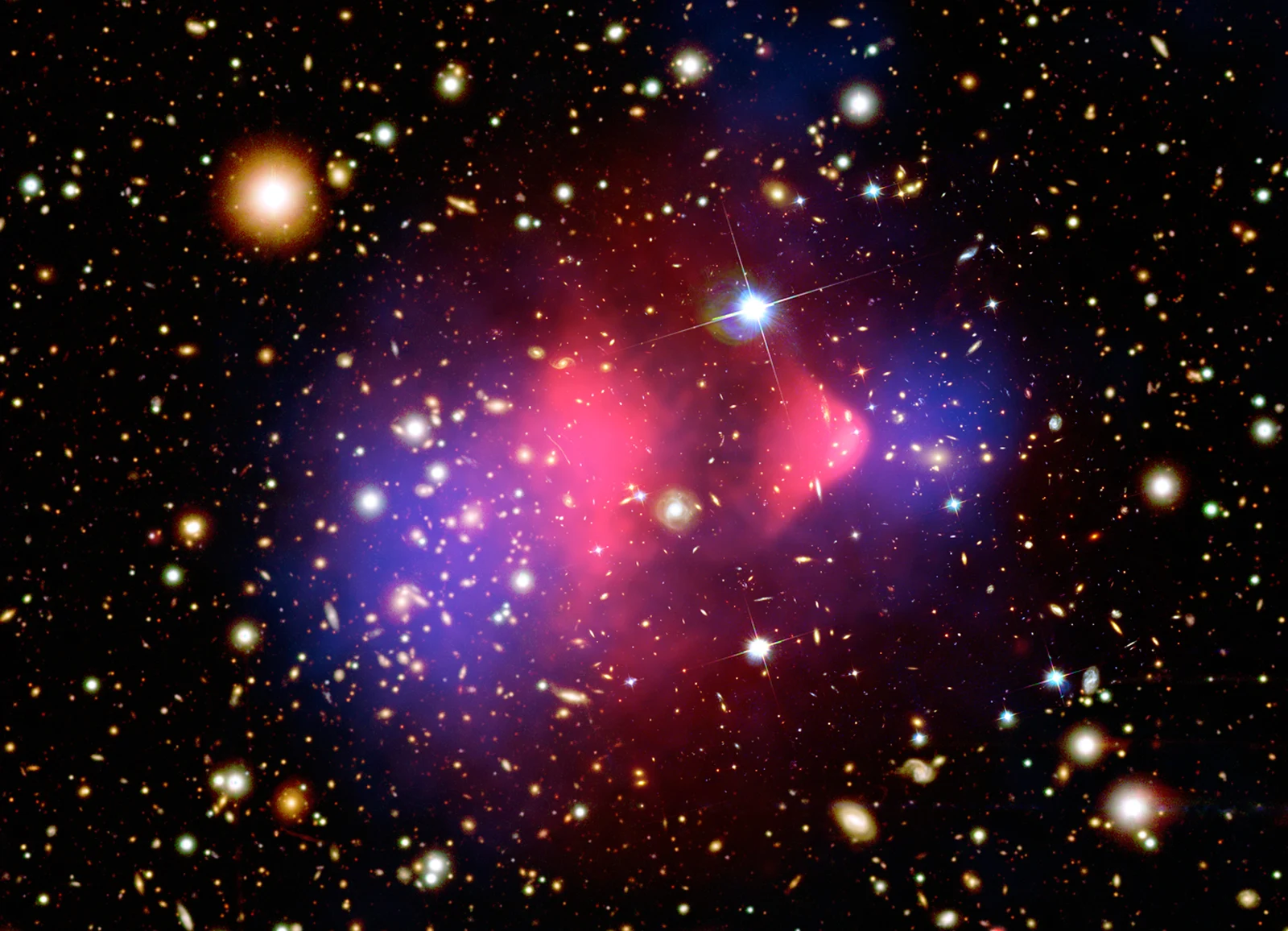
The evidence for dark matter begins with measurements of gravity. Gas and stars in many spiral galaxies orbit quickly even far from their centers. Light from distant galaxies also bends around galaxy clusters more strongly than their visible material alone can explain. In the Bullet Cluster, the strongest bending even occurs away from the bulk of the ordinary matter.
These measurements follow different things. A rotation curve follows motion. A lensing map follows shifts in the shapes of distant galaxies. A third measurement, from the early universe, helps say how much dark matter there is overall.
What did astronomers measure in rotating galaxies?#
A galaxy’s rotating disk sends some gas toward us and takes some away. The approaching side shifts recognizable lines of light to shorter wavelengths. The receding side shifts them to longer wavelengths. Astronomers use those Doppler shifts, together with the tilt of the disk, to estimate how quickly gas or stars are orbiting at different distances from the center.
In 1970, Vera Rubin and Kent Ford used light from dozens of glowing regions in Andromeda to map its rotation. Later measurements of other spiral galaxies followed the same idea out to large distances. Many rotation curves stay roughly level well beyond the bright center. If most of the mass were packed into that center, you would expect orbital speeds to decline well outside it. A halo with much of its mass spread farther out can explain why large orbits stay fast.
How can background light reveal mass in front of it?#
Gravity changes the route light takes past a mass. A galaxy behind a cluster can therefore appear stretched, shifted or, in a strong case, split into several images. In weak lensing, the change for one galaxy is usually too small to recognize confidently. Galaxies already have a range of shapes and orientations. Measure enough of them and a preferred distortion can emerge from the sample.
Researchers use those distortions and the distances involved to infer where mass lies across the field. It is a map of mass projected along the line of sight. Stars and gas can contribute to it, as can mass that produces very little light. The comparison with separate maps of stars and gas tells astronomers which ingredients could supply the gravity they infer.
What moved apart in the Bullet Cluster?#
Two galaxy clusters passed through each other. Much of their ordinary matter was hot gas. When the clouds of gas met, they slowed and heated, leaving bright concentrations visible in X-rays. The galaxies largely passed through. When the team mapped the strongest lensing, it found concentrations closer to the galaxies than to the two clouds of gas.
In the cover image, pink marks the X-ray gas and blue marks the concentrations inferred from lensing. The colors come from different measurements and the blue is a calculated overlay. The separation is important because most of the ordinary matter is in the gas. That gas cannot explain the locations of the strongest gravitational signal on its own.
Where does the “about 85 percent” estimate come from?#
Planck measured tiny temperature and polarization patterns in the oldest light we can observe, the cosmic microwave background. The patterns preserve the effects of waves in the early universe. Ordinary matter interacted with the light in that gas while dark matter contributed gravity without taking part in the same pressure waves. The relative sizes of features in the microwave data let researchers estimate the two amounts within a cosmological model.
In Planck’s standard model fit, the density estimates for cold dark matter and ordinary matter are proportional to about 0.120 and 0.0224. Dividing the first by their sum gives about 84 percent. That fraction uses cold dark matter and ordinary matter as its denominator. Dark energy belongs to the larger energy budget of the universe.
Sources: [5]
What has yet to be identified?#
The observations agree on a missing contribution to gravity across very different settings. Turning an orbital speed or a skewed image into a mass depends on a gravitational model. Even where several measurements favor the same extra component, they leave its microscopic identity open.
A candidate has to account for the rotation of galaxies, the behavior of whole clusters during a collision and the pattern of fluctuations in the early universe. Identifying the particles or other physical ingredients responsible for those effects is a separate question from measuring how much gravity they provide.
Keep exploring
Sources & further reading
Follow the original research, records, and explanations behind this story.
- Rotation of the Andromeda Nebula from a Spectroscopic Survey of Emission Regions Rubin and Ford, Astrophysical Journal; ADS archive
Historical spectra of ionized gas across Andromeda and inclination-corrected rotation curve.
- Rotational Properties of 21 Sc Galaxies with a Large Range of Luminosities and Radii Rubin, Ford and Thonnard, Astrophysical Journal; ADS archive
Rotation curves through the faint outer regions, without the expected decline in the measured range.
- A direct empirical proof of the existence of dark matter Clowe et al., Astrophysical Journal Letters; author preprint
Weak lensing reconstructions, projected mass and misalignment with the X-ray gas in the Bullet Cluster.
- Visible-light and x-ray composite image of galaxy cluster 1E 0657-556 ESA/Hubble
Identifies the optical galaxies, pink X-ray plasma and inferred blue mass distribution.
- Planck 2018 results. VI. Cosmological parameters Planck Collaboration, Astronomy & Astrophysics; author preprint
Fitted cold dark matter and baryon densities and use of microwave-background measurements.
Follow the thread