
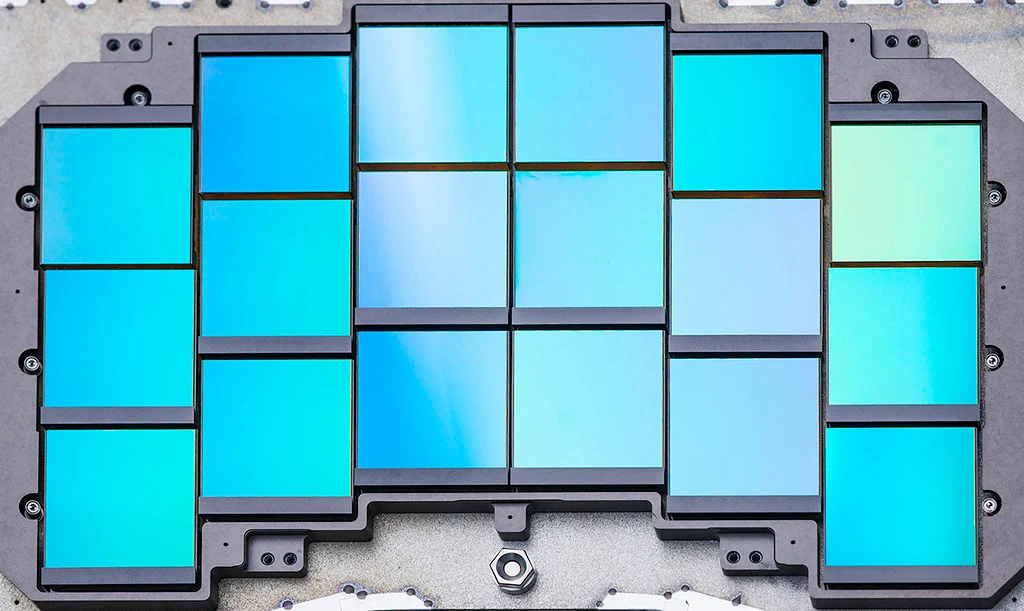
In one pointing, the Nancy Grace Roman Space Telescope's Wide Field Instrument can record about as much sky as 100 fields from Hubble's Advanced Camera for Surveys. Roman gets that coverage by spreading sharp images across 18 detectors. Both observatories have a primary mirror 2.4 meters across. Roman, which launched on August 30, 2026, was built to use that mirror for surveys.
That wide view changes the questions a telescope can answer. A small field might show one star brightening. A large field revisited at short intervals gives astronomers many stars to watch for short brightenings, including ones caused by the gravity of planets that give off almost no light of their own.
What exactly does “about 100 Hubble fields” measure?#
It measures angular area, the size of a patch as it appears on the sky. Roman's detectors cover about 0.281 square degrees, excluding the space between them. The Space Telescope Science Institute compares that active area with the Wide Field Channel of Hubble's Advanced Camera for Surveys, or ACS. Hubble has several cameras and modes. The same Roman field is roughly 200 times as large as the field of Hubble's Wide Field Camera 3 infrared channel.
Picture two square fields side by side. If one is 100 times as large in area, it is 10 times as wide and 10 times as tall. Roman and ACS have differently shaped footprints, so that arithmetic is a way to picture the scale. It says nothing by itself about how fine a detail one instrument can resolve.
Why do 18 detectors make a wider view possible?#
The primary mirror collects light. The rest of the optical system determines where light from each direction comes into focus, and the camera records the image where it lands. Roman's mirrors are shaped and tilted to bring light into sharp focus over a broad region away from the center. The detectors sit in three slightly staggered rows of six to follow that usable region. In NASA's photograph you can see the slight arch they form.
A pixel in Roman's camera samples about 0.11 arcseconds on the sky, close to the scale of Hubble's Wide Field Camera 3 infrared channel. An arcsecond is one 3,600th of a degree. Using more pixels lets Roman keep sampling at that fine scale over a much larger area. The optics still have to deliver a sharp image to the detectors, and how well two objects can be separated depends on the light's wavelength as well as the pixel scale.
Why do survey images need more than one exposure?#
The 18 detectors are separate pieces of hardware. If a star lands in the narrow space between two of them, it falls in a hole in that exposure's coverage. A second exposure shifted slightly across the sky can put that star on a working detector. This deliberate shift is called a dither. With several offsets, astronomers can fill gaps from more than one direction and combine images into a more continuous map.
A large survey may also move to a new part of the sky. These larger steps place adjoining or overlapping patches side by side in a mosaic. The number of exposures depends on the need to fill gaps, the desired depth, the filters and whether the observations have to be repeated. The hundredfold comparison counts recorded sky area per pointing. The observing plan determines how much time the map will take.
How does a wide field help find hard-to-see planets?#
When a foreground star passes close to the line of sight to a distant star, its gravity bends some of the background starlight toward us. The distant star temporarily appears brighter. A planet near the foreground star can cause a shorter change in that brightening. A planet on its own can also act as the lens. Astronomers call this gravitational microlensing.
Useful alignments are rare for any one star. The Galactic Bulge Time-Domain Survey is designed to revisit crowded fields toward the center of the Milky Way roughly every 12 minutes during its intensive observing seasons. Watching many stars at once gives Roman more chances to catch an alignment. Returning often enough is what lets it measure a short feature before the star fades back toward its usual brightness. The search takes both a large patch of sky and a record of how the light changes.
Why will Roman keep returning to distant galaxies?#
A repeating survey can also pick up light from a supernova as it brightens and fades. The High-Latitude Time-Domain Survey is designed to revisit the same distant fields about every five days through its main observing period. Astronomers can use measurements of Type Ia supernovae, a class of stellar explosions with a calibratable brightness, to estimate distances. They compare those distances with redshift, the stretching of wavelengths in the light as the universe expands.
One supernova gives a distance estimate at one point in that history. A sample of explosions across many distances lets astronomers test whether a single account of cosmic expansion fits data from different times. For those measurements, the useful product from Roman's wide camera is a series of well-measured changes across many patches of sky.
Keep exploring
Sources & further reading
Follow the original research, records, and explanations behind this story.
- The Wide Field Instrument Space Telescope Science Institute
Active sky area, relevant Hubble camera comparisons and pixel scale.
- Building Roman NASA Science
Description of Roman’s mirrors, the detector array and the exact cover photograph.
- Description of the WFI Space Telescope Science Institute
Physical detector layout, observing footprint and separation between detectors.
- Hubble vs. Roman NASA Science
Matches the 100-field claim to Hubble’s Advanced Camera for Surveys and confirms the shared primary diameter.
- NASA’s Dark Universe-Seeking Nancy Grace Roman Space Telescope Launches NASA
Confirms launch date and surveys as a mission goal.
- WFI Dithering Space Telescope Science Institute
How offset exposures fill gaps and improve sampling.
- Quick Start Guide Space Telescope Science Institute
Distinction between moving across sky tiles and filling gaps within a tile.
- Microlensing NASA Science
Primary mission explanation of microlensing and signals produced by bound or free-floating planets.
- Galactic Bulge Time-Domain Survey: Technical NASA Science
Current planned 12.1-minute cadence during the survey’s high-cadence seasons.
- High-Latitude Time-Domain Survey NASA Science
Repeated distant fields, Type Ia supernova measurements and expansion history.
- High-Latitude Time-Domain Survey: Technical NASA Science
Core survey schedule and use of Type Ia supernovae for precision expansion history.
Follow the thread