
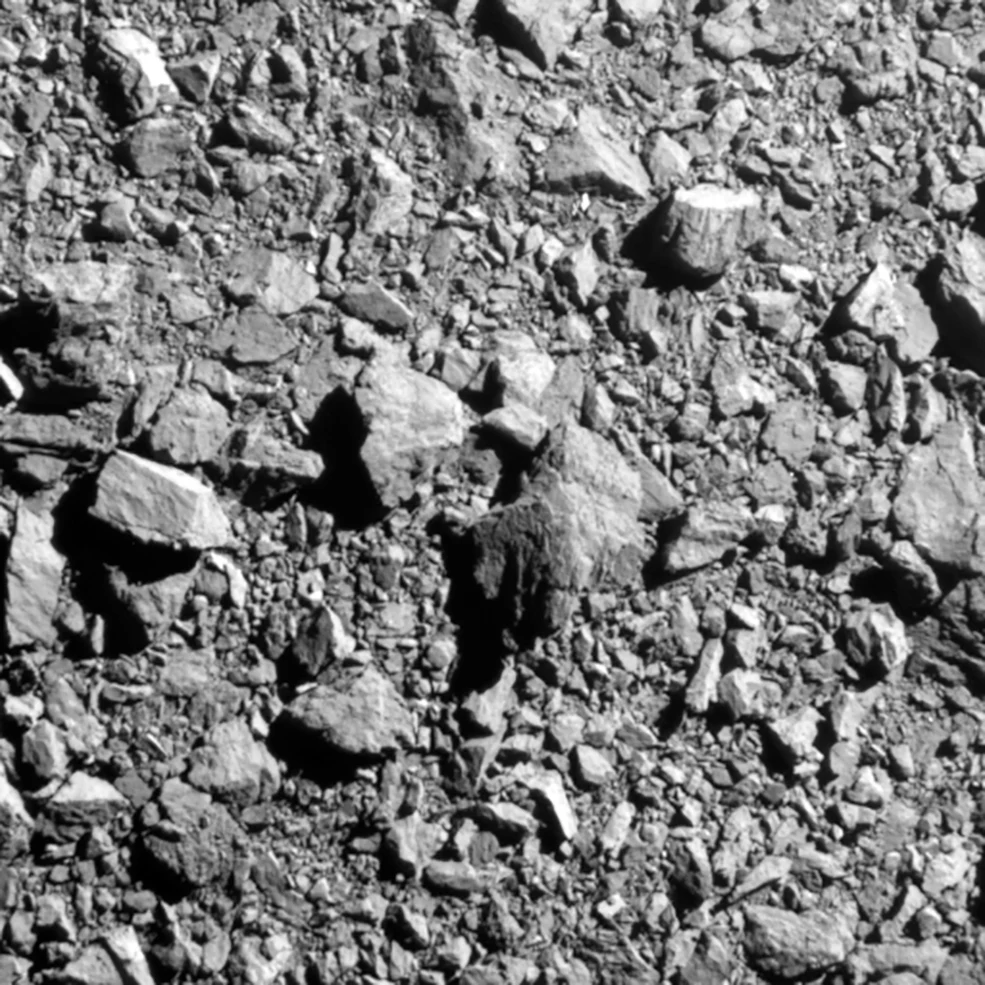
After NASA’s DART spacecraft struck Dimorphos on September 26, 2022, the small asteroid completed each circuit of its companion about 33 minutes sooner. Astronomers measured the change from Earth. They compared the timing of repeated dips in the light from the pair and checked the result against radar and spacecraft data.
Dimorphos still orbits Didymos. The shorter period was the evidence that the impact had shifted its path. A separate measurement years later found a much smaller change in the time the entire pair takes to go around the Sun.
Why test the technique on a moonlet?#
Didymos and Dimorphos form a binary asteroid system. Before the test, Dimorphos took about 11 hours and 55 minutes to make one circuit around the larger body. An observer could watch many circuits in the weeks after an impact and compare them with years of earlier observations. The moonlet’s orbit gave the experiment a repeatable clock.
Neither object posed an impact threat to Earth. The mission tested a change in an orbit that could be measured accurately without waiting for the object to come close to our planet. DART’s camera also recorded the approaching surface, including the blocky terrain in its final complete frame.
How could a dip in brightness reveal a shorter orbit?#
Ordinary telescope images from Earth generally did not separate both asteroids into distinct points. Their total brightness still changed when one body partly hid the other or passed through the other’s shadow. The dips recur like marks on a clock. After the impact, the dips gradually run ahead of the old timetable, revealing a shorter period.
An early peer-reviewed measurement put the change at 33 minutes, with an uncertainty of about one minute at the reported confidence level. A subsequent analysis found the period settled about 33 minutes and 15 seconds shorter over the following weeks. These figures come from different stages of the same analysis history. The later study distinguished the initial change from the period after the system had more time to evolve.
How did escaping rock add to the spacecraft’s push?#
DART carried momentum into the impact. The collision also threw rock and dust away from the surface. When material leaves with a net momentum in one direction, the asteroid that remains recoils in the other. The plume can therefore add to the change in motion delivered by the spacecraft.
One analysis inferred that Dimorphos slowed by about 2.7 millimeters per second along its orbit around Didymos at impact. That tiny number describes one direction of motion, as estimated from the new orbit. The strength of the recoil is harder to pin down because it also depends on the mass of Dimorphos and on how much debris left in each direction. Hubble’s early images show the expanding ejecta that made those details matter.
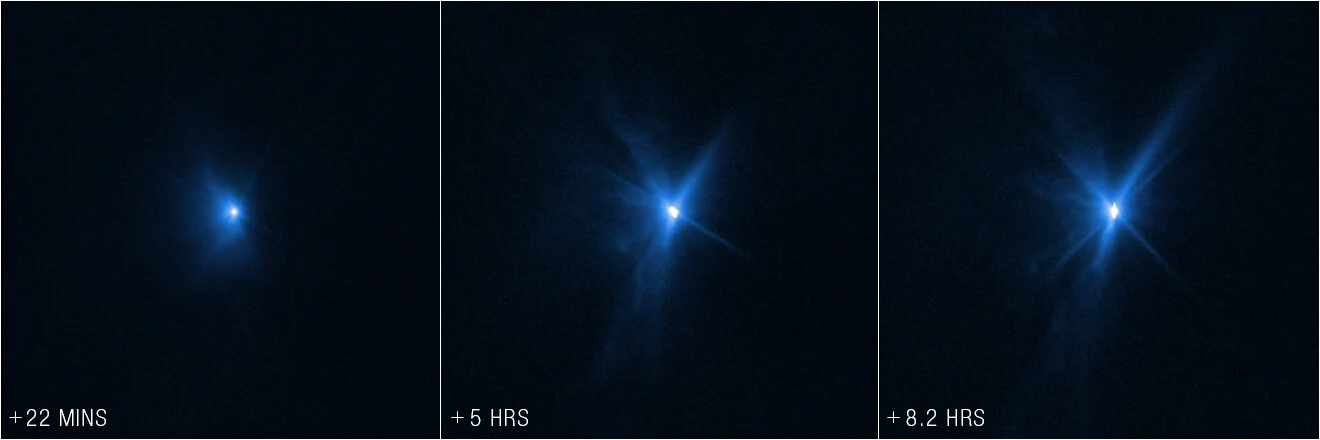
Image unavailable.
Three Hubble frames show blue rays and plumes of dust spreading from the bright asteroid system.
What changed about the pair’s journey around the Sun?#
The two asteroids also travel together around the Sun in about 770 days. NASA reported in 2026 that the period of that shared orbit shortened by roughly 0.15 seconds after the collision. The evidence came from precise timings of the pair passing in front of distant stars. When those brief events occurred helped locate the system along its nearly two-year orbit.
The 33-minute result measures one asteroid circling its companion. The 0.15-second result measures both asteroids together circling the Sun. Material escaping the pair can affect its shared motion as well as the orbit inside the pair.
Why does early discovery matter in a real deflection?#
A small change in velocity can build up into a much larger shift in position over time. An asteroid that reaches a crossing point a little earlier or later can miss Earth because Earth itself has moved in the meantime. More warning gives a small shift longer to accumulate.
DART demonstrated that a moving spacecraft can measurably alter an asteroid’s orbit. To predict the effect on another asteroid, scientists would still need to know the target’s path, mass and response to an impact. The timing measurements at Dimorphos turned a visible collision into a test of that prediction.
Keep exploring
Sources & further reading
Follow the original research, records, and explanations behind this story.
- Didymos & Dimorphos NASA Science
The binary system, pre-impact timing, safety of the target and the mission’s purpose.
- Surface Image of Dimorphos NASA Science; DART DRACO / APL
Last complete DART image, its scale, date and time before impact.
- Orbital period change of Dimorphos due to the DART kinetic impact Thomas et al., Nature; author manuscript
Initial fitted period change from photometry and radar.
- NASA Study: Asteroid’s Orbit, Shape Changed After DART Impact NASA
Timings of mutual events and the change to a settled period.
- Momentum transfer from the DART mission kinetic impact on asteroid Dimorphos Cheng et al., Nature; author manuscript
Along-track velocity change, ejecta recoil and mass dependence.
- Hubble Captures DART Debris (27 September 2022) ESA/Hubble
Photographs of the growing ejecta plumes.
- NASA’s DART mission changed orbit of asteroid Didymos around sun University of Illinois Urbana-Champaign, report from a participating institution
Direction and rounded magnitude of the independently measured solar orbit change.
- NASA’s DART Mission Changed Orbit of Asteroid Didymos Around Sun NASA
Describes stellar occultations, radar and volunteer timing observations.
- Planetary Defense Missions: Rapid Mission Architecture Study NASA; Planetary Science Decadal Survey study
Why warning time and later tracking matter for deflection feasibility.
Follow the thread