
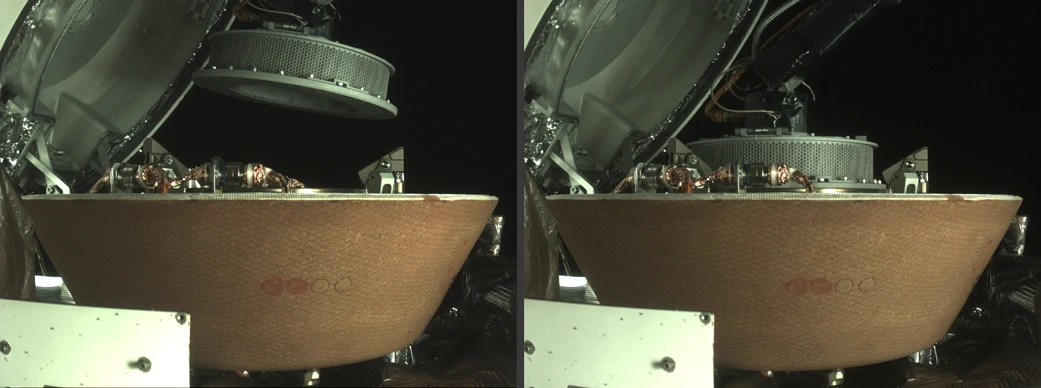
Two days after NASA's OSIRIS-REx spacecraft touched asteroid Bennu, its camera showed grains floating away from the collector. The head looked full, and the team suspected some larger pieces were holding its flexible flap partly open. NASA canceled a planned spin to estimate the sample mass and moved the entire collector into the return capsule ahead of schedule.
The decision left one question open. Engineers could see enough material to be confident their collection had worked, but they could only measure what made it home once the capsule was opened on Earth. The final tally was 121.6 grams, just over twice the mission's minimum.
How did OSIRIS-REx pick up rocks without landing?#
On October 20, 2020, OSIRIS-REx descended toward a site called Nightingale. The spacecraft held a round collector at the end of a robotic arm. The head was the only part of the spacecraft designed to touch the surface, which it did for about six seconds before the spacecraft backed away.
A burst of nitrogen gas stirred rocks and loose dust into the open head. A flexible Mylar flap helped retain material that entered the sampler. The design gave the spacecraft a way to collect loose surface material, or regolith, in a brief touch. It could then fire its thrusters and leave the surface with the sampler still on the arm.
How could the team tell that the sample was leaking?#
On October 22, the spacecraft's SamCam photographed the head from several orientations. The new images showed particles outside the collector and material packed against the inside. Comparing them with photographs of the head before sampling helped the team identify what had changed. That evidence located the problem at the collector, which had yet to be placed in the return capsule.
The team's explanation was that some of the larger pieces had caught in the flexible flap, leaving small gaps through which grains could slip. The images supported that diagnosis, although they did not show every grain's path. Even a few particles seen outside the head can tell you something important about a closure, while offering very little information about the mass still inside.
Sources: [2]
Why did NASA cancel the measurement spin?#
The planned mass measurement required rotating the spacecraft with the arm extended. Added mass out on the arm would make the craft harder to spin up by a measurable amount. The principle is the same as holding a weight at arm's length and feeling how it changes the effort of turning. This method would have estimated the sample without opening the head.
With the flap apparently jammed, rotating the spacecraft or repositioning the arm would accelerate a container with a gap in it. Engineers already had imaging evidence of a substantial sample. The information from a more precise estimate was less valuable than keeping that material inside, so the team canceled the spin and a planned braking burn.
How did the return capsule stop further losses?#
The robotic arm guided the whole collector head into the open return capsule and seated it on a capture ring. The team verified the latch by pulling gently on the head with the arm, then disconnected the head and closed the capsule. NASA reported sending the command to close it on October 28, several days ahead of the original early-November plan.
Because changes in the head's position might shake loose material, operators checked their progress with images after successive steps. They could leave the rocks where they were and put a second enclosure around them. Once that enclosure closed, particles already loose inside it would still travel back with the sample.
What did the 121.6 grams include?#
The capsule returned to Earth on September 24, 2023. Curation staff collected some dust and small rocks from inside the canister and from the head before it had been fully disassembled. Two fasteners kept staff from removing the top plate with the tools on hand. The team made and tested new tools suited to the protected curation environment. The final pour after the head was opened added 51.2 grams to material already collected.
NASA's final figure of 121.6 grams is the total mass recovered on Earth. The mission required 60 grams. Dividing the measured return by that target gives about 2.03. Subtracting the target from the return says how much the mission exceeded its requirement. The navigation team used images to estimate that the loss was on the order of tens of grams. With the weighing spin canceled, the team had no direct measurement of the original load to compare with the return.
Keep exploring
Sources & further reading
Follow the original research, records, and explanations behind this story.
- OSIRIS-REx Tags Surface of Asteroid Bennu NASA
Nightingale sampling, brief contact and gas burst.
- NASA’s OSIRIS-REx Spacecraft Collects Significant Amount of Asteroid NASA
Escaping particles, suspected flap obstruction, canceled spin and braking burn.
- OSIRIS-REx, Returning the Asteroid Sample NASA Technical Reports Server
Planned estimate using spacecraft rotation and the change in inertia.
- NASA’s OSIRIS-REx Successfully Stows Sample of Asteroid Bennu NASA
Sequence and timing of early stowage.
- NASA Announces OSIRIS-REx Bulk Sample Mass NASA Science
60-gram requirement, curation delays, final pour and 121.6 grams returned.
- OSIRIS-REx In the Midst of Sample Stowage NASA
Collector above the capsule and then seated on the capture ring.
Follow the thread