
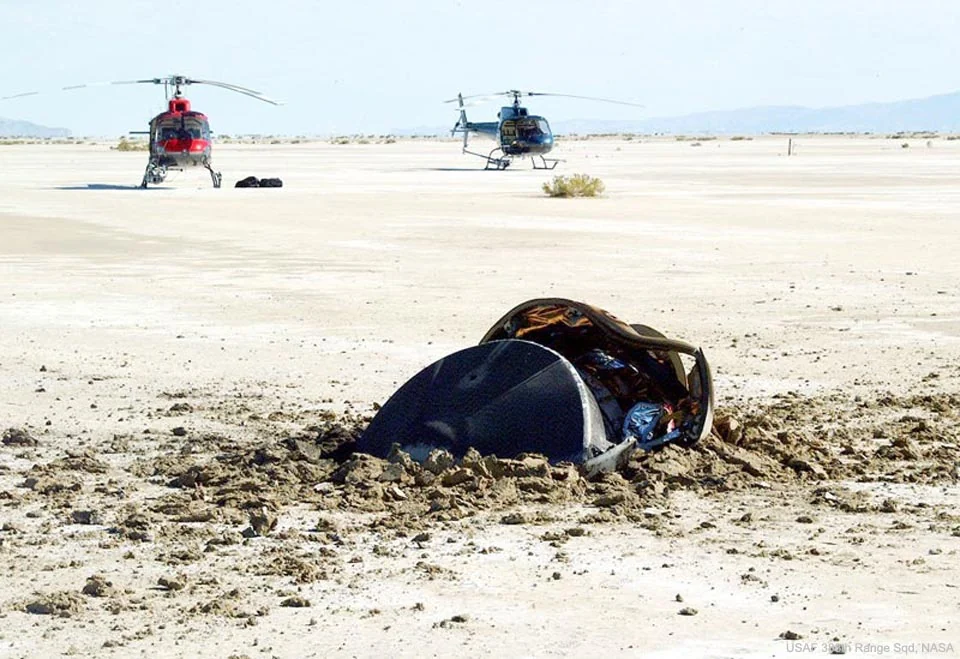
NASA's Genesis capsule crashed because the sensors that should have started its parachute sequence faced the wrong way. On September 8, 2004, it struck the Utah desert at about 193 mph, or 311 km/h. Yet the crash did not destroy every solar-wind atom it had collected. Many remained embedded beneath the surfaces of surviving collector fragments.
Recovering that material required more than finding the wreckage. Scientists had to identify the fragments, remove or measure contamination, and separate the composition of the solar wind from the composition of the Sun itself. The resulting oxygen and nitrogen measurements helped establish how the material that formed rocky planets differed from the solar system's starting mixture.
What happened when Genesis returned to Earth?#
The capsule reached its intended return region, but its parachutes never deployed. Helicopter crews were already airborne over the Utah Test and Training Range, ready for a carefully rehearsed catch. Instead, the capsule hit the ground near Granite Peak, leaving its scientific cargo exposed to desert material.
The speed reported by the mission team was an estimate of the impact speed, not the much greater speed at which the capsule had entered the atmosphere. Its heat shield and aerodynamic braking had already removed much of its energy. What failed was the descent sequence needed to slow and stabilize the final approach.
The object in the dirt was the sample-return capsule, not the entire spacecraft. Genesis had released this smaller vehicle before entry. The carrier spacecraft remained in space. Inside the capsule, an aluminum science canister had protected the collectors during the journey home; after impact, that protective enclosure was breached too.
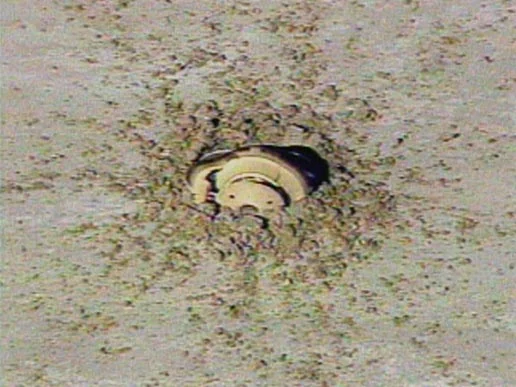
Image unavailable.
An overhead archive view shows the round Genesis capsule partly embedded in Utah soil.
How can a spacecraft collect a sample of the Sun?#
It can intercept material the Sun is already sending outward. The solar wind is a stream of electrically charged particles escaping from the Sun's outer atmosphere, the corona. It contains protons, electrons and ions of other elements. An ion is an atom that carries an electrical charge because it has gained or lost electrons.
Genesis exposed specially prepared surfaces to that stream. The arriving ions carried enough energy to enter the collector material, where some remained trapped. This gave the spacecraft physical samples to return to Earth without approaching the Sun's visible surface.
The same outflow interacts with Earth's magnetic environment. During disturbed conditions, that interaction can help drive the effects described in how the Sun can disrupt a railway telegraph. Genesis used the particles as chemical evidence: what elements and isotopes were present, and in what proportions?
Why use the Sun to investigate how planets formed?#
The Sun contains about 99.8 percent of the solar system's present mass. It formed roughly 4.6 billion years ago from the same collapsing cloud of gas and dust that supplied the planets. A measurement of solar material therefore provides a valuable reference against which to compare the much smaller bodies assembled around it.
The relevant reference is the composition of the Sun's outer layers. Nuclear fusion changes material in the core, but the outer layers preserve useful information about the original mixture for many elements and isotopes. Researchers must still examine the assumptions behind that comparison; it is not a claim that every part of the Sun has remained unchanged.
A reference matters because a difference needs something to be different from. If a meteorite has an unusual isotope ratio, is the meteorite unusual, or is the terrestrial material used for comparison unusual? Genesis supplied a solar measurement that could help resolve that ambiguity.
When did Genesis launch, and where did it go?#
Genesis launched on August 8, 2001. It reached the vicinity of the first Sun–Earth Lagrange point, L1, in November and opened its collectors in late 2001. Collection continued until April 2004, when the arrays were stowed for the return journey.
This was a long exposure to a very dilute stream. The mission accumulated atoms over more than two years rather than scooping up a visible lump of solar material in a single encounter. Different arrays had different exposure histories, which later became part of the information needed to interpret their samples.
The route home also served the recovery plan. Genesis swung beyond Earth toward the L2 region before returning for a daylight arrival over Utah. That geometry gave the helicopter crews a chance to see and intercept the descending parafoil. The sample-return capsule separated on September 8, 2004; the carrier then diverted away from its atmospheric entry path.
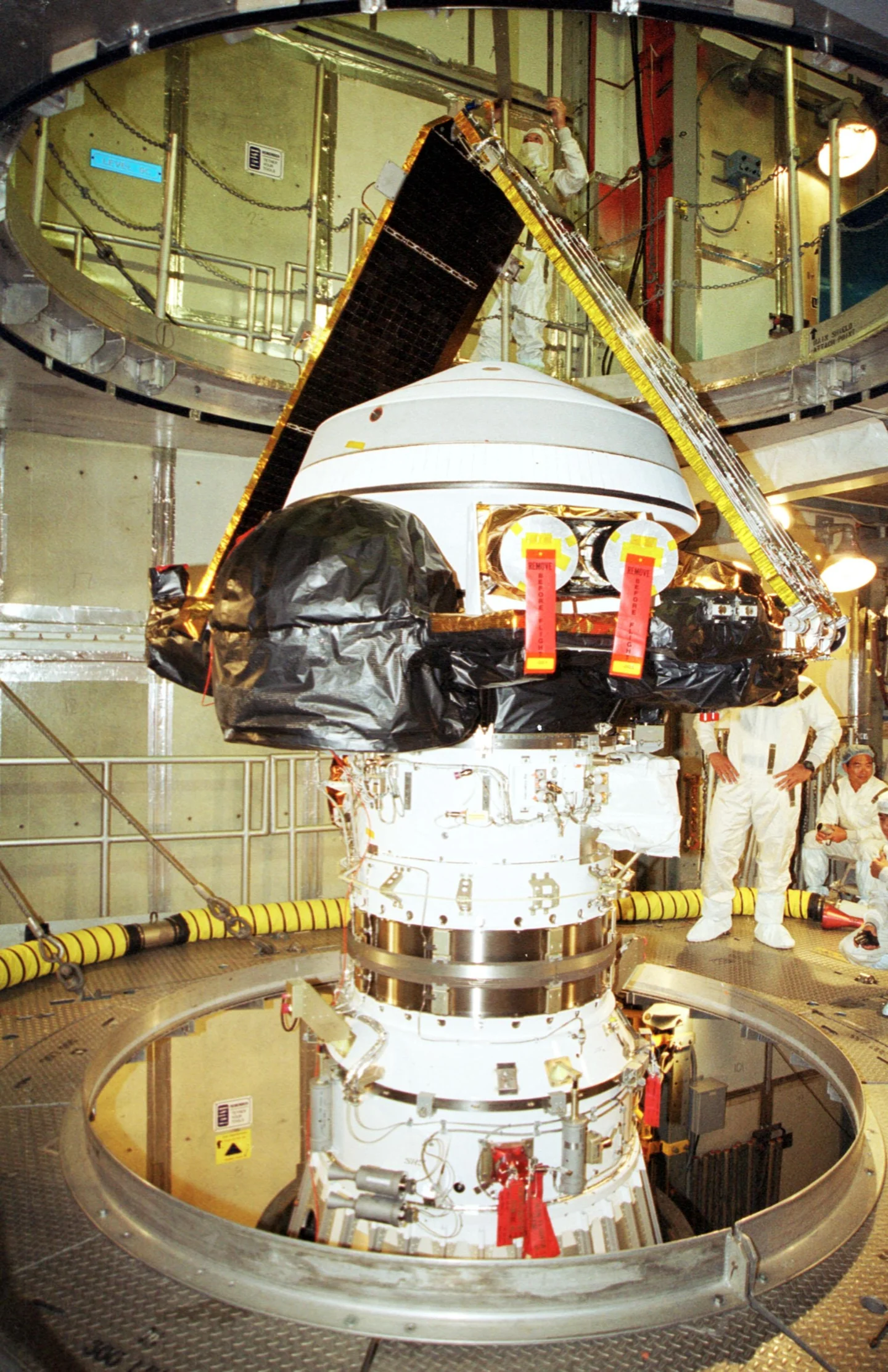
Image unavailable.
The Genesis spacecraft sits above a Delta II rocket inside its launch-service tower, beside technicians.
Why collect solar wind near L1?#
L1 lies roughly 1.5 million kilometers from Earth in the direction of the Sun. A spacecraft there can sample the incoming solar wind upstream of Earth's main magnetic obstacle. Collecting closer to Earth would make it harder to avoid particles altered by their interaction with Earth's magnetic environment.
A Lagrange point is a location where the combined gravitational influence of two large bodies allows a small object to move with them. Describing L1 as a place with no gravity is misleading. Both the Sun and Earth still exert gravity, and the entire arrangement travels around the Sun.
Genesis followed a halo orbit around the L1 region rather than remaining motionless at a single coordinate. L1 is also unstable: spacecraft operating nearby need trajectory corrections. For Genesis, its value was the observing and collecting environment, with a relatively consistent view toward the source of the particles.
Why were the collectors made from silicon, sapphire and other materials?#
Each material offered a different combination of purity, particle retention and ease of analysis. About half the collector area used silicon. Other materials could retain elements that silicon did not retain well, or make particular laboratory measurements easier. The instrument was therefore a set of different sampling surfaces, even where its repeated hexagonal tiles looked similar.
Purity was part of the measurement. If a collector already contained much of the element being sought, researchers would have to distinguish that background from the small amount delivered by the solar wind. A very pure starting material made the added solar contribution easier to identify.
The surfaces also had to survive launch vibrations and heating during collection. Keeping an atom after it arrived was as important as intercepting it. The materials team selected and tested substrates for these combined engineering and scientific requirements. A hard, attractive or expensive material was not automatically a useful collector.
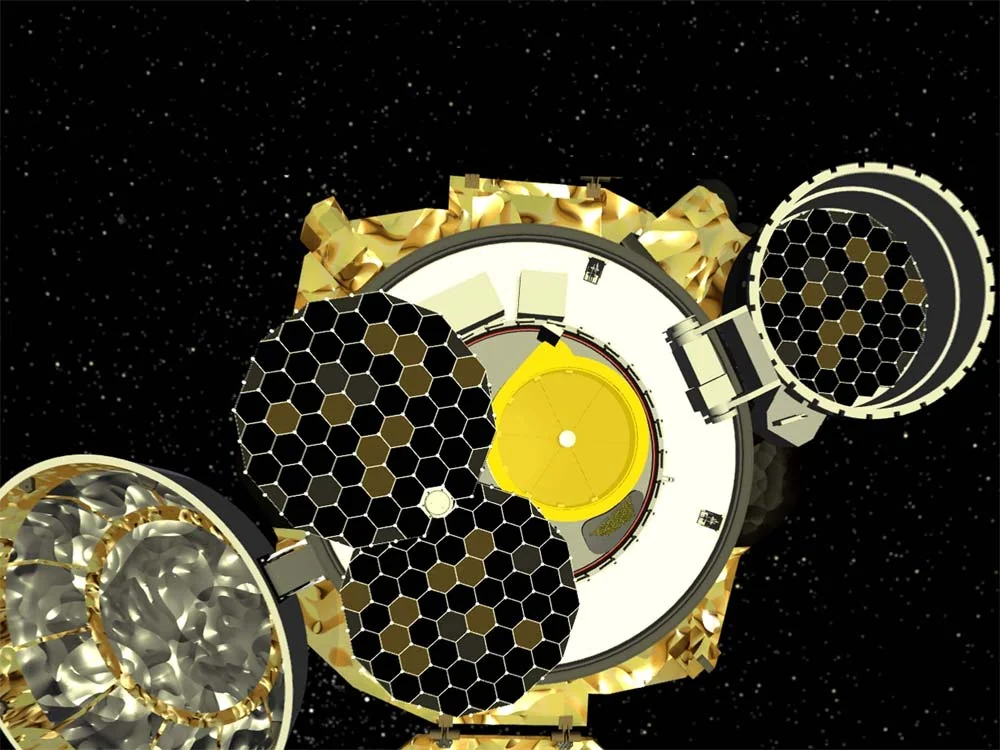
Image unavailable.
JPL archive view of the Genesis collector assembly with circular arrays of hexagonal wafers unfolded around a central housing.
Where were the solar particles stored inside a collector?#
They were implanted in a very shallow layer beneath its polished surface. NASA's sample catalog describes typical depths of about 40 to 100 nanometers. A nanometer is one-billionth of a meter, so that interval is only 0.04 to 0.1 micrometer deep. The exact distribution depends on the particles and collector material.
The exposed wafer acted as both the collecting surface and the storage medium. There was no bag of loose solar dust to pour out after landing. Scientists would later measure atoms within the manufactured solid.
That arrangement explains why some science survived the impact. A wafer could fracture along several lines while leaving small areas of its implanted surface intact. Breakage reduced the usable area and made handling much harder, but it did not automatically erase the sample from every piece. Conversely, a fragment that looked intact could still be unsuitable for a particular analysis because of its contamination or background composition.
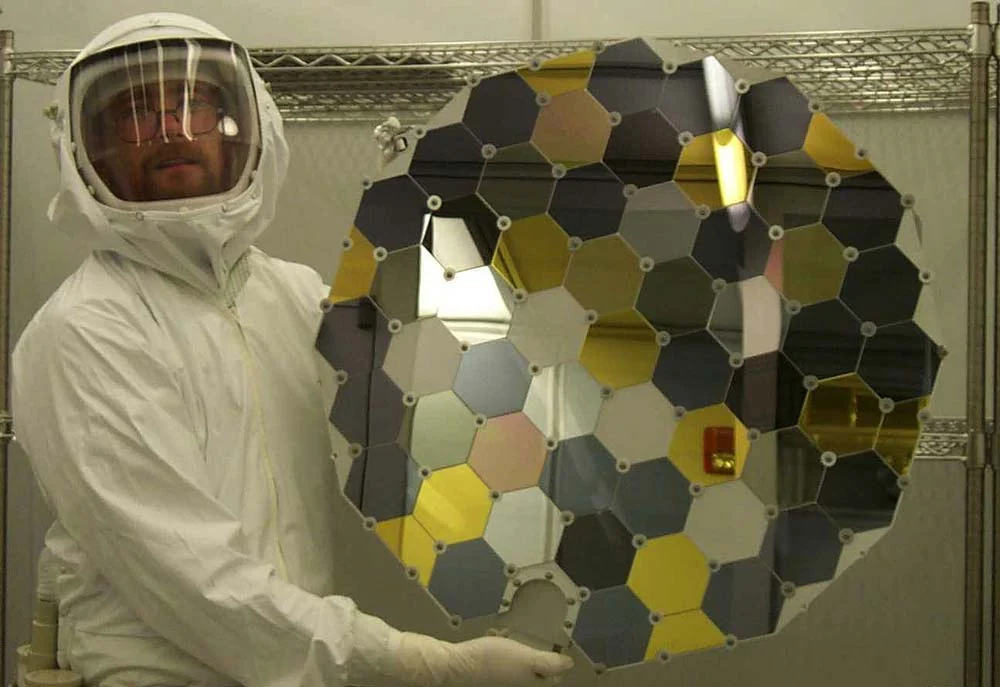
Image unavailable.
A technician in cleanroom clothing holds a circular array of reflective hexagonal Genesis collector wafers.
Why did Genesis keep different kinds of solar wind separate?#
The solar wind changes as different source regions on the Sun face the spacecraft and as eruptions pass by. Genesis distinguished fast wind, slower interstream wind and material associated with coronal mass ejections. It carried monitors to measure the particles and identify the conditions during collection.
Some collector surfaces remained exposed to build up a bulk sample. Other arrays could rotate into view when the appropriate type of wind arrived. Keeping these samples separate allowed researchers to compare material collected under different conditions instead of averaging every difference away.
This was essential to the larger scientific question. The processes that release and accelerate solar particles can alter their relative abundances, a process called fractionation. If different wind regimes contain different mixtures, scientists need to understand that sorting before using any one mixture as a measurement of the Sun. The spacecraft's measurements and the returned solids thus supplied complementary evidence.
What did the solar-wind concentrator do?#
The concentrator increased the number of selected solar ions reaching a small target. Its electrical fields filtered and focused particles, improving the amount of material available for demanding oxygen and nitrogen measurements. The average concentration was about twenty times that of ordinary passive collection.
Its name describes an optical-like operation on charged particles. An electrostatic system can bend their paths, much as a lens redirects light, although the physical mechanism is different. The instrument reduced the overwhelming contribution of hydrogen ions and directed selected heavier ions onto specially chosen target materials.
The targets were especially valuable after the crash: three of the four survived intact, while the diamond-on-silicon target broke. Even that broken target remained scientifically useful. A later curation project carefully subdivided a surviving piece for analysis, after testing the cutting method on nonflight material. Both the collection efficiency and the subsequent preparation history had to be understood when interpreting measurements.
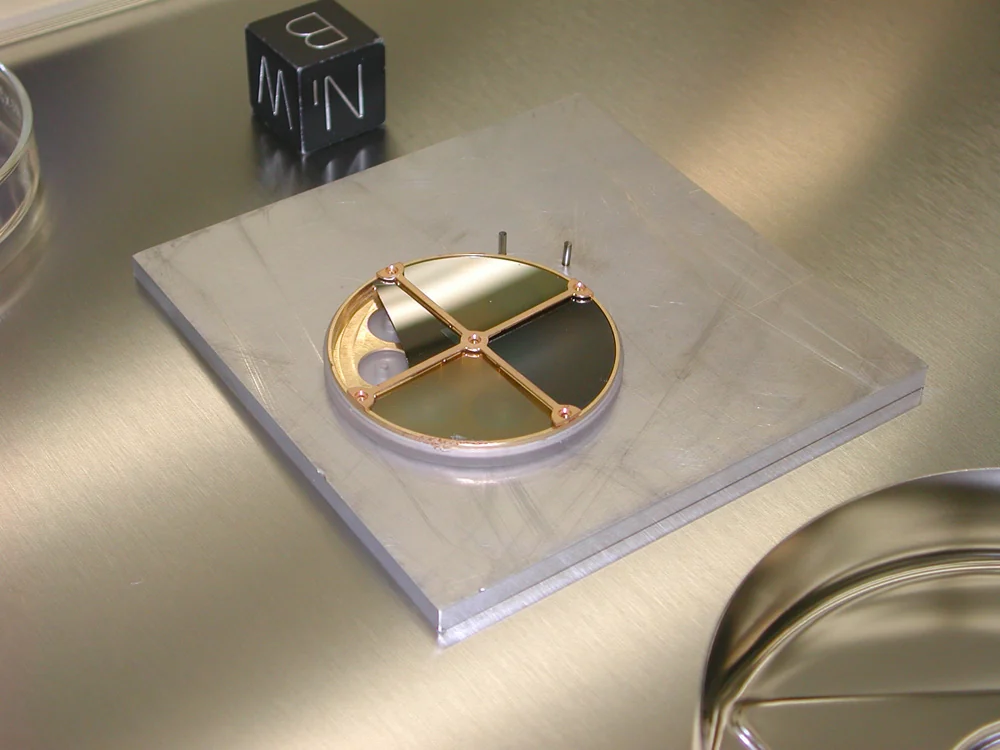
Image unavailable.
A circular concentrator target sits on a laboratory support beside a scale cube during disassembly.
Why bring the samples home instead of analyzing everything in space?#
Returning solid material lets researchers choose and improve the analytical method after the flight. Laboratory instruments can be larger, more complex and easier to recalibrate than equipment carried by a small spacecraft. Different laboratories can also approach related questions with different techniques.
Genesis still needed instruments in space to record the collecting environment. Those measurements helped determine which array to expose and how the concentrator should operate. The returned material provided another kind of record: atoms that could be examined directly long after the spacecraft stopped collecting.
There is a cost to this flexibility. Handling, dividing and measuring a fragment can change or consume it. Researchers need suitable standards and a documented history of what happened to each sample. A return mission therefore includes a long period of curation and laboratory work. The flight delivers the material; it does not complete every experiment that material makes possible.
Why was NASA going to catch the capsule with a helicopter?#
The collectors were fragile enough that even a normal landing under a parachute might fracture plates or dislodge them. The helicopter catch was intended to prevent that final ground impact and carry the capsule to a controlled landing.
The helicopter would intercept the inflated parafoil above the capsule. A long pole with a hook extended beneath the aircraft; the crew approached the canopy rather than trying to strike or grip the capsule itself. A second helicopter was available if the first attempt failed. Rehearsals tested the maneuver before the return.
This plan depended on the capsule arriving beneath a properly deployed parafoil. The crews were not equipped to catch an uncontrolled capsule plunging toward the ground. When the parachutes failed, the retrieval attempt could not proceed. The airborne crews instead became part of the contingency response, helping locate and assess the impact site.
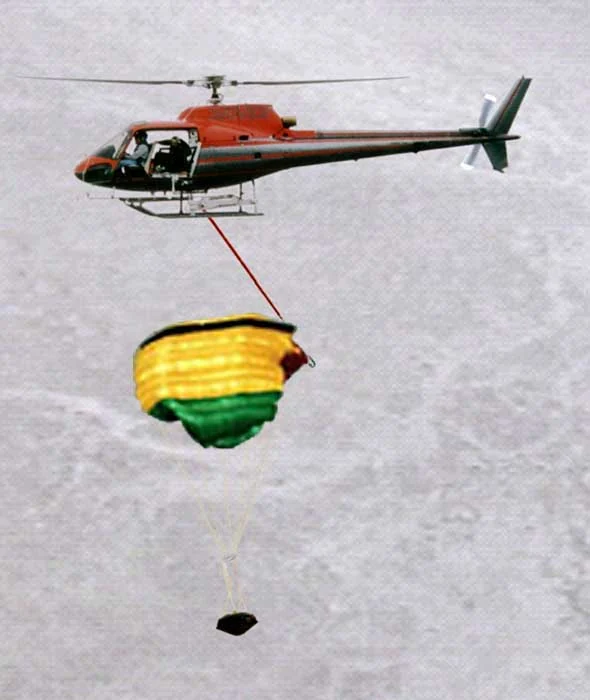
Image unavailable.
A helicopter carries a parafoil and suspended training capsule during a midair recovery rehearsal.
What was supposed to trigger the parachutes?#
The capsule used small mechanical acceleration switches, often called G-switches, to recognize the deceleration of atmospheric entry. Their signals controlled the start of an electronic timer, which then commanded the deployment sequence.
The planned logic distinguished rising and falling deceleration. Reaching about three times Earth's surface gravitational acceleration, or 3 g, armed the sequence; falling back through that level started the timer. This allowed the capsule to relate later events to the braking it had actually experienced.
A small drogue parachute was supposed to deploy first, stabilizing the capsule. Later, separation hardware would release the relevant aft section, and the departing drogue would extract the larger parafoil. These were connected operations. Without the initial deployment, the hardware never reached the configuration needed for the helicopter catch. The failure therefore began inside the capsule well before the pilots could contribute.
How could backward switches prevent deployment?#
Each switch contained a moving mass restrained by a spring. With the correct orientation, entry deceleration would move that mass against the spring and close an electrical contact, arming the sequence. As deceleration later fell, the contact would open again and the timer would start.
The flight switches were oriented the wrong way. Under the forces of entry, their masses could not compress the springs as required. The electrical event that initiated the parachute sequence never occurred.
NASA's investigation compared the recovered flight units, assembly drawings and photographs taken before flight. The hardware matched the drawings. The error was already in the design, so describing the accident simply as someone installing a correctly specified part backward misses a crucial finding. Inspection against an incorrect drawing can confirm that the hardware is built as instructed while leaving the actual flight behavior wrong.
Sources: [12]
Why did backups and testing fail to catch the mistake?#
The two avionics units shared the same mistaken sensor orientation. Either could repeat the intended function, but neither could supply the missing trigger in the flight configuration. Duplication protected against some individual failures; it did not correct a design error common to both units.
The investigation also found that a planned centrifuge test had been removed in favor of drawing inspections. A centrifuge could have applied acceleration in the relevant direction. The substitute unit test checked electrical continuity but did not establish the switches' orientation.
The board identified failures in requirements, verification and review, including unwarranted confidence in an inherited design. The practical distinction is between checking a component's connections and checking its response in the assembled system. Genesis needed the latter. Its sensors had to work in the capsule's coordinate system, under the forces the capsule would encounter, before the timer and parachutes could do their jobs.
Sources: [12]
How did the team begin recovering the wreckage?#
Recovery crews used contingency procedures prepared before the return. They documented the capsule and surrounding area, assessed hazards and confirmed the separation charge was safe before moving the hardware. The science canister reached the nearby cleanroom at Dugway early that evening.
The immediate task was to limit further damage and contamination. Specialists removed pieces of dirt and mud lodged in the canister, then began a careful inventory. Initial hope that useful samples remained was a working judgment to investigate, not yet a scientific result.
The sorting effort eventually dealt with more than 10,000 collector fragments. Many no longer occupied their original positions on the arrays. Teams recorded dimensions, likely material identity and the location where a piece had been found. That information could help reconstruct what the fragment had collected and what it had encountered after impact. The samples moved to Johnson Space Center in October 2004 for continued work.
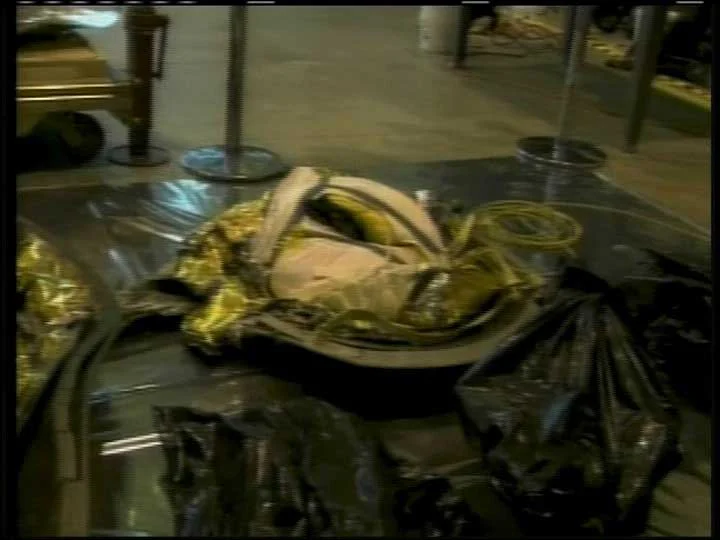
Image unavailable.
The damaged Genesis science canister rests on reflective protective material inside a cleanroom.
What kinds of contamination made the samples difficult to use?#
Desert dust was only one part of the problem. Researchers also encountered material from the capsule's carbon–carbon heat shield and debris from shattered collectors, including silicon and germanium. A fragment could carry a mixture of contaminants originating outside and inside the capsule.
The difficulty depends on the measurement. An instrument detecting a particular element cannot simply assume that every atom of that element came from the Sun. Dirt, the collector's own material and debris from neighboring parts can all contribute a signal. The small quantity of implanted solar material makes those competing contributions especially consequential.
Curators therefore characterized more than a fragment's appearance. They recorded its material, surface condition and probable solar-wind regime, and examined contamination at different scales. They also preserved reference materials and handling records. A photograph can show visible debris; it cannot, on its own, demonstrate that a sample is clean enough for a particular isotope measurement.
How do you clean a sample only nanometers below the surface?#
The aim is to remove unwanted material while preserving the implanted layer. A treatment that polishes away the top of the collector may remove the solar atoms along with the dirt. Different surfaces therefore require different approaches, and cleaning has to be judged by the analysis it enables.
Researchers first tried techniques on substitute materials deliberately contaminated with soil and collector debris. The tests revealed limits to apparently simple solutions: blowing inert gas over a surface left substantial particulate contamination, while brushing could scratch softer coatings. A technique suitable for one substrate might damage another.
One documented method used flowing ultrapure water energized with megasonic, high-frequency sound. Before-and-after photographs of a silicon fragment showed reduced visible contamination. Further measurements were still needed to assess the surface and the sample beneath it. The improvement was evidence that a treatment removed particles, not proof that every contaminant had vanished or every solar isotope remained unaffected.
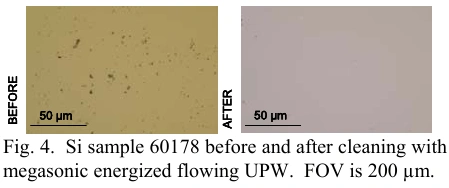
Image unavailable.
Microscope photographs of silicon sample 60178 before and after megasonic ultrapure-water cleaning, with original 50 micrometre scale bars.
How can a laboratory tell solar atoms from terrestrial material?#
It combines sample preparation, knowledge of the collector and calibrated measurements. In some analyses, scientists measure how the signal changes with depth. Surface contamination and the shallow implanted solar-wind layer can produce different profiles. Secondary ion mass spectrometry, or SIMS, removes material with an ion beam and analyzes ions released from the sample; carefully prepared standards help translate the instrument's response into quantities.
An isotope is a version of an element with a different number of neutrons. Oxygen-16, oxygen-17 and oxygen-18 all have eight protons, but their masses differ. Their relative abundances can distinguish materials that all contain oxygen. Nitrogen offers a separate comparison through nitrogen-14 and nitrogen-15.
The last step is an inference. The mixture in the solar wind has been affected by escape and acceleration from the Sun. Collection and measurement can introduce additional differences. Researchers must account for those effects before reporting a solar composition. A precise wind measurement and an inferred solar value are related, but they are not interchangeable numbers.
What did Genesis reveal about oxygen?#
The 2011 oxygen study found that the Sun was relatively enriched in oxygen-16 compared with Earth, the Moon, Mars and bulk meteorites. Viewed from the solar reference, rocky material in the inner solar system had higher proportions of oxygen-17 and oxygen-18 relative to oxygen-16.
The researchers estimated an enrichment of roughly seven percent in those heavier-isotope ratios. This does not mean that Earth contains seven percentage points less oxygen-16, or seven percent less oxygen overall. It describes the small rarer-isotope populations relative to the dominant oxygen isotope.
The result helped define an early solar-system reference that comparisons among planetary samples alone had struggled to establish. It also left a question: what processes changed the isotope mixture in the material that became rocky bodies? The authors proposed chemistry before the first planetesimals accumulated as a likely explanation. The measurement constrains that history; it does not reconstruct every chemical step by itself.
What did the nitrogen measurements add?#
Nitrogen supplied an independent example of a substantial isotopic difference. The 2011 study measured a nitrogen-15 to nitrogen-14 ratio of 0.00218 in implanted solar wind, with a reported uncertainty of 0.00002. Relative to Earth's atmosphere, that wind was about forty percent poorer in nitrogen-15.
The inferred ratio for the early solar system was slightly different: 0.00227, with an uncertainty of 0.00003. Keeping those values separate matters. One describes the sampled wind; the other includes the interpretation needed to estimate the earlier solar reservoir.
The comparison concerns isotope proportions, not the total amount of nitrogen on Earth or in the Sun. Together with oxygen, it showed that a common origin in the solar nebula did not require every resulting body to have an identical isotope mixture. Explaining how the differences arose remains a scientific problem within that shared origin, rather than evidence that Earth formed independently of the Sun.
Was Genesis a failed mission or a scientific success?#
The planned recovery failed, and the damage imposed years of extra work. Important scientific measurements nevertheless succeeded. Both statements are needed to describe the outcome accurately. The published oxygen and nitrogen results demonstrate that useful evidence survived; they do not mean the crash was harmless or that every planned measurement became easy.
The fragments retained value because the project preserved more than physical material. Curation records include how collectors were manufactured, handled, cleaned and allocated, alongside reference samples that can help characterize backgrounds. Improved instruments can revisit remaining material, provided future researchers can understand its history.
Other missions make different choices about what should return and what must be protected. Cassini's planned ending at Saturn addressed a different problem: protecting potentially habitable moons. Genesis was built to bring material home. Even after that return went badly wrong, surviving collector surfaces allowed laboratory measurements to answer questions the flight alone could not.
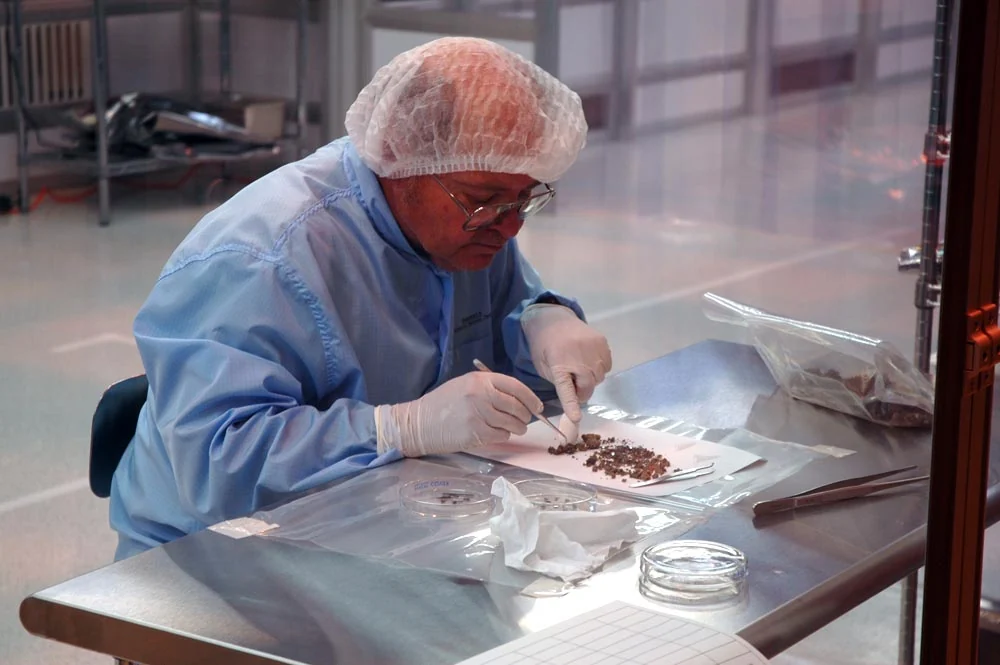
Image unavailable.
Genesis principal investigator Don Burnett examines recovered material with tools in a clean laboratory workspace.
Keep exploring
Sources & further reading
Follow the original research, records, and explanations behind this story.
- Genesis NASA Science
Launch and flight chronology, return capsule versus carrier, estimated impact speed.
- What Is the Solar Wind? NASA Science
Charged particles, solar source regions and interaction with Earth.
- Sun: Facts NASA Science
Common solar-nebula origin, age and the Sun’s approximately 99.8 percent share of system mass.
- What is a Lagrange Point? NASA / WMAP Science Team
Lagrange-point dynamics and L1 instability.
- Genesis Spacecraft Begins Mission to Collect Samples of the Sun NASA Jet Propulsion Laboratory
Late-2001 deployment, approximate Sunward distance, collectors, monitors and concentrator.
- The Genesis Solar-Wind Collector Materials Jurewicz et al. / CaltechAUTHORS
Collector selection, purity, retention, materials diversity and engineering constraints.
- A Little Glitz Goes a Long Way for NASA's Genesis NASA Jet Propulsion Laboratory
Near-surface implantation, material purity, silicon/sapphire retention and thin-layer analysis.
- Genesis Sample Catalog NASA Open Data Portal
Typical 40–100 nm implantation depth and separate solar-wind regimes.
- NASA Mission Returns with a Piece of the Sun NASA Jet Propulsion Laboratory
Fragile collectors, helicopter hook/parafoil capture, second helicopter and rehearsals.
- Genesis Sample Return Press Kit NASA / Jet Propulsion Laboratory
Capsule nesting, 3-g arming/timer logic, connected parachute sequence and electric-field concentrator.
- Genesis Mission Status Report — September 8, 2004 NASA Jet Propulsion Laboratory
Impact at estimated 193 mph/311 km/h, crews airborne and safety/contingency procedures.
- Genesis Mishap Investigation Board Report, Volume I NASA
Wrong G-switch orientation specified by drawings, failure to start the entry timer, duplicated defect and inadequate verification.
- Genesis Mission Status Report — September 8 evening NASA Jet Propulsion Laboratory
Science canister reached Dugway cleanroom that evening; dirt/mud removed before inventory.
- Genesis Mission Status Report — September 9, 2004 NASA Jet Propulsion Laboratory
Careful initial inventory and contemporary hope that samples could satisfy goals.
- Genesis: Sorting Out the Pieces McNamara et al. / NASA NTRS
More than 10,000 collector fragments, uncertain former array positions, classification and October 4 transfer.
- Genesis: Removing Contamination from Sample Collectors Lauer et al. / NASA NTRS
Dirt/heat-shield/collector contaminants, analog testing, limitations of gas cleaning and abrasion risk.
- Genesis Solar Wind Sample Curation: A Progress Report Allton et al. / NASA NTRS
Fragment characterization and megasonic flowing ultrapure-water cleaning.
- Accurate analysis of shallowly implanted solar wind ions by SIMS backside depth profiling Heber et al. / Arizona State University
Depth profiles, calibrated ion-implant standards and sample-preparation/sputtering artifacts.
- Atomic Weights and Isotopic Compositions for Oxygen NIST Physical Measurement Laboratory
Oxygen atomic number 8 and isotope mass numbers 16, 17 and 18.
- The Oxygen Isotopic Composition of the Sun Inferred from Captured Solar Wind McKeegan et al. / CaltechAUTHORS
2011 solar oxygen-16 enrichment and approximately 7 percent heavy-isotope-ratio enrichment of rocky materials.
- A 15N-poor isotopic composition for the solar system as shown by Genesis solar wind samples Marty et al. / Science, via PubMed
Measured solar-wind and inferred protosolar nitrogen isotope ratios and their stated uncertainties.
- The future of Genesis science Burnett, Jurewicz and Woolum / Meteoritics & Planetary Science
Solar reference assumptions, regimes, fractionation corrections, target survival and continued scientific possibilities.
- Genesis Solar Wind Sample Curation Documentation Allton et al. / NASA NTRS
Manufacturing, cleanliness, handling and reference-material records needed to interpret later analyses.
- Dividing the Concentrator Target From the Genesis Mission NASA Johnson Space Center / NTRS
Surviving concentrator targets and later controlled subdivision of broken diamond-on-silicon target.
- NASA Mission Suggests Sun and Planets Constructed Differently NASA Jet Propulsion Laboratory
Contemporary context for oxygen/nitrogen findings and target image; launch-year error explicitly excluded.
- Genesis capsule embedded in Utah desert with helicopters USAF 388th Range Sqd., Genesis Mission, NASA
Image identity and provenance. Establish the actual crash and distinguish it from the planned airborne recovery.
- Genesis atop Delta II during launch preparation NASA/KSC
Image identity and provenance. Show the physical spacecraft and size of the return capsule before launch.
See the story in motion
Watch our illustrated video, then explore another question below.
Watch on YouTubeFollow the thread