
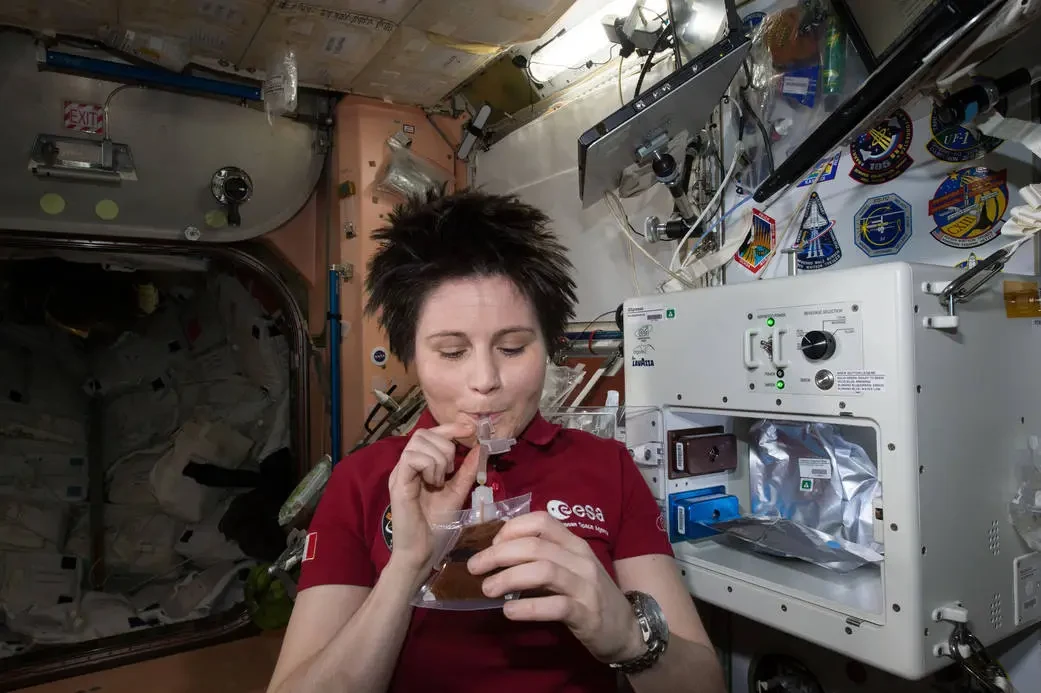
On 3 May 2015, Samantha Cristoforetti drank espresso aboard the International Space Station. Making it required a machine that could heat and pressurize water safely in orbit. Drinking it from an open cup required a different invention.
ISSpresso brewed the coffee and delivered it into a sealed pouch. The separate Space Cup used its shape to bring liquid to the drinker’s lips. Together they show how engineers replace the quiet work gravity does in an ordinary kitchen.
What was new about the first espresso in space?#
ISSpresso brought capsule-brewed espresso to a station where astronauts already drank instant coffee. The novelty was extracting coffee from grounds with hot, pressurized water in orbit, rather than adding hot water to soluble coffee in a pouch.
The machine was developed by the Italian aerospace engineering company Argotec and coffee company Lavazza, with the Italian Space Agency as the payload’s sponsor. NASA reviewed its safety and station interfaces. Cristoforetti, an ESA astronaut on the Italian Space Agency’s Futura mission, operated it for the first espresso on 3 May 2015.
The developers adapted commercial capsule brewing to the station’s requirements. Even the capsules needed attention: their packaging had to prevent loose grounds escaping if a capsule broke, and the system had to remain safe through cabin depressurization and repressurization. A familiar drink had become spacecraft hardware.
Why does a coffee maker need gravity’s help?#
Gravity normally separates liquids and gases for us: liquid settles in a reservoir, bubbles rise through it, and a stream falls into a cup. In the station’s near-weightless environment, that reliable sorting largely disappears. A bubble does not simply rise out of the way of an inlet, and a spill does not drain onto the floor.
This does not mean water becomes impossible to pump. The cup researchers make a useful distinction: flow involving one fluid phase behaves broadly similarly on Earth and in space; the especially difficult problems arise when phases such as liquid and gas share the system. Engineers must know where each is and keep it on the intended route.
Surface tension and wetting become particularly useful. Surface tension is the tendency of a liquid surface to resist being stretched. Wetting describes how a liquid contacts and spreads over a solid. Together with the shape of a container, they can organize liquid where gravity no longer provides the dominant direction. These effects exist on Earth too; orbit makes them useful over much larger containers.
Sources: [4]
How did ISSpresso turn a water bag into a drink?#
ISSpresso used a controlled path from an input water bag, through the heated brewing circuit and coffee capsule, to a separate output pouch. Its engineering paper describes a standard NASA water bag filled with 250 millilitres from the station’s potable water dispenser. A millilitre is one thousandth of a litre; the machine offered beverage selections of 30, 60 or 120 millilitres.
The pressurizer was an unusual part of the design. A stepper motor drove a double-acting linear mechanism that pressurized water and air. The engineers avoided the vibrating pump common in terrestrial machines because its vibrations could disturb other experiments’ microgravity conditions. Heating and pressurization prepared the water; a ready light enabled brewing once the required conditions were reached.
Hot water passed through the capsule and extracted coffee into the attached drink pouch. The pouch connections secured the bags with spring-loaded mechanisms. After extraction, a small quantity of pressurized air cleared residual coffee from the final branch of tubing. An astronaut could then drink through a standard station straw.
The pouch was part of the design’s containment and observation strategy. Lavazza’s release describes a transparent pouch that allowed the coffee and its crema, the bubbly foam associated with espresso, to be observed. It was the machine’s receiving container. The open Space Cup was a separate piece of experimental hardware.
Was the coffee really brewed at 400 bar?#
The often-repeated 400-bar figure describes the steel tubing’s ability to withstand pressure. It is not a measured brewing pressure. Lavazza’s 3 May 2015 release says the tube could withstand over 400 bar; the developers’ engineering paper does not give a numerical operating pressure for extraction.
A bar is a unit of pressure approximately equal to atmospheric pressure at sea level. A component’s pressure capability and a machine’s operating pressure answer different questions. The former concerns what the component can survive; the latter concerns the conditions the machine actually produces during use. Substituting one for the other turns a safety feature into a misleading coffee recipe.
The engineering paper describes pressure-relief valves, pressure switches and thermal controls, as well as leak and proof-pressure tests. Those protections addressed failures such as overpressure, overheating or escaping hot liquid. A photograph of a successful cup cannot establish those internal pressures or verify the tests.
How could an astronaut drink from an open cup?#
The Space Cup used a tapering interior corner to keep liquid connected to the lip. It belonged to the separate Capillary Beverage investigation, developed through work involving astronaut Don Pettit and fluid-physics researchers including Mark Weislogel and Andrew Wollman. Six 3D-printed cups were flight certified, with demonstrations aboard the station during May–August 2015.
Its broad, rounded reservoir narrows into a corner that becomes a cusp at the drinking lip. The combination of surface tension, wetting and this changing geometry produces a capillary pressure gradient: a pressure variation that draws liquid toward the lip. A pump is unnecessary in the cup itself.
At the lip, the liquid can reach an equilibrium and stop advancing. When the astronaut makes contact and drinks, more liquid moves along the corner to replace what was removed. Mouth shape and suction regulate the drinking rate. Tilting an ordinary mug and waiting for its contents to fall would not provide the same dependable supply in orbit.
The cup’s rim also helps stabilize the liquid during ordinary handling. The published photographs show Cristoforetti drinking espresso from the smaller demitasse version in the station’s cupola, with liquid gathered at the lip.
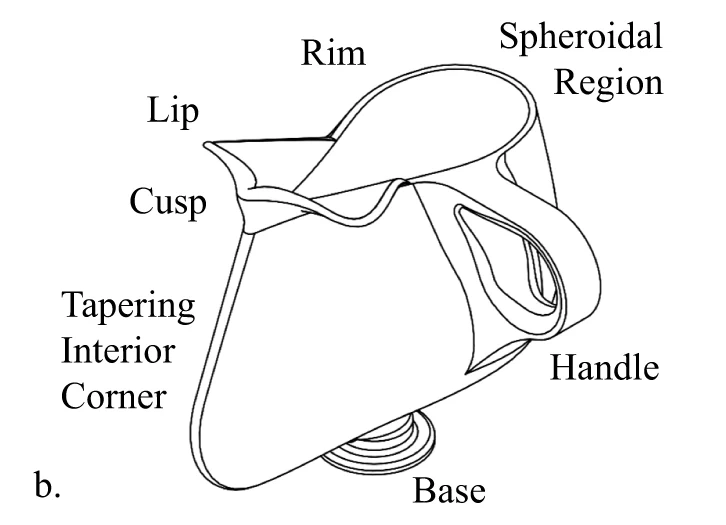
Image unavailable.
Published cup model labels the rim, lip, cusp, tapering interior corner, rounded reservoir, handle and base.
What did the demonstrations prove, and what were their limits?#
The demonstrations showed that people could use carefully shaped open cups to drink in orbit. The cup team reported successful drinking with water, coffee, cocoa, fruit punch, limeade and peach-mango smoothie. Different liquids, bubbles and suspended particles made this a more useful test than a demonstration with clean water alone.
The photographs document use and visible liquid placement. The broader engineering explanation rests on the cup geometry, fluid observations and the team’s analyses. The cup researchers describe the liquid as resistant to disturbances from normal handling. That is a bounded claim: it does not mean hot liquid is harmless, or that every sudden movement leaves every drop contained. Their paper also discusses small droplets produced when liquid connections break.
The immediate human benefit was a familiar activity, including being able to smell a beverage while drinking it. The machine developers presented menu variety and crew comfort as benefits. These are reasonable design goals, rather than proof that espresso alone measurably improved a mission’s psychological outcomes.
The fluid-engineering value extends beyond beverages. Containers that guide liquid predictably without moving parts can inform spacecraft systems for water, laboratory samples and liquid–gas separation. The useful lesson is how wetting and geometry can do some of gravity’s organizing work; a drinking demonstration does not by itself qualify a fuel tank or a life-support system.
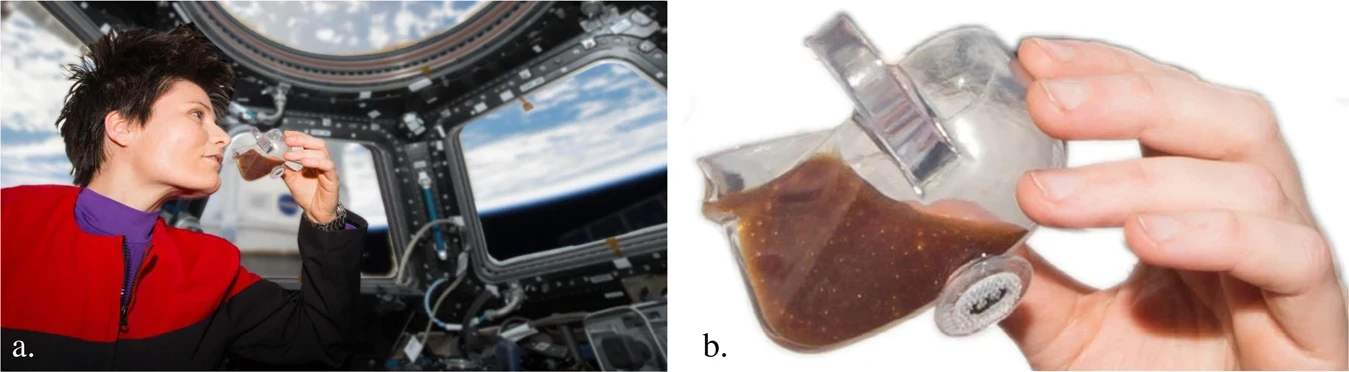
Image unavailable.
Two published photographs show Cristoforetti sipping from a clear Space Cup in the cupola and a close view of coffee touching its lip.
Where does the “million-dollar coffee” claim come from?#
It comes from combining a reported machine mass with a cargo-transport figure. Neither number is the price of an espresso. A June 2014 report described ISSpresso as about 20 kilograms, or 44 pounds. Lavazza’s release on the first-use date in May 2015 reported about 25 kilograms and attributed the substantial mass to duplicated critical components for safety.
Those are different reported figures from different stages of the project. The available reports do not establish exactly which configuration, included items or measurement convention accounts for the difference. They should remain attributed estimates rather than being silently converted into one precise flight mass. Kilograms describe mass; becoming nearly weightless in orbit does not remove the material that had to be launched.
In a 2018 discussion of the economics of future private space stations, NASA’s Office of Inspector General reported that NASA was then paying approximately $63,000 per kilogram for cargo transportation by SpaceX and Orbital ATK. Applying that later figure to an earlier machine would produce a hypothetical comparison across different dates and contexts. It would not identify the amount invoiced to deliver ISSpresso, or the marginal charge for adding it to a particular flight.
A price for one drink would require further choices about development, safety testing, transport, supplies, operation and the number of drinks made. The cited mass reports and cargo figure do not provide that accounting.
Keep exploring
Sources & further reading
Follow the original research, records, and explanations behind this story.
- ISSpresso Development and Operations Di Tana and Hall, Journal of Space Safety Engineering 2(1), 39–44 (2015)
Primary engineering paper: instant coffee, sponsor, brewing path, pressurizer, interlocks, containment and verification.
- Espresso Coffee Conquers Space Lavazza via PR Newswire
Contemporaneous manufacturer report of first espresso, transparent pouch, >400-bar tube capability and about 25 kg.
- ESA Astronaut Samantha Cristoforetti Enjoys Her First Drink NASA
Mission photograph ISS043E160082, dated 3 May 2015; shows pouch drinking beside ISSpresso.
- How advances in low-g plumbing enable space exploration Weislogel et al., npj Microgravity 8, 16 (2022)
First-team account of Capillary Beverage, cup design and demonstrations; Figures 1–3 and reuse terms.
- A Zero-Gravity Cup for Drinking Beverages in Microgravity Pettit, Weislogel, Concus and Finn; NASA Tech Briefs (2011)
Earlier technical description of corner flow, equilibrium and replacement flow during sipping.
- Orbital Brew: Astronauts to Get 1st Space Station Coffee Maker Robert Z. Pearlman, collectSPACE via Space.com
June 16, 2014 contemporary reporting and illustration caption documenting the earlier 20 kg figure; not a measured flight manifest.
- NASA’s Management and Utilization of the International Space Station (IG-18-021) NASA Office of Inspector General
July 30, 2018 report, printed pp. 26–27: then-current cargo-transport figure in a private-station economics comparison.
See the story in motion
Watch our illustrated video, then explore another question below.
Watch on YouTubeFollow the thread