
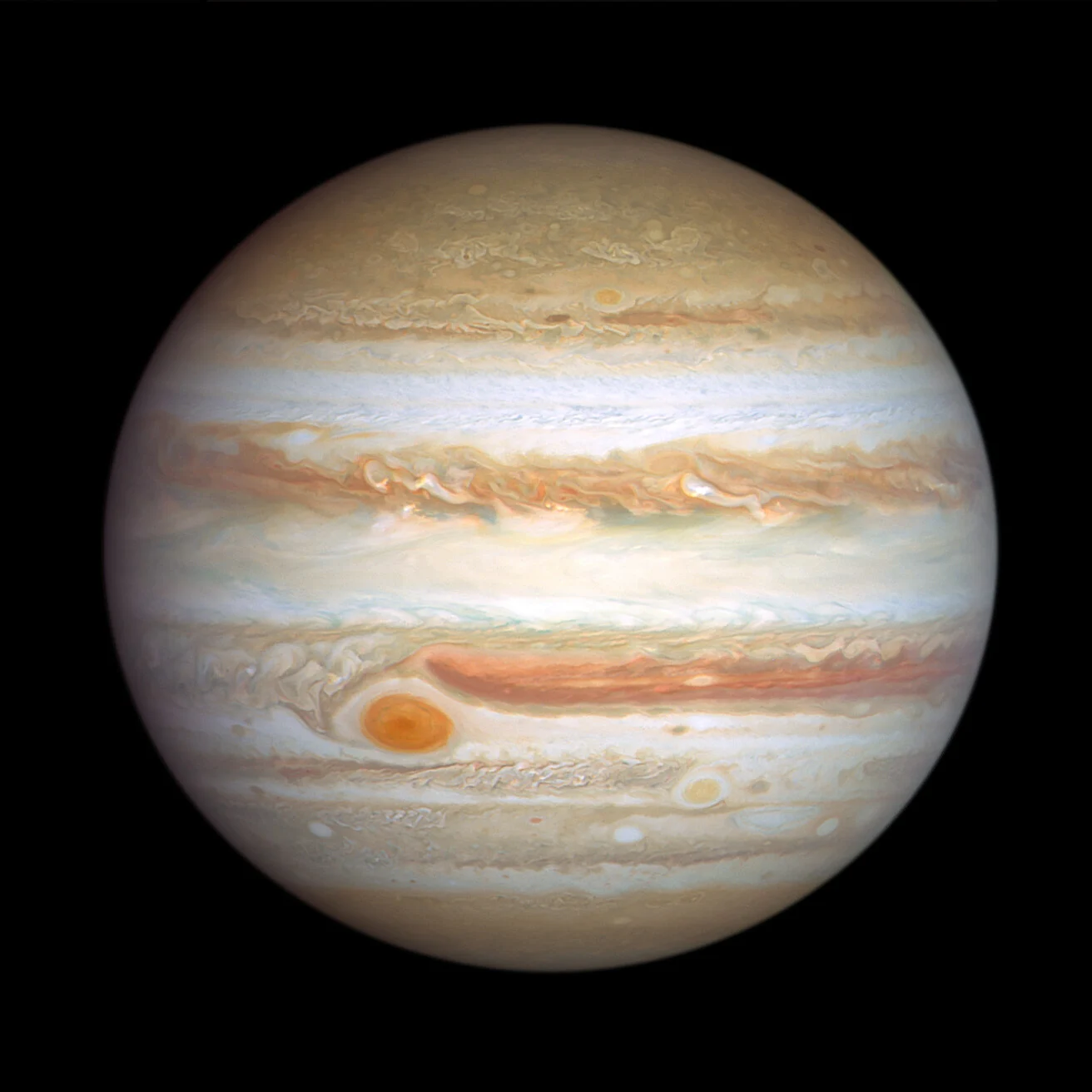
High above Jupiter’s Great Red Spot, sunlight may help make the material that gives the storm its color. A laboratory experiment produced a reddish residue by exposing ammonia and acetylene to ultraviolet light. When researchers used its measured properties in a cloud model, the result matched important features of the light Cassini saw reflected from the storm.
That is a test of a possible recipe. Jupiter offers more than one way to make a reddish material, and a telescope sees their effects on light rather than scooping up a sample. The height and distribution of the haze are part of the puzzle.
Why is the Great Red Spot a good place to look for a coloring layer?#
The spot is an anticyclone, a huge vortex whose circulation is associated with high pressure. Clouds swirl within the oval while winds carry other clouds past it. Measurements at different wavelengths give evidence that the storm has clouds and haze reaching higher than much of its surroundings. A substance spread thinly across the top can affect a large part of the light that comes back out toward a telescope.
In Hubble’s January 2024 view, a smaller storm lies to the lower right. This feature, often called Red Spot Jr., has changed between reddish and paler colors. The comparison raises a question about what each vortex does to the material above its clouds. The motion of an oval tells us where a storm is. Its color tells us how the clouds and haze interact with light.
What did ultraviolet light make in the lab?#
When an ammonia molecule absorbs ultraviolet light, it can split into fragments. In the Carlson team’s experiment, those fragments could react in a mixture containing acetylene, a small hydrocarbon. A reddish film formed in the apparatus. The team measured how much light passed through it at different wavelengths.
The relevant result is how that solid changes reflected sunlight. A material that takes more blue and ultraviolet light out of the beam returns proportionally more of the longer visible wavelengths. Spread it over pale clouds and the combined reflection can look redder. Researchers call the coloring material a chromophore.
Sources: [3]
How did Cassini help test where the color sits?#
During its 2000 flyby, Cassini measured the storm’s reflected light with its Visible and Infrared Mapping Spectrometer. A spectrum sorts that light by wavelength. A model can then ask how the spectrum changes if a candidate material absorbs and scatters light in one layer or another.
The ammonia and acetylene product worked in a model with a thin coloring layer near the top of the main clouds. With that arrangement, sunlight can pass through the overlying haze, scatter in the clouds below and pass through the haze again. The comparison tells scientists that one measured material in one plausible setting can account for much of the color. It leaves room for a different material with similar optical properties.
What would narrow down the list of ingredients?#
A separate team irradiated ammonium hydrosulfide, another compound relevant to Jupiter’s clouds. In their experiments the product and its color varied with temperature and the way it was processed. Some of those products absorb in the same broad region of the spectrum where the Great Red Spot darkens. A slope toward the blue and ultraviolet can therefore leave more than one candidate in play.
One way to separate the possibilities is to compare candidate materials over more wavelengths while also testing where the atmosphere must place them. Repeated Hubble observations add another constraint. They show that the storm’s shape, brightness and color vary over time. A successful explanation has to account for the changing haze as well as the color seen in one image.
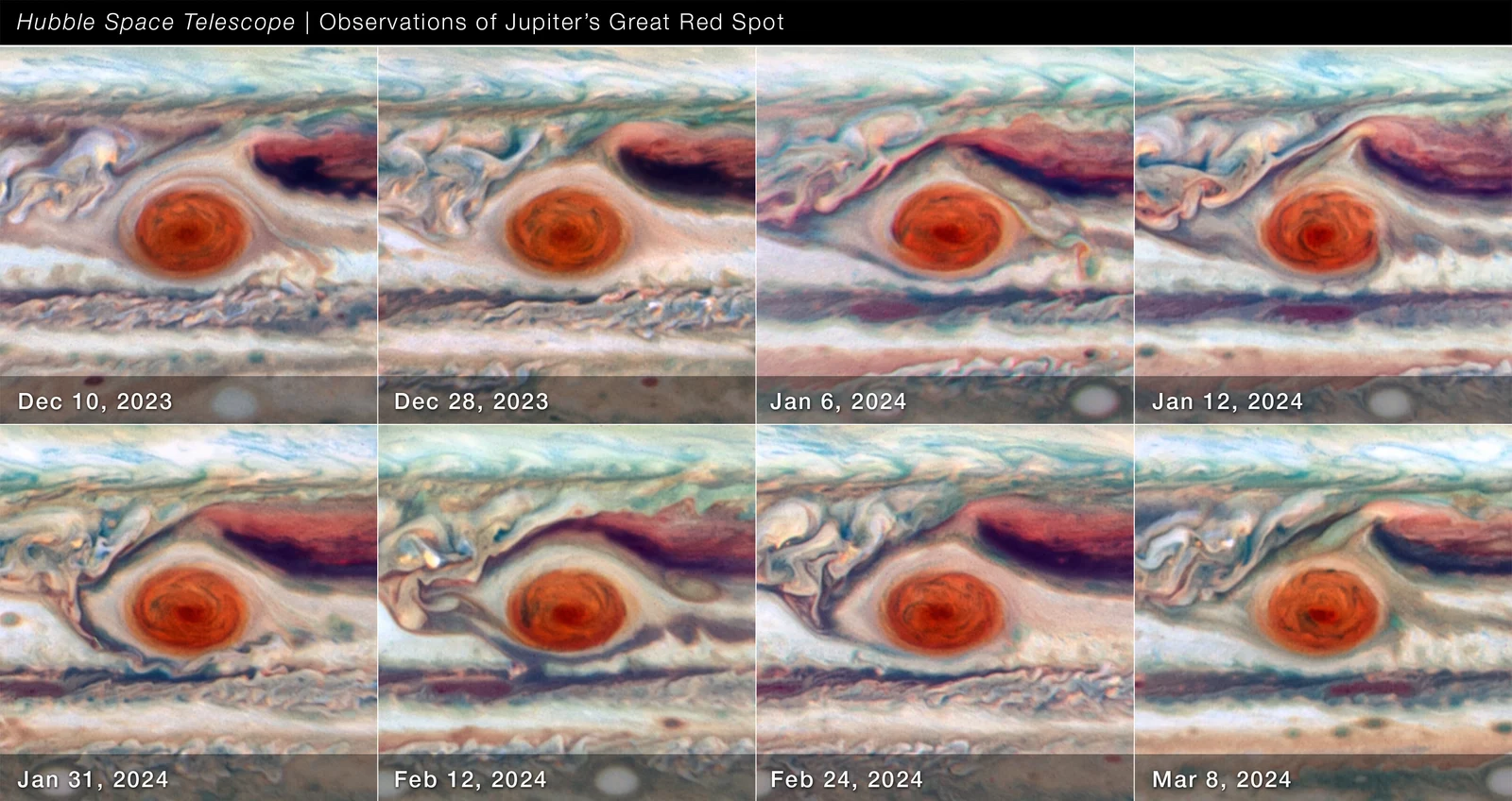
Image unavailable.
Eight Hubble close-ups of Jupiter’s red oval set against pale cloud bands.
Keep exploring
Sources & further reading
Follow the original research, records, and explanations behind this story.
- Jupiter (5 January 2024) ESA/Hubble
The broad planetary view and a smaller neighboring storm whose color changed.
- Is Jupiter’s Great Red Spot a Sunburn? NASA Science
Cassini’s flyby, elevated clouds and early fit of a laboratory haze to VIMS observations.
- Chromophores from photolyzed ammonia reacting with acetylene: Application to Jupiter’s Great Red Spot Carlson et al., Icarus; INAF open archive
Laboratory generation and spectral measurement of a candidate film, and a model using Cassini visible spectra.
- Coloring Jupiter’s clouds: Radiolysis of ammonium hydrosulfide Loeffler et al., Icarus; NASA GSFC archive
Color and absorption changes under different irradiation and temperature conditions.
- Close-up of Jupiter’s Great Red Spot (December 2023 to March 2024) ESA/Hubble
Eight archived Hubble views over an oscillation cycle and the quantities measured.
Follow the thread