
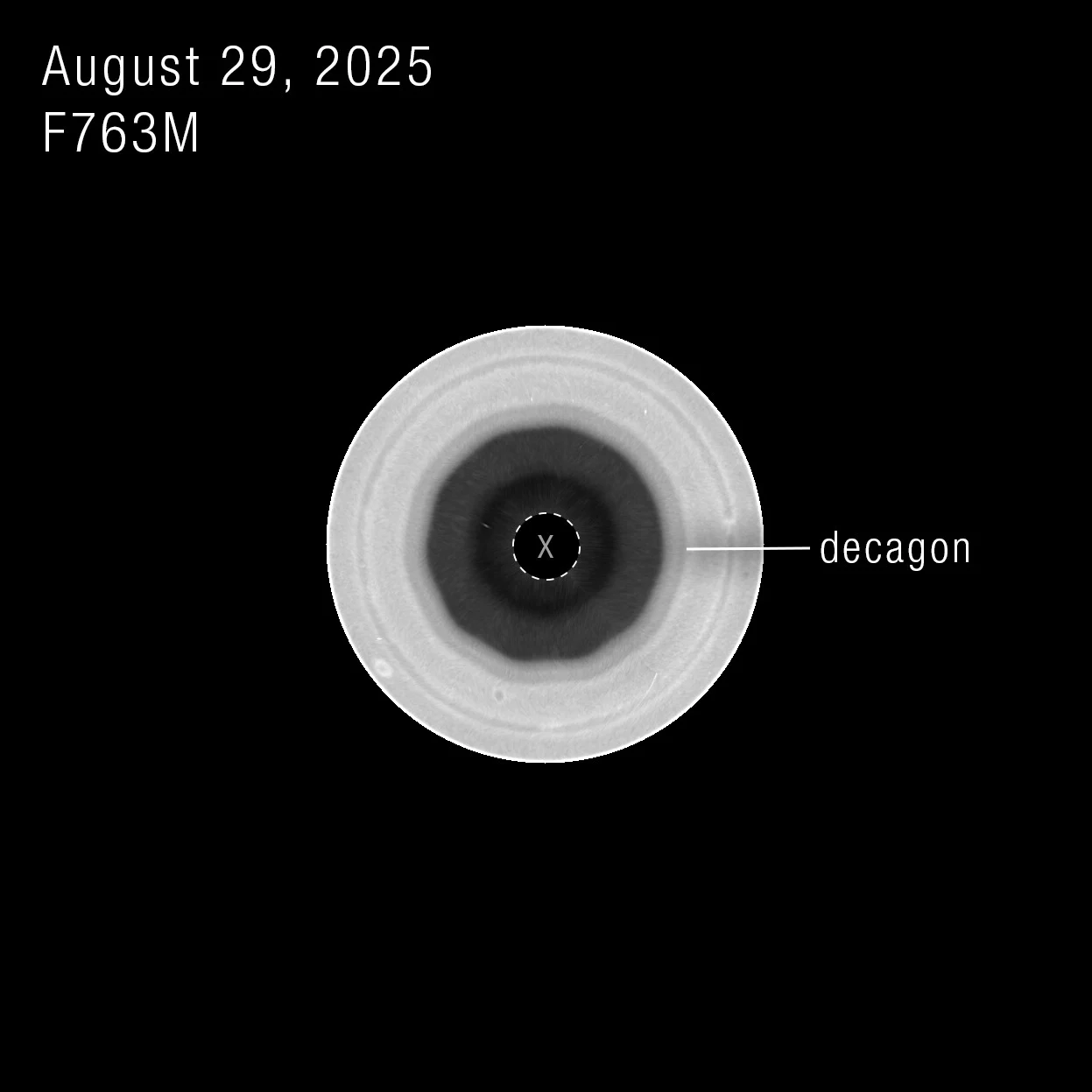
Ten bends in a band of clouds now mark the path of a jet near Saturn’s south pole. Hubble images from 2025 show all ten corners. When researchers revisited older images, they found a fainter outline in 2023 and 2024. The sequence catches a giant atmospheric pattern becoming easier to see.
Tracking the corners and the clouds gave the team two different speeds. The corners drift slowly east across Saturn’s rotating map while the wind flows past them. That difference gives astronomers a way to study what keeps the pattern together.
How did astronomers find the ten corners?#
Saturn’s tilt gradually brought its southern hemisphere back into view from Earth in 2023. The pole still looked foreshortened. In 2024, researchers examining images from amateur telescopes noticed an undulating band in that region. More ground-based views in 2025 captured the pattern, and Hubble resolved bends that were hard to pick out from Earth.
The team mapped the images as if looking down on the south pole. That view makes it easier to follow a band around the planet without mistaking the narrowing of a distant limb for a change in shape. In the August and September 2025 Hubble data, all ten corners were present, with some clearer than others. Looking back through the annual Hubble record revealed weaker features at the same latitude in 2023 and 2024.
Cassini caught a brief, partial polygonal disturbance in the southern jet in 2004. Its record through 2017 contains no comparable long-lived wave there. Conditions for seeing the pole from Earth improved years later, so the first clear outlines put a lower bound on the age of the feature. Its formation date remains unknown.
How big is one bend?#
In Hubble’s red-filter images, the centerline of the wave sits around 63 degrees south. Following that band around Saturn gives ten repeats, each averaging about 17,000 kilometers along the jet. The north–south swing from the top of a bend to the bottom of the next one is about 2,600 kilometers. It takes roughly six times as far to travel between successive crests along the circumference as it does to cross the wave’s full north–south swing. This is why the outline can look like a nearly circular band with shallow corners.
The entire shape sits well outside the pole itself. In the overhead image, the dashed circle and cross at the center mark a gap in Hubble’s coverage. The measurements come from the visible band around that gap.
How can the wind overtake the corners?#
The researchers followed the corners from late June to October 2025, using a map that rotates with a standard Saturn reference period. The average position of a corner moved east at about 2.5 meters per second on that map. Individual corners also shifted ahead of and behind their average drift, mostly on a cycle of about 32 days.
Wind speed came from a separate measurement. The team matched cloud markings in Hubble images taken one Saturn rotation apart and used their displacement to estimate the flow at each latitude. The jet peaked at 116 meters per second, slightly closer to the equator than the main outline. Even at the red-filter outline’s own latitude, the marking-based wind estimate was about 35 meters per second faster than the corners. A cloud can travel through a bend while the bend itself drifts slowly around the pole.
Sources: [1]
Why does the outline move when Hubble changes filters?#
Methane in Saturn’s atmosphere absorbs strongly near a wavelength of 889 nanometers. Light reflecting off deeper clouds passes through more methane, so those clouds contribute less to the image than they do in filters that avoid strong absorption. The methane filter gives higher clouds and haze more weight.
In the strong methane filter, the main pattern was centered near 60.5 degrees south, a little closer to the equator than the outline around 63 degrees in red filters. Other bands with similar bends show up across a wider stretch of latitude. Together the measurements point to a layered atmospheric disturbance. Each filter mixes light from a range of heights, so the images tell researchers more about where the wave leaves a trace than where it begins.
What might keep a jet bent into ten sides?#
One possibility is a Rossby wave, a large-scale bend in a rotating atmosphere. The effect of rotation varies with latitude, and the speed of Saturn’s jet also changes across the band. A shift north or south puts moving air in different conditions for turning. The jet may help confine the resulting bends to a narrow band. The slow motion of the outline compared with the surrounding wind is consistent with this explanation.
The team tested possible origins with a model that represented the atmosphere as one thin layer of fluid. In some runs, a spinning storm just north of the jet disturbed the flow enough to produce a repeating pattern. Other runs started with ten small disturbances spaced around the jet. They produced the right number of bends, though that simulated pattern moved much faster than the observed wave. The model still has to explain how ten bends could drift as slowly as the pattern that Hubble and ground-based telescopes tracked.
Saturn’s six-sided northern wave has persisted since the Voyager flybys. The south now offers a shorter record with measurable changes in the corners. Following their motion through more seasons can show whether the outline settles into a comparably lasting pattern and whether the nearby storm matters to its survival.
Keep exploring
Sources & further reading
Follow the original research, records, and explanations behind this story.
- A decagon wave around Saturn’s south pole Science Advances, Sánchez-Lavega et al.
Hubble and ground-based measurements, southern viewing history, drift and wind measurements, different filters, and three model tests.
- NASA’s Hubble Tracks New Decagon Encircling Saturn’s South Pole NASA Hubble Mission Team, Goddard Space Flight Center
How changing viewing geometry, amateur astronomers and Hubble’s annual record led to identification; differences from the northern hexagon.
- Decagon on Saturn’s south pole (single filter image) ESA/Hubble
The August 29, 2025 red-filter cover is an annotated overhead-style polar projection built from Hubble data. The cross and dashed circle show missing coverage.
Follow the thread