
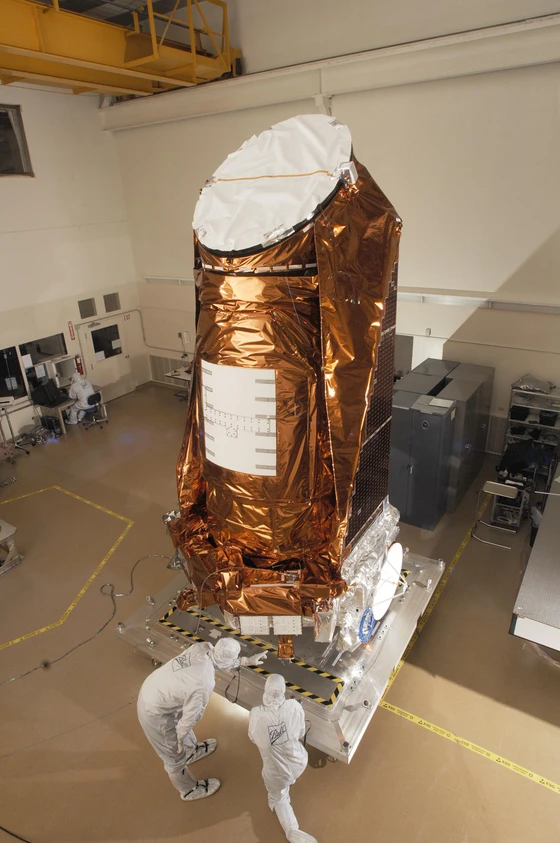
Two of Kepler's four reaction wheels had failed by 2013, leaving NASA's planet hunter unable to hold its usual view steadily. The team found a way to point the observatory so the push of sunlight tended to balance across it. The two surviving wheels controlled two directions of motion, and small thruster firings corrected the remaining drift. The spacecraft went back to collecting data as the K2 mission.
That recovery traded a long, nearly fixed stare for a succession of shorter observing campaigns. It worked because engineers took a force that had been nudging the telescope off target and reduced the amount of turning it could cause.
Why does a planet hunter need steady pointing?#
Kepler watched stars for quiet drops in brightness. When an orbiting planet crosses the face of its star from our perspective, it blocks a small fraction of the star's light. The detector records the drop as a transit. The signal can be very small. A light curve, a graph of brightness over time, is useful only if the instrument can track changes of that size.
As a telescope turns slightly, a star's image lands on different detector pixels. The pixels do not all respond identically, so movement can introduce apparent changes in brightness. Astronomers can correct much of that effect if they can follow the motion, but too much drift makes precise measurements harder. Stable pointing was part of the observing method from the start.
What could two surviving wheels still do?#
A reaction wheel is a flywheel attached to the spacecraft. When a motor speeds up the wheel, the rest of the spacecraft tends to turn the other way. Slowing the wheel reverses that exchange. It lets the spacecraft make small pointing adjustments without firing a thruster every time.
Kepler had four wheels, with three needed for its usual way of holding the view. After the second failure, the remaining pair could still control two directions of turning. The troublesome direction was roll, a twist around the telescope's line of sight. Even if the center of the image remains pointed toward the same spot, roll shifts stars farther from the center across the detector.
How did the team make sunlight easier to handle?#
Light carries momentum. As photons strike the spacecraft and are absorbed or reflected, they exert a small force. The push can turn the observatory when it acts unevenly across its shape. The relevant effect here is pressure from photons, including the light that falls on Kepler's sun-facing surfaces.
For K2, engineers picked fields near the ecliptic, the plane of Earth's orbit, and chose a starting roll angle that made the sunlight fall nearly symmetrically on the spacecraft. Picture two people pushing down with equal force at opposite ends of a seesaw. The beam feels both pushes, and their turning effects cancel around the pivot. For Kepler, the symmetry made the roll torque small enough to manage for extended periods.
The balance was approximate. Thrusters still corrected accumulated roll drift. The wheels also needed periodic thruster firings to shed momentum so they could keep reacting to small disturbances. Sunlight set up favorable conditions to use the hardware the spacecraft still had.
Why did K2 move from field to field?#
As Kepler moved around the Sun, the direction of sunlight changed relative to any fixed star field. The choice of a balanced orientation therefore limited the time a field could be held. K2 worked in campaigns along the ecliptic, each lasting weeks and in favorable cases roughly 80 days. The original survey had watched one main field for years.
Most repeated-transit searches benefit from seeing several passages. An 80-day field gives many chances to see a planet on a nine-day orbit, provided its orbit crosses the star from our viewpoint. An orbit lasting hundreds of days may offer only one transit or none in the same window. In exchange, successive K2 fields opened up fresh parts of the sky, including star clusters and targets outside the original survey.
How did the team know the new approach could find a planet?#
The first announced K2 planet, HIP 116454 b, came from a test observation in February 2014. It has a roughly nine-day orbit. Kepler recorded a transit signal, and a ground-based spectrograph measured the star's motion under the planet's gravitational pull. Those observations answered different questions. The dip tracked light blocked during a crossing, while the spectrum showed the host star moving in response to a companion.
The February data were taken before NASA approved the full K2 mission in May 2014. By the time the discovery was announced that December, the engineering test had already yielded a scientific result. A telescope with two working reaction wheels could still make a measurement precise enough for another instrument to follow up.
Keep exploring
Sources & further reading
Follow the original research, records, and explanations behind this story.
- The K2 Mission: Characterization and Early Results Howell et al., Publications of the Astronomical Society of the Pacific
Pointing recovery, ecliptic campaigns and the effect of detector motion on photometry.
- K2 mission Jet Propulsion Laboratory
Pitch and yaw control, roll corrections and momentum unloading.
- Kepler / K2 In Depth NASA Science
Wheel failures, the original field and the K2 approval and start dates.
- NASA’s Kepler Reborn, Makes First Exoplanet Find of New Mission NASA
Transit survey and first announced K2 planet.
- NASA’s Kepler Spacecraft in a Clean Room Jet Propulsion Laboratory
Prelaunch hardware shown at Ball Aerospace.
Follow the thread