
A weather station on Mars can count out a day only about 40 minutes longer than ours. The air is thin, and its pressure rises and falls with the heating cycle. Farther north, an excavation exposed pieces of buried ice that vanished within days.
Different missions measured those properties in different ways. Phoenix dug into frozen ground. Lander operations tracked the Sun to keep the clocks straight. Curiosity checked what happened to the atmosphere as the Sun moved across the sky.
How do we know that some Martian soil contains water ice?#
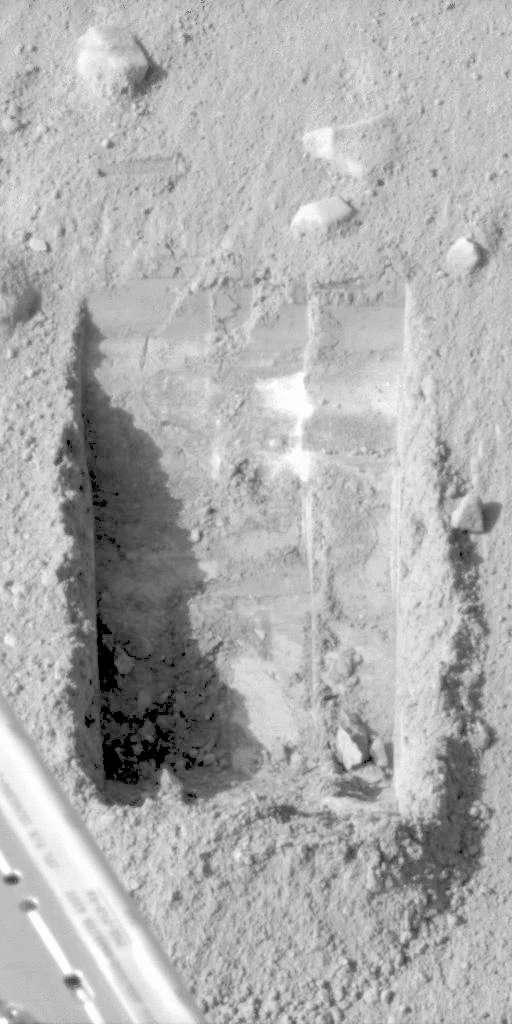
In the Martian far north, Phoenix’s robotic arm scraped through loose material to reach harder ground. Bright fragments appeared in a trench called Dodo-Goldilocks and disappeared a few sols later. Their disappearance was consistent with sublimation, in which ice turns directly into vapor.
There was also a separate laboratory measurement. Phoenix delivered soil from the Snow White trench to a small oven and examined the gas released as the sample heated. An instrument detected water vapor. Together, the excavation and the oven measurements gave scientists more than a resemblance to frost in a photograph. They still described the ground at one site, with different amounts of ice elsewhere.
How far does a sol drift against an Earth clock?#
A sol is one mean solar day on Mars. It lasts about 24 hours, 39 minutes and 35 seconds. Mars therefore rotates from one mean local noon to the next about 39 minutes and 35 seconds later on an Earth clock each time. Mars’s year and its daily clock are two different measures.
The offset builds quickly. After 12 sols, a task scheduled for the same time of day on Mars falls almost eight hours later by an Earth clock. Rover teams can record an observation by sol number and local solar time. That lets them compare the same phase of daylight across several days even as the hours of the Earth-based shift move.
Sources: [5]
What did Curiosity find when it watched the air all day?#
Mars has a thin atmosphere made mostly of carbon dioxide. An atmospheric pressure sensor measures the weight of the air above it per unit area. The reading depends on elevation and changes over the course of a Martian day and year.
Early in Curiosity’s mission, the Rover Environmental Monitoring Station recorded a daily pressure variation of around 10 percent on the sample days reported by NASA. Sunlight heats the ground and atmosphere, driving a traveling pressure pattern called a thermal tide. Meanwhile, as the seasons change, carbon dioxide freezes onto or vaporizes off the polar caps. That adds gas to or removes it from the atmosphere itself over the year. The daily and seasonal changes are separate effects.
How do the three measurements fit together?#
Every landing site has a local record. A bright patch below the soil tells a mission where to investigate a possible resource. The depth, amount and composition of the ice require more measurements. A clock tells the crew when daylight returns. Sensors show how air pressure and temperature change during the hours when people or machines could be out working.
A day that feels familiar by the clock leaves the basic conditions unchanged. Air outside is too thin and too rich in carbon dioxide for people to breathe. A future crew would depend on a pressurized habitat and would need to learn how its site behaves through the day and across the seasons. The Phoenix and Curiosity records show why a survey needs both a specific location and observations over time.
Keep exploring
Sources & further reading
Follow the original research, records, and explanations behind this story.
- Disappearing Ice NASA Photojournal
Phoenix images of Dodo-Goldilocks taken on sols 20 and 24.
- NASA Spacecraft Confirms Martian Water, Mission Extended NASA Jet Propulsion Laboratory
Mission report on the oven measurement and the handling of a separate soil sample.
- Next Mars Soil Scoop Slated for Last of Lander’s Wet Lab Cells NASA Jet Propulsion Laboratory
Identifies Snow White as the trench where the July sample came from and explains how TEGA measures vapor.
- Mars Phoenix NASA Science
Timeline, buried ice and the confirmed TEGA detection of water.
- Mars24 Sunclock Time on Mars NASA Goddard Institute for Space Studies
Length of the mean Mars solar day and solar time conventions.
- Mars Facts NASA Science
Thin atmosphere dominated by carbon dioxide and information about the seasons.
- Pressure Cycles on Mars NASA Science; Curiosity REMS team
Early Curiosity pressure curves, the daily thermal tide and seasonal exchange of carbon dioxide.
Follow the thread