
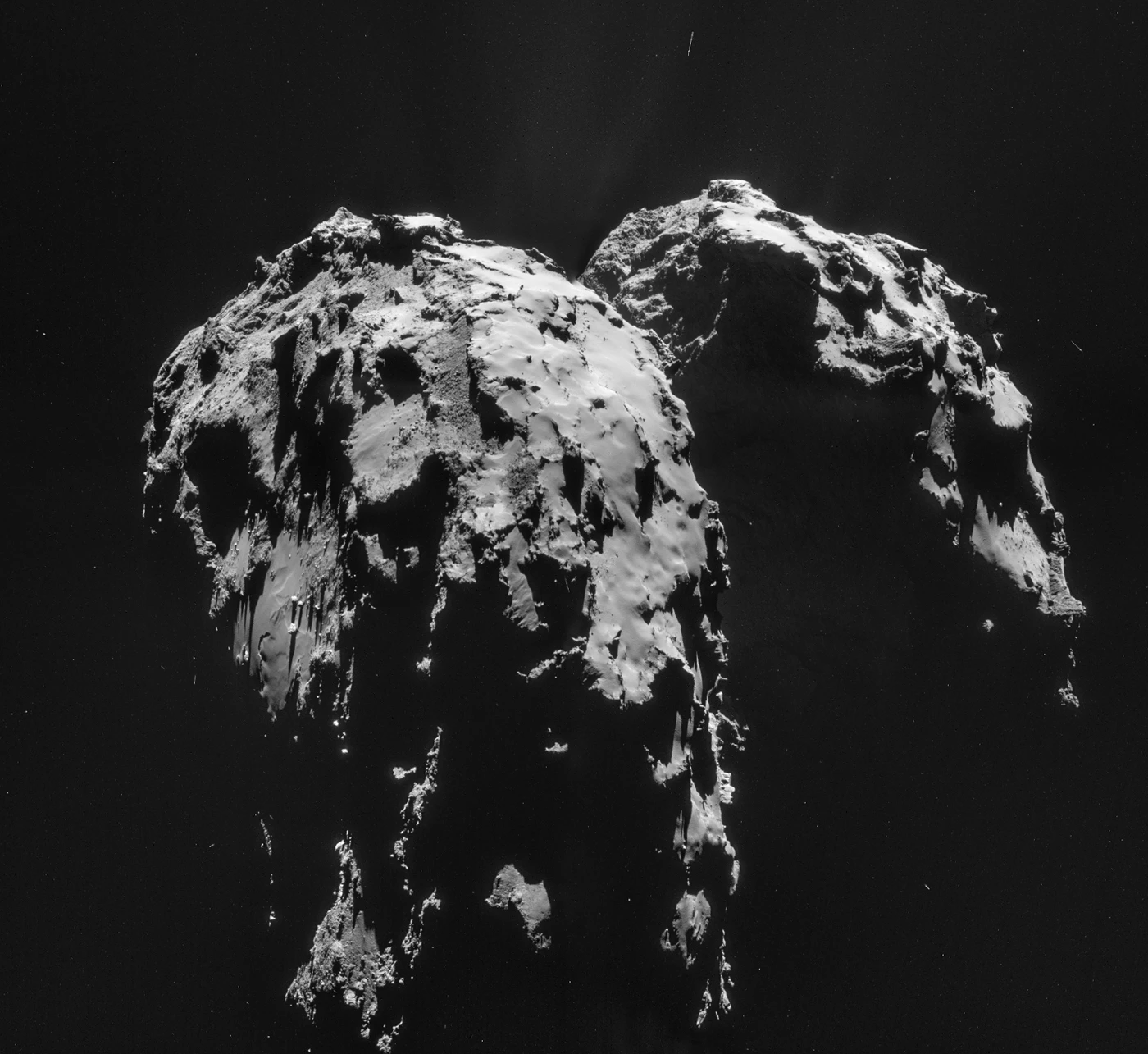
Philae reached its intended landing area on comet 67P on November 12, 2014. Its harpoons failed to fire, and the lander rebounded in the comet's weak gravity. It crossed part of the surface, struck more terrain and eventually came to rest in a dark crevice. Rosetta photographed it there almost two years later.
The final photograph answered where Philae had stopped. A separate investigation used old photographs and the lander's own instrument readings to find a place it had struck on the way. The mark it left in a boulder became a way to estimate the strength of the ice inside.
Why did Philae need anchors on a comet?#
On Earth, gravity brings a bounced object back to the ground quickly. On comet 67P, a much weaker gravitational pull gave even a slow rebound time to carry the lander away from its first contact. The designers expected to absorb part of the landing energy and attach the lander to the surface.
Philae had three legs with screws at the feet, two harpoons attached to cords and a cold-gas thruster intended to press the body down as the harpoons fired. Before separation, checks indicated that the thruster could not be relied on. The harpoons did not fire at touchdown, and the ice screws did not penetrate the hard surface at the first site. The legs made contact and the lander bounced free.
Sources: [1]
Where did the lander go after touching down?#
The first landing site, Agilkia, was in the area the team had aimed for. Rosetta had released the lander about seven hours earlier. The first touchdown was at about 15:34 GMT by the spacecraft clock. Signs in images taken before and after contact helped locate the event independently of the signals from Philae.
The reconstruction traces a roughly two-hour journey from Agilkia to the final resting place, Abydos. After rebounding, Philae hit a cliff edge and tumbled toward a group of boulders. The lander made several contacts in that boulder group before moving on again. The team later used its instrument records and Rosetta's images to reconstruct that part of the path.
Why did Rosetta take so long to find Philae?#
Abydos was a shaded spot. Philae ran on its primary battery for about three days, then went into hibernation. It briefly made contact again in June and July 2015, when more sunlight was available as the comet approached the Sun. The radio signals helped narrow the search, but identifying a small machine against broken rock required a good view.
On September 2, 2016, Rosetta passed within 2.7 kilometers of the surface. Its OSIRIS camera caught the lander's body and two of its three legs in a dark crack. The image established the lander's orientation, helping to explain why contact had been difficult. It also gave researchers a fixed location for interpreting measurements Philae had made while sitting on the surface.
Sources: [3]
How did the team identify the place Philae hit in between?#
Finding Abydos left a gap in the route. The team compared Rosetta photographs of the nearby landscape with a record from Philae's magnetometer. The sensor was mounted on a boom. Changes in its signal helped reconstruct when the lander moved or pressed the boom against the terrain. It had been built to measure magnetic fields, and the way its readings changed provided a record of mechanical contact.
The clues converged at a crevice among boulders now called Skull-top ridge, about 30 meters from Abydos. Comparison of images taken before and after the landing revealed exposed bright material and marks consistent with the reconstructed contacts. The nearby resting site shown in the famous 2016 photograph is a separate location.
Sources: [4]
What did a dent reveal about the comet's ice?#
At the end of the crevice, the team interpreted an impression about 25 centimeters deep as a mark made by Philae. They combined the mark with their reconstruction of the lander's motion to estimate the force the material could withstand before crushing. Their published estimate was below 12 pascals. A pascal is a newton of force per square meter. Here it describes compressive strength, a limit on how much load the material can sustain.
The researchers also estimated that roughly three-quarters of the boulder's interior volume was pore space. Both results apply to the material exposed at this particular site. Agilkia's hard surface and the weak ice inside a boulder at Skull-top ridge describe different places and depths. Philae's detour gave the mission a chance to compare them.
Keep exploring
Sources & further reading
Follow the original research, records, and explanations behind this story.
- Rosetta and Philae: one year since landing on a comet European Space Agency
Landing design and observed behavior of the three anchoring aids.
- Philae found! European Space Agency
Final location, sighting date, relatively close passage and communications.
- Philae’s second touchdown site discovered at ‘skull-top’ ridge European Space Agency
Intermediate route and evidence from imagery and movement of the ROMAP boom.
- The Philae lander reveals low-strength primitive ice inside cometary boulders O’Rourke et al., Nature; DLR repository copy
Measured impression and modeled bounds on strength and porosity.
- Comet on 1 December 2014 – NavCam European Space Agency
Whole-comet archive view by Rosetta after landing.
Follow the thread