
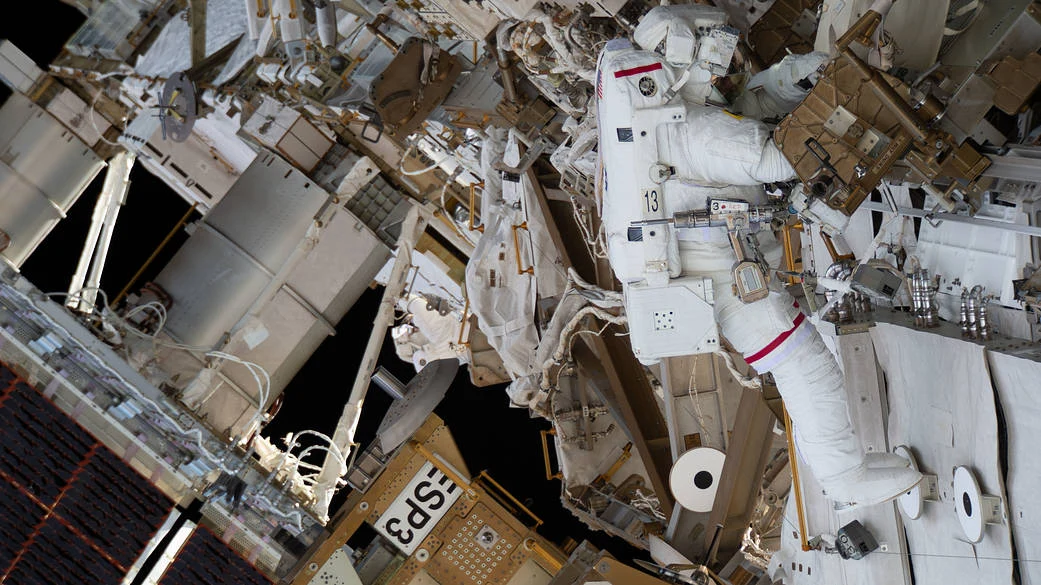
A spacewalker can spend several hours outside the International Space Station with no way to get to its toilet. Inside the suit, the astronaut wears a Maximum Absorbency Garment, or MAG. It serves as a temporary place to contain waste during the period when the suit has to stay closed.
Back in the cabin, a toilet can move waste away from the user. A fan draws air through its funnel and seat as soon as the toilet is in use.
Why does the suit have to stay closed?#
The spacewalk suit supplies pressure, breathing gas and cooling. Outside the station, its pressure garment and closed helmet maintain the small environment the astronaut depends on. To use a cabin toilet, a spacewalker would need to return through the airlock, close the outer hatch and restore pressure before leaving the suit.
That sequence takes time, and a spacewalk can last for hours. NASA also describes absorbent garments for launch and landing, when crew may have to remain suited. The same constraint applies in each case. There can be a long interval between putting the suit on and being able to take it off.
Where does the absorbent garment fit?#
A description of the space station’s Extravehicular Mobility Unit puts the MAG below the liquid cooling and ventilation garment. The cooling garment uses water circulating in tubes to carry away heat. The absorbent garment collects waste. Those layers sit inside the suit whose pressure system supplies the spacewalker’s environment.
The MAG works by keeping the waste in a layer the astronaut can remove after the suited work. It needs no external plumbing or airflow to carry waste out of the suit. A cabin toilet can use a powered fan and a hose to move liquid waste away from the user.
How does the station toilet catch waste without a downward pull?#
On Earth, gravity gives liquid waste a predictable direction away from the body. In the station cabin, the crew and the toilet are falling around Earth together. Fans draw air into the collection openings and keep waste moving into the equipment instead of drifting into the cabin.
For urine, the opening is a funnel attached to a hose. Solid waste enters through a seat and is collected separately. Foot restraints or handholds help a user stay in place. Close contact with the seat also helps airflow go where it is needed. Those details are practical responses to the same weightlessness the rest of the station works in.
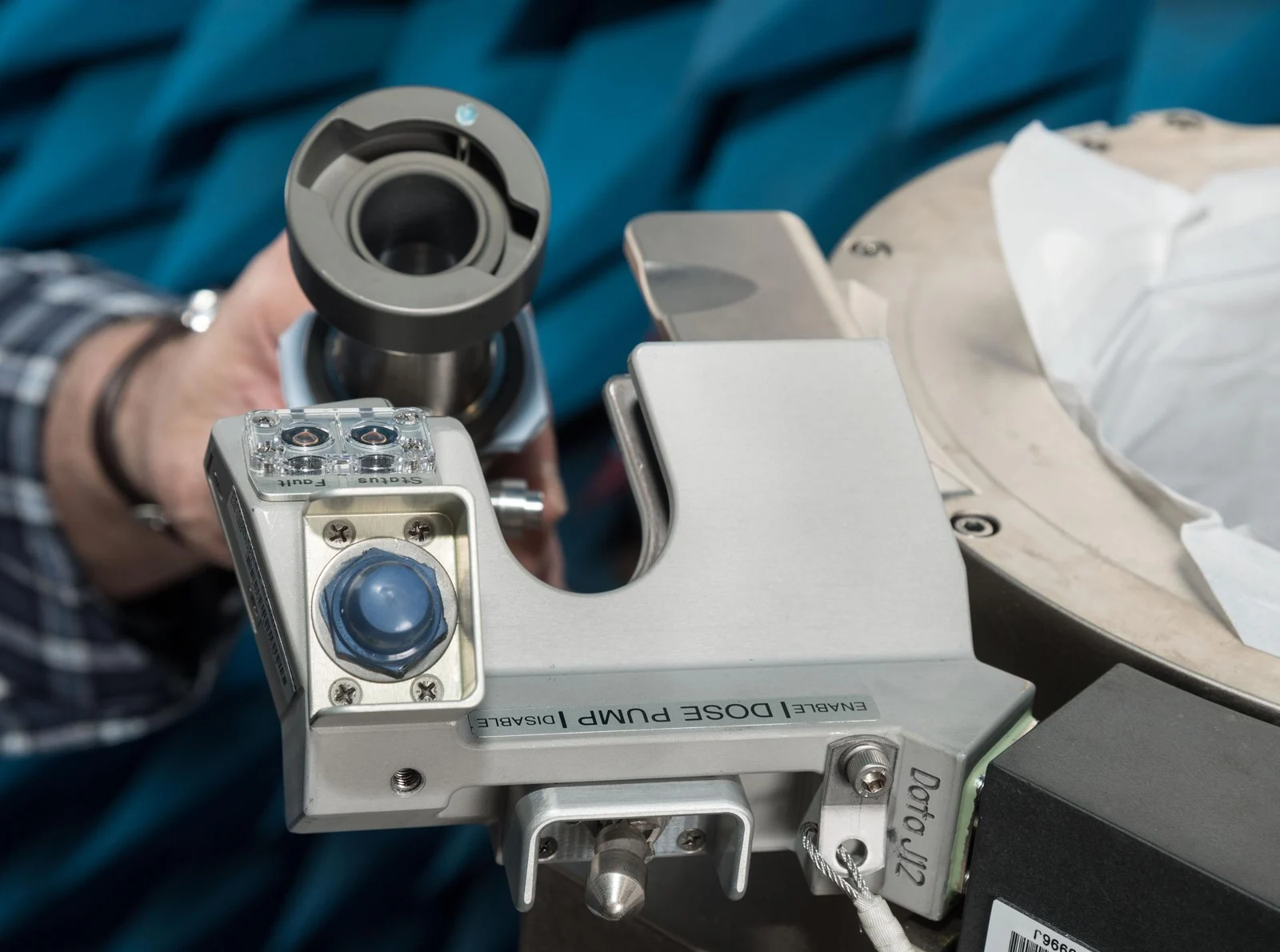
Image unavailable.
A person demonstrates lifting the urine hose from its support on the Universal Waste Management System.
Why keep the two waste streams separate?#
The station can send collected urine to water recovery equipment. That equipment separates water from dissolved material and then passes it through further treatment and checks. The toilet does the collecting. The treatment equipment does the work of making the recovered water usable.
NASA’s description of the Universal Waste Management System follows solid waste into individual bags and a removable canister. Most of those canisters are disposed of on departing cargo vehicles. In the suit, the absorbent garment buys time until the crew can handle the waste. In the cabin, separate routes carry it away from the astronaut.
Keep exploring
Sources & further reading
Follow the original research, records, and explanations behind this story.
- Spacewalk Spacesuit Basics NASA Johnson Space Center
Pressure garment, cooling and the length of suited work.
- OCHMO-MTB-003 Urinary Health NASA
NASA’s definition and the periods when the garment is worn.
- Extravehicular Mobility Unit NASA Johnson Space Center
Ordering of the absorbent and cooling garments within the EMU.
- Astronaut Josh Cassada is tethered to the station during a spacewalk NASA
Expedition 68 image and date of Cassada’s spacewalk.
- Boldly Go! NASA’s New Space Toilet Offers More Comfort, Improved Efficiency for Deep Space Missions NASA
Airflow, restraints, separate waste streams, canister handling and photos of the UWMS.
- Morning Routine in Space NASA
Fan-driven air and waste transport and cabin hygiene.
- NASA Achieves Water Recovery Milestone on International Space Station NASA
Treatment stages for recovered water.
Follow the thread