
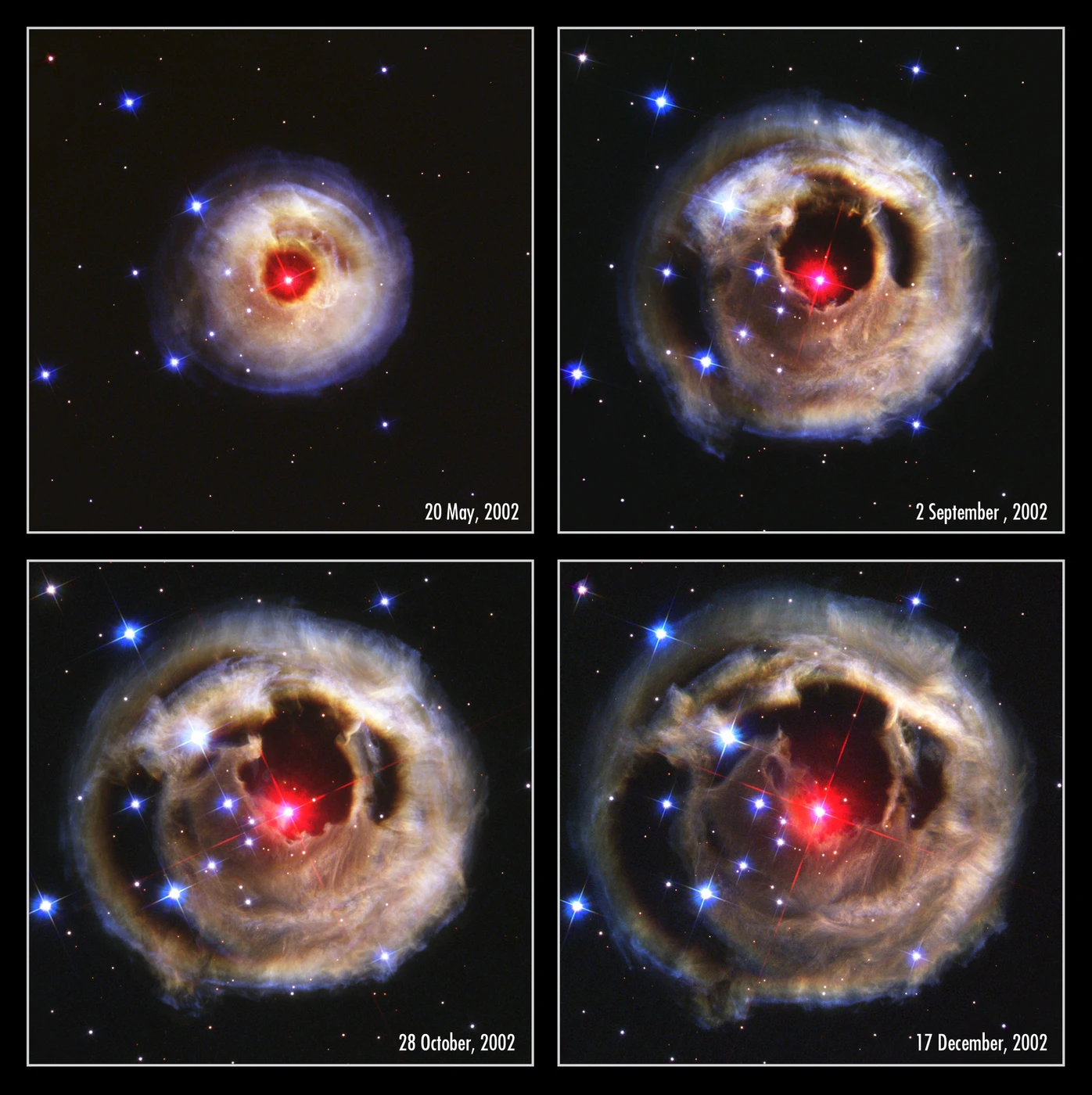
Between May and December 2002, a glowing pattern around the star V838 Monocerotis grew from about four to seven light-years across in Hubble's images. The telescope was seeing light from an outburst reach fresh parts of a dust cloud. The dust was already there, and the scattered light from each patch reached Earth by a different route.
The four photographs record seven months of arrivals at Hubble. Read them as a sequence of delays and the apparent expansion makes sense. The same delays help astronomers work out where the dust lies in space and estimate how far away the star is.
What did Hubble see in 2002?#
V838 Monocerotis brightened dramatically early in 2002. The Hubble sequence shows the star surrounded by arcs, dark gaps and bright strands that change from one exposure to the next. The first and last of the four images were taken on May 20 and December 17. The reported diameters of about four and seven light-years describe the extent of the illuminated pattern in those views.
The dates of the photographs tell us when the light arrived here. Polarization measurements of the echo put the star about 20,000 light-years away, so the outburst itself happened long before 2002. The delay from one photograph to the next is measured against that already long journey.
Why does a light echo take longer to reach Earth?#
Some of the outburst's light traveled straight to Earth. Some went off to the side, hit grains of dust and scattered in our direction. That second route is longer. The length of the detour determines how long after the direct flash we can see a particular scattering patch.
Imagine two dust clouds that appear equally far from the star in a photograph. One is well in front of the star and the other is behind it. The cloud in front lies closer to our end of the journey. The light that scatters from the cloud behind the star has already gone farther away from us and has a longer return trip. The two clouds can light up at the same apparent distance from the star on the sky and reach our view at different times.
The geometry works in reverse, too. A particular time delay can include light from many different places. Imagine grouping all the dust locations that add the same length to the trip. For a distant observer, those locations lie on a curved surface shaped like a paraboloid. The luminous structures trace the places where that surface crosses actual dust.
Sources: [2]
How can the pattern grow faster than light travels?#
A bright arc seen in May and an arc farther out in December can belong to separate parts of the cloud. Light from the same outburst reached each group of grains along its own path.
Using NASA's rounded diameters, the difference is about three light-years. Half of that, 1.5 light-years, is the change in apparent radius over roughly seven months if we treat the outline as a circle. That gives about 2.6 times light speed as a rate for the projected radius in that simplified comparison. The ragged outline makes this an illustration of the scale, with a different meaning from a speed measured for a moving parcel of dust.
The geometry can produce that effect even in a thin sheet of dust in front of a star. Close to our line of sight, spreading outward a little across the sheet adds very little to the full route. A small extra travel time can therefore reveal a patch much farther across the image. Each individual path is still covered at light speed.
What do the bright arcs and dark gaps tell us?#
A bright arc shows where there was dust able to scatter the outburst's light toward Earth at that delay. Watching a succession of arcs is like sampling new slices of a cloud. The sequence gives astronomers information they could never get from a single picture of a dark cloud.
Brightness also depends on how the dust scatters light, how far it lies from the star and how bright the outburst was at the relevant time. A dim patch in one exposure may represent little dust, an unfavorable scattering angle or material outside the part of the cloud lit at that moment. An exposure records the dust and illumination together. A sequence, combined with the record of the outburst, helps untangle them.
How can the echo measure the distance to the star?#
Scattered light can be polarized, meaning its electric field tends to oscillate in certain directions. In the model the Hubble team used, the strongest polarization occurred close to a right-angle scatter. Dust scattering light at 90 degrees lies close to the plane through the star perpendicular to our line of sight. For that geometry, the delay of the echo gives the physical distance across the sky from the star to the highly polarized ring.
Hubble measures that ring's angular size. Comparing the corresponding physical size with the angle gives the distance, much as a known-sized object looks smaller when farther away. The team's result was 6.1 kiloparsecs, with a quoted uncertainty of 0.6 kiloparsecs. That is roughly 20,000 light-years. The uncertainty includes assumptions about the scattering angle and the time profile of the flash. The glowing pattern that appeared to outrun light provided a geometric ruler once those effects were accounted for.
Sources: [3]
Keep exploring
Sources & further reading
Follow the original research, records, and explanations behind this story.
- Light Echo from Star V838 Monocerotis NASA Science
Growth of the apparent diameter from four to seven light-years.
- An energetic stellar outburst accompanied by circumstellar light echoes Bond et al., Nature
Scattering paths and the apparently superluminal pattern.
- V838 Monocerotis: A Geometric Distance from Hubble Space Telescope Polarimetric Imaging of its Light Echo Sparks et al., The Astronomical Journal
Geometric distance and error sources.
- Hubble watches light echo from mysterious erupting star (composite) ESA/Hubble
Four archived Hubble photographs and the changing illuminated outline.
Follow the thread