
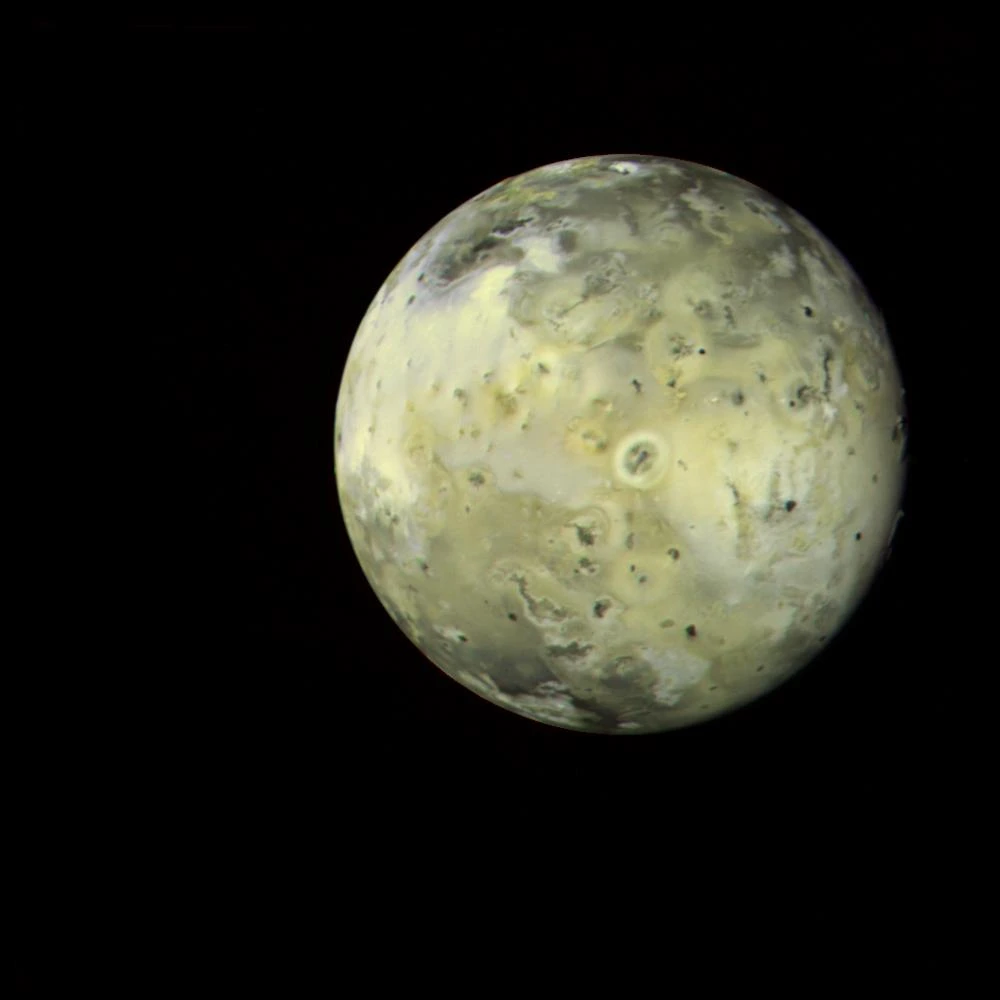
Voyager 1 took a picture of Io on March 8, 1979, while heading away from Jupiter. The following day, JPL optical navigator Linda Morabito recognized a bright curve beyond Io's edge. It was a volcanic plume. A second plume appeared near the line dividing day and night. Together they gave scientists the first direct evidence of active volcanism on a world other than Earth.
The frame had a job before the discovery. It helped the navigation team locate a moon against a background of stars. That meant the team was examining the very part of the image where the unexpected plume stood out, just beyond the moon's expected outline.
Why can we see the side of Io that faces away from the Sun?#
The Sun lights one side of Io directly. Jupiter redirects some sunlight onto the moon's night side. That reflected light is weak compared with direct daylight, yet it is enough to make the dark part of Io visible in the archived image. The relationship is familiar from Earthshine on our own Moon, when sunlight reflected from Earth gives the night side of a crescent Moon a faint glow.
Light on the night side helps establish where Io's surface ends. Material high above that surface can still catch sunlight, even when the terrain beneath is in darkness. In the Voyager picture that distinction lets the observer see both the moon and material lifted beyond its rim.
Sources: [1]
Where are the two plumes in the image?#
One plume rises past the outer edge, or limb, of Io. NASA's image record describes the curved cloud as extending roughly 260 kilometers above the surface. Its apparent separation from the rim is the visible clue. It rises across black sky where we would expect nothing from the solid moon.
The other appears closer to the boundary between sunlight and darkness on the disk, called the terminator. At that location, the plume catches the first light while the ground beside it remains dark. One cloud was easy to distinguish by its outline against space. The other gained contrast because sunlight reached the elevated material first. The positions explain why a single picture could reveal two eruptions with very different appearances.
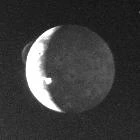
Image unavailable.
A small black-and-white navigation frame showing Io with a bright curved plume beyond the moon’s limb.
Where could the heat for such eruptions come from?#
Io circles close to Jupiter. Jupiter's gravity pulls harder on the near side of Io than on the far side, stretching the moon. Io's orbit is slightly elongated, so the strength of the stretching changes as its distance from Jupiter changes. Flexing the rock again and again dissipates energy inside the moon as heat.
Europa and Ganymede help keep Io's orbit from becoming perfectly circular. The moons' orbital periods are locked in a repeating relationship, so their gravitational tugs recur in an organized way. A study published shortly before the Voyager encounter had already identified tidal heating as a way for Io's interior to stay hot. The plumes then gave the spacecraft team direct evidence of what that heat could do at the surface.
What changed when Voyager saw an eruption in progress?#
Landforms can preserve evidence of ancient volcanism long after a world stops erupting. The Voyager team was looking at clouds of material above Io at the time the camera recorded it. That is why the 1979 discovery paper treats the image as evidence for ongoing activity.
The discovery also gave scientists a reason to revisit earlier photographs of the encounter with a new question. Marks on Io that might have been described from shape and color alone could now be interpreted alongside direct signs of eruptions. A picture designed to locate Io had recorded what was happening on it.
Keep exploring
Sources & further reading
Follow the original research, records, and explanations behind this story.
- Volcanic Eruptions on Io NASA Photojournal
Date of the image, distance, height estimate, Jupiter-shine and separate plume locations.
- Ed Stone NASA Science
Role of optical navigation and the day of recognition at JPL.
- Discovery of currently active extraterrestrial volcanism Morabito et al., Science
Two active plumes in an optical navigation image and the first such detection beyond Earth.
- Melting of Io by tidal dissipation Peale, Cassen and Reynolds, Science; UC Santa Cruz archive copy
Resonant orbital eccentricity and substantial internal heating by Jupiter-driven tides.
- Io NASA Science
Role of Jupiter, Europa and Ganymede in the modern explanation.
- Io - Full Disk NASA Photojournal
Earlier Voyager 1 mosaic and interpretation of surface features.
Follow the thread