
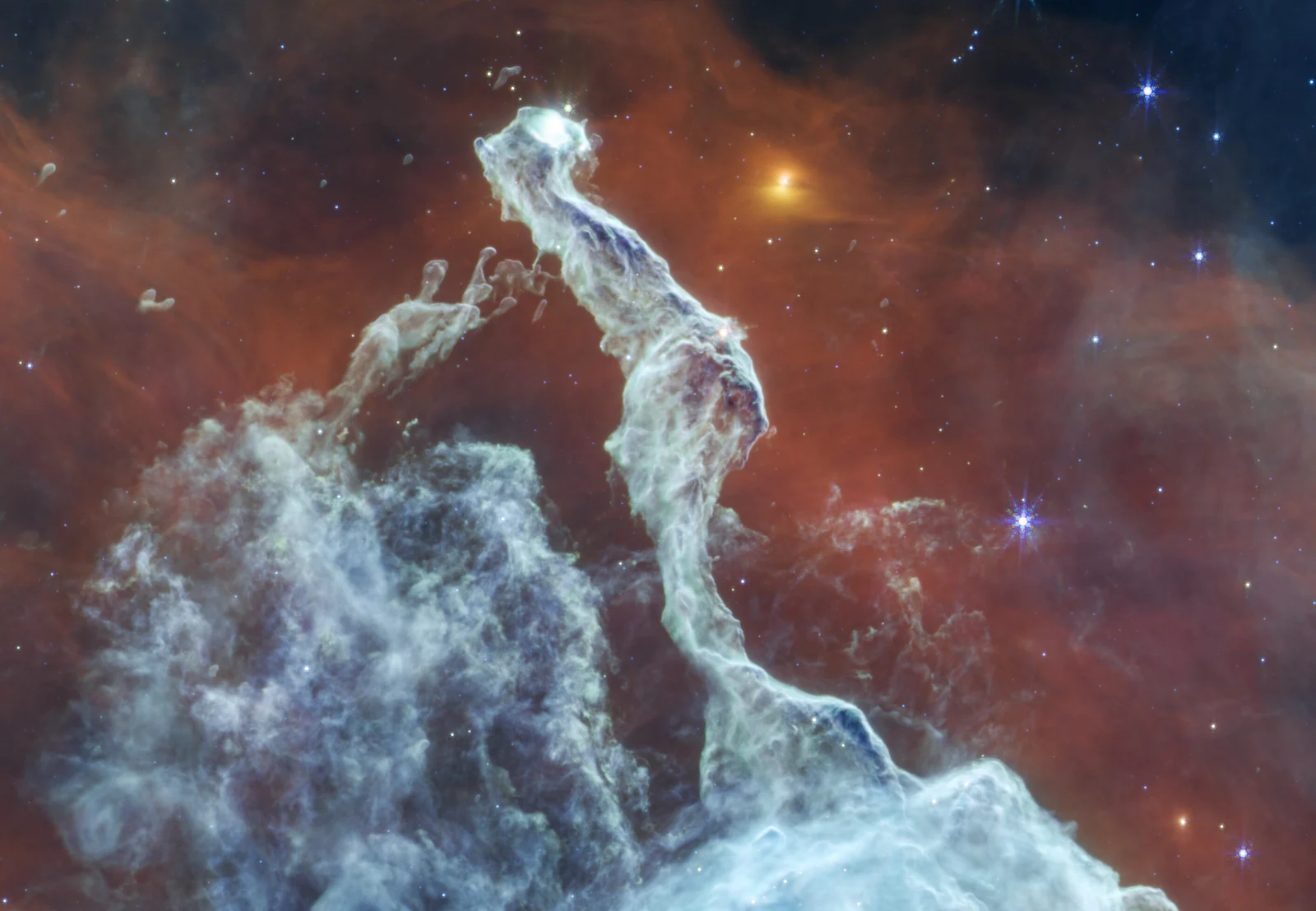
The Cat’s Head Nebula is a pillar of gas and dust in the Carina Nebula, about 7,500 light-years away. In Hubble’s visible-light image it looks like a dark animal turning its head. The James Webb Space Telescope sees starlight coming through parts of that silhouette. In a separate Webb image, the material that did the obscuring gives off infrared light of its own.
The three views let astronomers compare the stars, the dust between them and the edge of the pillar where light from nearby stars strikes the gas.
Why does Hubble see a dark pillar?#
In visible light the cloud presents a dark outline against a luminous background. Dust in the pillar absorbs some of the starlight passing through it and scatters some out of the direct path to the telescope. A patch can look almost empty when there is enough dust along that line of sight to hide most of the light behind it.
Outside the dark outline, filters on Hubble’s Wide Field Camera 3 record light from oxygen, hydrogen and sulfur as well as starlight scattered by dust. That mixture changes across the image. The surroundings help you make out the pillar’s narrow neck and the head turned to the right. Its dark shape is itself a record of how much light the material blocks.
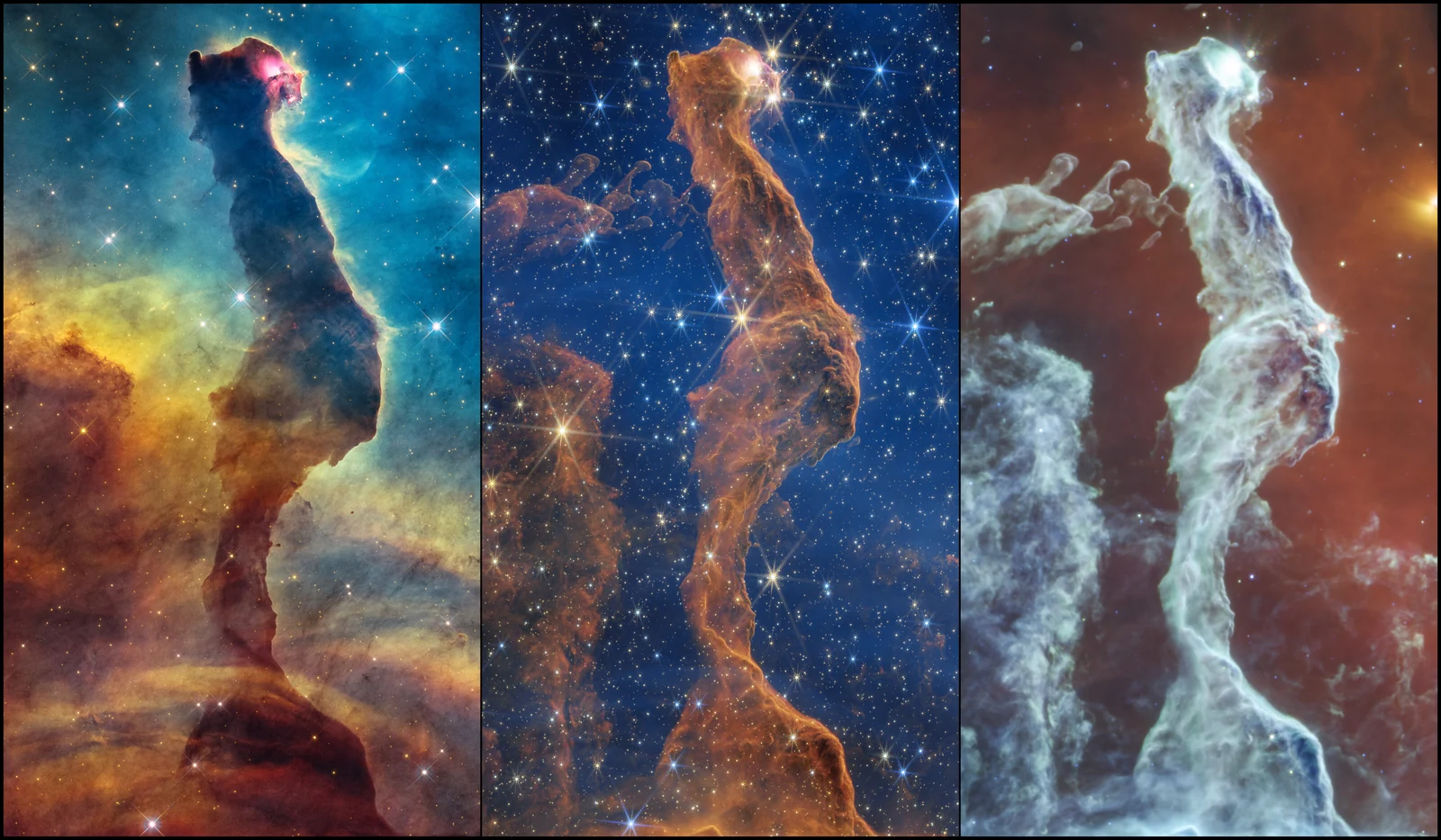
Image unavailable.
Three views of the same narrow pillar. The left outline is dark, the middle outline is translucent among many stars and the right outline is blue-white.
How can Webb see stars through the dust?#
Webb’s Near-Infrared Camera records light at longer wavelengths than Hubble used for this visible-light picture. Dust grains generally hinder that light less, which makes part of the pillar translucent and brings more points of light into view. At the thickest places, enough dust still lies in the way to dim some stars considerably.
Webb also picks up faint galaxies beyond the Milky Way through parts of the field. That helps explain why a dot projected on the pillar is hard to place in depth. It may lie in the cloud or along the same line of sight in front of or behind it. To find stars forming in the nebula, astronomers need evidence beyond where a point lands on the image.
Why do strands of dust light up in the mid-infrared?#
Webb’s Mid-Infrared Instrument records longer wavelengths again. Here, relatively warm dust can be bright in its own right. Emission from dust and carbon-based molecules traces fine strands and small clumps, especially to the left of the pillar. In the side-by-side views those strands are much easier to distinguish in the mid-infrared panel.
The rendered colors help separate signals that our eyes could never see directly. Imaging specialists assign visible colors to measurements through different infrared filters. A blue-white filament in this release therefore describes how the data were displayed. To infer what is emitting and under what conditions, astronomers need to know which filters recorded the light and how strong the signals were in each.
What carved the outline and lit up its right edge?#
The team’s interpretation is that massive stars nearby helped sculpt the pillar with ultraviolet light and stellar winds, streams of material flowing outward from the stars. More tenuous gas and dust are easier to strip away. A dense column can hang on longer as its surroundings thin out.
Hubble’s narrow, bright rim on the right shows where that process may be underway. Ultraviolet light can strip electrons from atoms and heat the outer gas. Once heated, the gas can expand and flow away from the pillar. Astronomers call that loss photoevaporation. The rim is consistent with it, though the image does not measure how fast the pillar is losing material.
What is the light that looks like an eye?#
The point at the cat’s head is conspicuous in Hubble’s image and in the infrared. The teams identify it as a candidate young star still partly wrapped in dust. Webb’s mid-infrared image also shows a separate bright yellow source off to the right, probably another young star embedded in dust. A narrow filament seems to cross that second source in the picture. Their apparent intersection leaves open whether they actually meet in space.
Follow the bright rim down the right side in Hubble’s panel, then look for the same outline in Webb’s. The point that looks like an eye stays in roughly the same place while the dust around it appears translucent in one Webb view and bright in the other.
Keep exploring
Sources & further reading
Follow the original research, records, and explanations behind this story.
- Ghostly Cat’s Head Nebula lurks within sight of Hubble and Webb ESA/Hubble
The interpretation of the pillar, dust, stars and ultraviolet-lit rim.
- Cat’s Head Nebula (Hubble WFC3, Webb NIRCam, and Webb MIRI images) ESA/Hubble
The public comparison identifies its panels and places the pillar in Carina.
- Cat’s Head Nebula (Hubble WFC3 image) ESA/Hubble
Hubble’s visible-light morphology, the optical filters and signs of ultraviolet-illuminated gas.
- Cat’s Head Nebula (Webb MIRI) ESA/Hubble
The mid-infrared archive view and identification of fine strands and a separate young-star candidate.
- Infrared Astronomy NASA Science
The different effects of dust on visible and infrared wavelengths and dust’s own infrared emission.
- How Are Webb’s Full-Color Images Made? NASA Science
How image specialists map infrared filter data to visible colors.
Follow the thread