
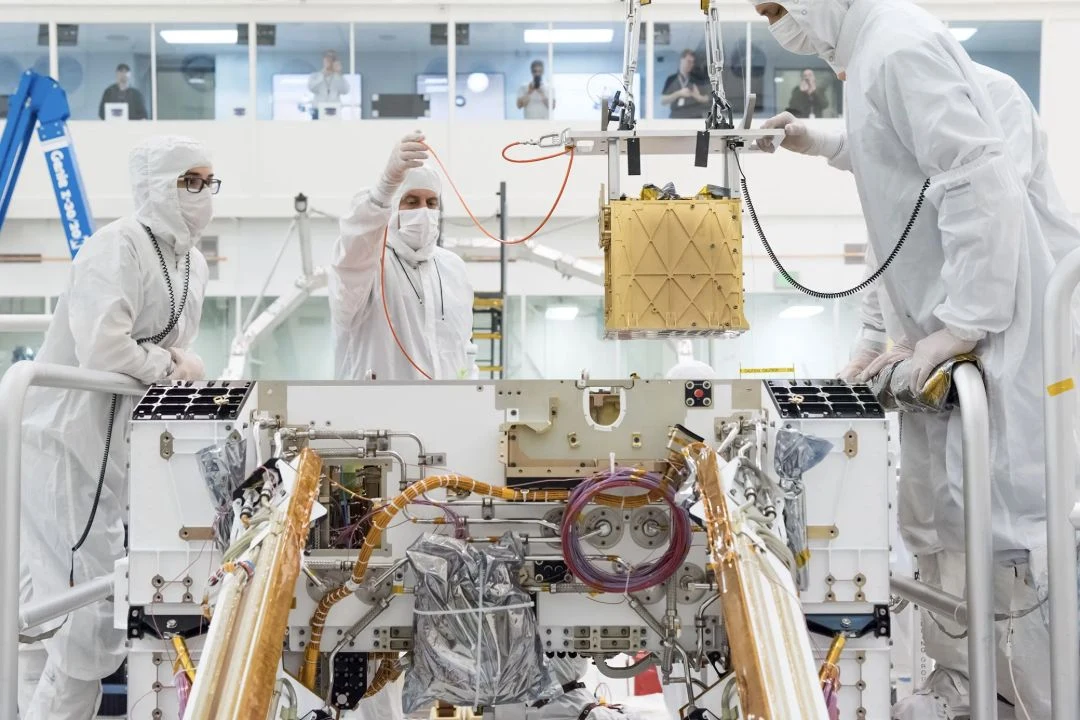
A useful day on Mars could end with a carefully documented rock sample and a small, well-measured quantity of oxygen. The rock would help reconstruct the planet’s past. The oxygen would test whether future explorers could manufacture a resource they need to stay alive and leave again.
In the fictional fourth episode of Mars: The First 500 Days, two astronauts investigate a dry ridge while two others test an oxygen-making machine. Their Sol 100 workday is imagined. Its scientific foundations come from real robotic exploration: Curiosity’s observations of ancient stream deposits, laboratory measurements inside rovers, and the MOXIE oxygen experiment carried by Perseverance.
These missions establish different things. Rounded gravel can reveal flowing water. Rock chemistry can indicate an environment that could have supported microbes. An oxygen experiment can demonstrate a working process.
What would an ordinary working day on Mars involve?#
The episode puts field science and engineering in the same working day. One team asks what happened to the landscape; the other asks whether equipment behaves as expected in the local environment. Neither task needs a spectacular discovery to produce a useful result.
For the field team, picking up an interesting stone would only begin the investigation. Its position, the surrounding material and any exposed layers would help explain where it came from. A loose pebble might have weathered out of nearby rock or arrived from somewhere else. A photograph of the surrounding outcrop could therefore be as valuable to the interpretation as a close-up of the pebble.
For the engineering team, a number on an oxygen sensor would need context too. How much air entered the machine? Had the equipment reached its operating temperature? How much oxygen emerged, and how pure was it? Recording the conditions makes the result useful when the same test is repeated.
Real people already rehearse parts of this combination on Earth. NASA’s CHAPEA analog crews have carried out simulated Marswalks alongside science investigations and the routine work of living in an isolated habitat. Those exercises study human performance under selected mission-like constraints. They cannot reproduce the whole Martian environment, and they do not document the fictional crew in this story.
The practical setting for the episode is explored in the earlier articles about its prepositioned habitat, power supply and water system. Sol 100 turns to the work those systems would make possible.
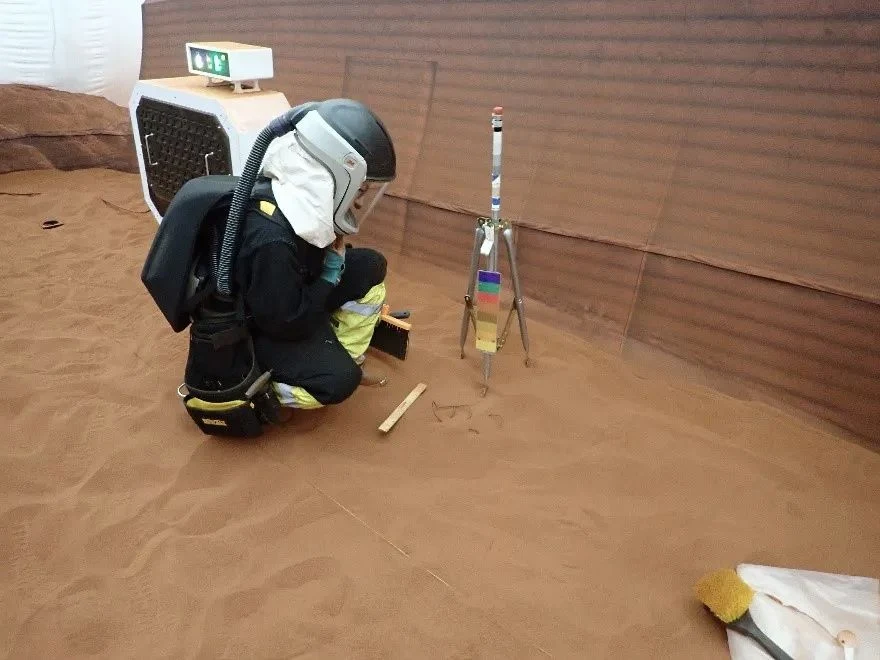
Image unavailable.
A CHAPEA participant kneels beside equipment in an indoor red-sand test area.
How can dry pebbles reveal an ancient stream?#
The strongest clue is a combination of grain shape, grain size and the way the grains sit together. A dry landscape can preserve the products of a wet process long after the water has disappeared.
In 2012, Curiosity photographed an outcrop called Hottah in Gale Crater. It is a sedimentary conglomerate: a rock made of smaller fragments cemented into a finer-grained matrix. Some of its embedded gravel pieces are rounded and a few centimeters across. Loose gravel also lies around the outcrop as fragments weather out of it.
Moving water can carry gravel, repeatedly knocking pieces against one another and against the bed beneath them. The collisions wear down corners. When the flow weakens, sediment settles; later burial and cementation can turn the deposit into rock. The surviving shapes and arrangement preserve clues to that earlier transport.
Roundness alone would leave room for several explanations. The Hottah interpretation also depends on the grains’ size and their presence in the conglomerate. The science team concluded that these grains were too large for wind to have transported them. Taken together, the observations supported transport by a vigorous water flow.
Hottah is an observation from Curiosity’s real mission, not a site visited by the imagined Sol 100 crew. It is also in Gale Crater, whereas Perseverance and MOXIE landed in Jezero Crater. The episode borrows the method of reasoning from evidence; it does not place these separate discoveries on the same ridge.
A fictional crew finding similar material would still need to test that interpretation against the setting. The outcrop’s layers, the distribution of gravel and other nearby deposits would help distinguish a transported sediment from a pile assembled by another process. Finding one promising rock would be a reason to investigate further.
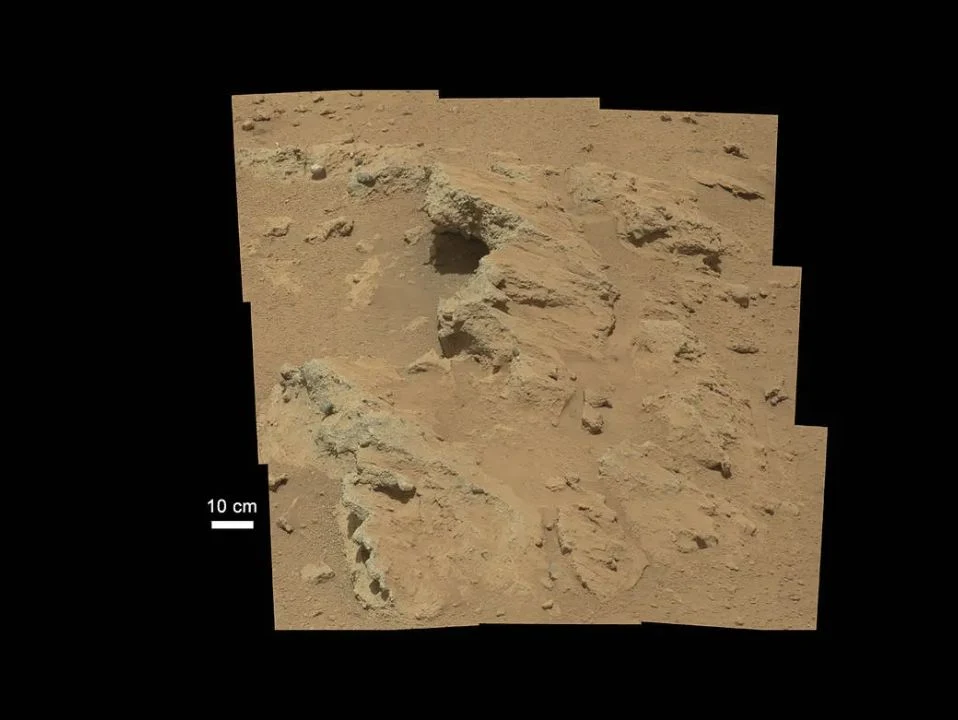
Image unavailable.
A tilted slab of Hottah conglomerate and surrounding gravel on Mars, with the original ten-centimeter scale.
Sources: [4]
Does evidence of water mean that Mars had life?#
Water evidence answers a question about an environment. Establishing that the environment could support life requires more information. Showing that organisms actually lived there requires evidence of life itself.
Curiosity’s work at Yellowknife Bay illustrates the distinction. After the rover drilled the rock called John Klein, its instruments analyzed the resulting powder. In March 2013, the mission team reported chemical ingredients important to life, clay minerals, and combinations of chemicals that could have supplied energy to microbes. The inferred ancient environment was not strongly acidic, highly salty or harshly oxidizing.
The combination mattered. Liquid water in an otherwise unsuitable chemical setting would not make the same case. Clay minerals helped reveal reactions involving water, while the mixture of chemicals in different oxidation states suggested possible energy sources. An oxidation state describes how an element’s electrons are distributed in a compound; differences between chemical states can provide energy when reactions occur. Some microbes on Earth exploit such differences.
These findings supported ancient habitability: conditions that could have sustained microbial life. They were not a report that microbes had been found in the drill powder. The difference remains essential when interpreting a landscape that looks familiar to an Earth-trained observer.
For the imagined ridge investigation, a possible stream deposit would help reconstruct where water once moved. It would not establish how long the place stayed wet, whether its chemistry suited life, or whether anything lived there. Those are further questions for measurements, comparisons and additional samples.
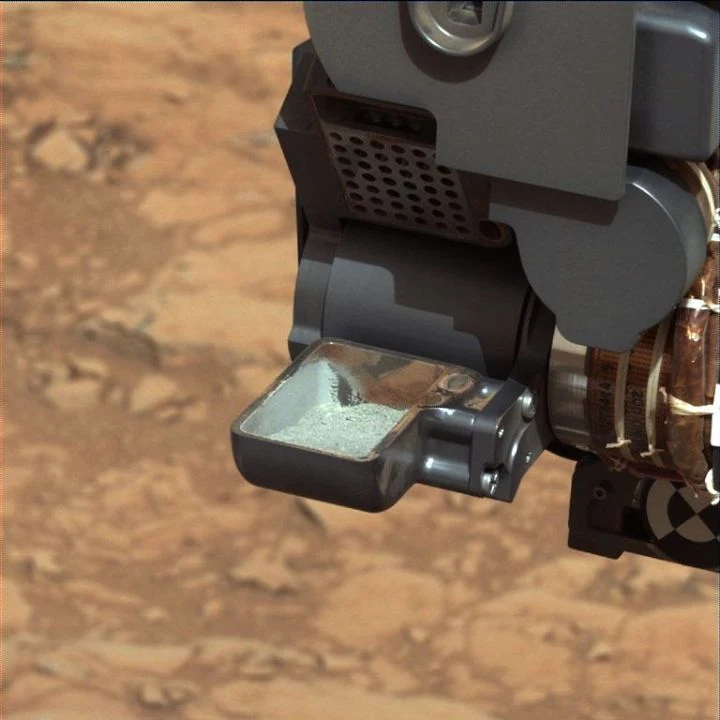
Image unavailable.
Gray-green John Klein drill powder sits in Curiosity’s scoop, with red residue on the scoop walls.
Why does a rock sample need a record of its surroundings?#
A sample gains much of its meaning from its origin. Its layers and neighboring rocks can show whether it belongs to a stream deposit, a lake bed, a volcanic unit or material displaced from somewhere else. Detaching the rock also separates it from those clues unless they have been recorded.
Curiosity’s John Klein work shows one way to examine material on Mars: drill it into powder and deliver portions to onboard instruments. The process changes the sample so the instruments can measure its composition. The accompanying images and location records connect those measurements back to the original outcrop.
Perseverance uses a different sampling approach, taking cylindrical rock cores and sealing them in titanium tubes. Its first successful rock sample, collected in September 2021, came from a rock nicknamed Rochette in Jezero Crater. Cameras checked that the core was present before the tube was sealed and stored. The sequence made the physical sample and its documentation parts of the same scientific record.
A preserved core does not explain an entire landscape by itself. Comparing samples from different positions can reveal how conditions varied, while photographs and observations keep each piece tied to its geological setting. A tube containing rock is evidence of successful collection; the interpretation still depends on what was measured and where the rock came from.
The fictional team could follow the same principle without copying either rover’s exact procedure. Documenting a modest sample carefully would leave a result another investigator could examine and question. That would remain useful even if the day produced no sign of life.
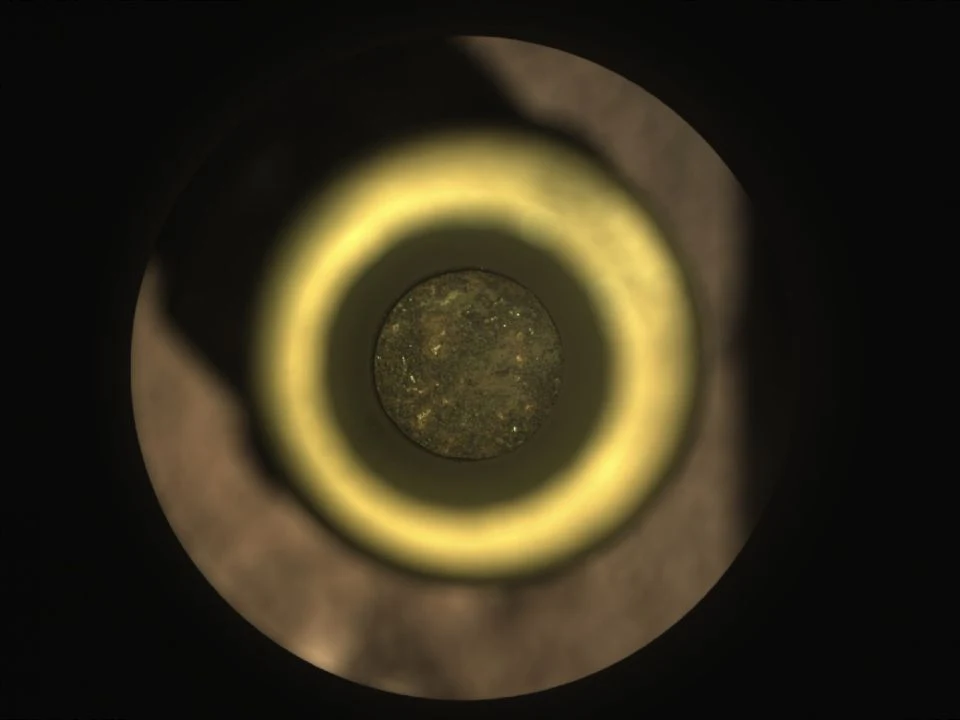
Image unavailable.
The circular end of Perseverance’s first Martian rock core is visible inside a titanium sample tube.
How can a machine make oxygen from Martian air?#
MOXIE demonstrated an electrical process for extracting oxygen from carbon dioxide, the main gas in Mars’ atmosphere.
The instrument first drew air through a filter and pressurized it. That prepared the thin Martian air for the solid-oxide electrolyzer at the center of the system. An electrolyzer uses electrical energy to drive a chemical reaction. In MOXIE, the reaction ran at about 800 degrees Celsius, so heating, insulation and control of the gas flow were important parts of the machinery.
Carbon dioxide contains carbon and oxygen. Inside the hot electrolyzer, the process separated oxygen ions, which are electrically charged forms of oxygen. Those ions were collected and recombined into molecular oxygen, the O2 used for breathing. The process also produced carbon monoxide. Sensors measured the amount and purity of the oxygen output.
Oxygen production required supplied energy. The atmosphere provided the raw material; it did not provide free operating power. For a future surface base, a resource-making plant would therefore be another demand on the mission’s power system, alongside heating, communications and other equipment.
MOXIE’s experimental oxygen was measured and then released. It was not piped to astronauts or accumulated in a rocket tank. The demonstration established that the conversion process could work on Mars under real atmospheric conditions. Keeping the product for later use would require additional equipment.
Why couldn’t MOXIE supply a crew or its return rocket?#
The demonstrated production was small, and the experiment ran intermittently aboard a rover. Supporting a crew or preparing a rocket would require a much larger system, a dependable energy supply and a way to store the oxygen.
NASA’s September 2023 completion report recorded 16 oxygen-production runs and 122 grams of oxygen in total. At its best, MOXIE produced 12 grams per hour at 98 percent purity or better. The peak hourly rate and the total production describe different things: one is the speed reached during a test, while the other is the amount produced across the demonstration.
The tests also had to fit around Perseverance’s other work. An earlier MIT account described several hours of warm-up followed by about an hour of oxygen production. A future plant intended to make a large supply would need sustained operation and evidence that it could tolerate that duty. Successful short runs do not by themselves establish years of reliable service.
The rocket requirement is particularly demanding. Oxygen serves as the oxidizer that lets a fuel burn; it is not the fuel itself. In a mission example described by the MOXIE team in 2021, launching four astronauts from Mars would require about 25 metric tons of oxygen with 7 metric tons of fuel. Those are estimates for that example, rather than universal requirements for every possible Mars spacecraft. They show why propellant production draws interest even though astronauts would also need oxygen to breathe.
NASA’s completion report identified a fuller successor as an oxygen generator combined with equipment to liquefy and store the product. Scaling up therefore involves more than enlarging the hot chemical core. The system would have to collect air, manage heat, verify product quality and retain a useful supply.
During the imagined Sol 100 test, a measured result could reveal whether equipment was ready for another run, needed adjustment or required more investigation. Alongside the ridge samples, it would add evidence about two different problems: understanding the planet and making useful materials there.
Keep exploring
Sources & further reading
Follow the original research, records, and explanations behind this story.
- NASA’s Oxygen-Generating Experiment MOXIE Completes Mars Mission NASA/Jet Propulsion Laboratory
Historical final demonstration results, oxygen quantity/purity and the need for liquefaction and storage.
- NASA’s Perseverance Mars Rover Extracts First Oxygen From Red Planet NASA Jet Propulsion Laboratory
Atmosphere, approximately 800°C processing, carbon monoxide output and explicitly historical mission-scale example.
- MIT’s MOXIE experiment reliably produces oxygen on Mars MIT News
Filtered/pressurized feed, solid-oxide electrolysis, product measurement/release and intermittent warm-up/testing.
- Remnants of Ancient Streambed on Mars NASA
Hottah conglomerate, embedded rounded gravel and water-transport interpretation; actual image credit and scale-bearing mosaic.
- NASA Rover Finds Conditions Once Suited for Ancient Life on Mars NASA Jet Propulsion Laboratory
John Klein, Yellowknife Bay chemistry, minerals and potential chemical energy supporting habitability rather than a life detection.
- First Curiosity Drilling Sample in the Scoop NASA Jet Propulsion Laboratory
February 20, 2013 John Klein drill powder; red Rocknest residue, white balance, delivery to CheMin/SAM; exact photo credit.
- NASA’s Perseverance Rover Collects First Mars Rock Sample NASA Jet Propulsion Laboratory
September 2021 Rochette core, camera verification and titanium tube sealing; image caption identifies actual first core.
- First NASA Mars Analog Crew Passes Mission Halfway Mark NASA
Earth analog simulated Marswalks and science tasks; actual sandbox photo and NASA/CHAPEA crew credit.
Follow the thread