
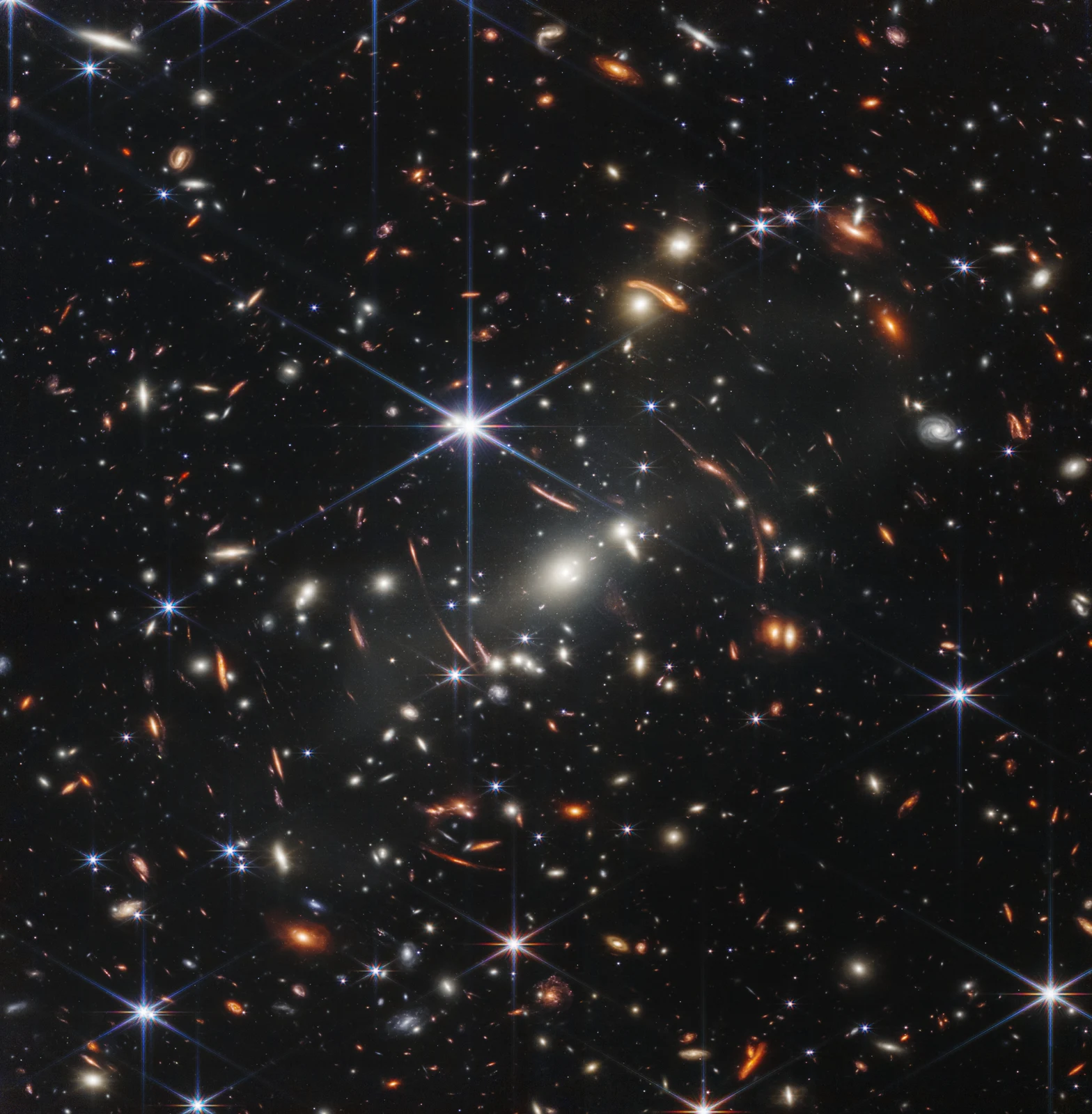
Webb’s gold-colored mirror collects wavelengths that human eyes cannot see. Much of the telescope’s work happens in the infrared, where faint light from distant galaxies can arrive after billions of years of travel. Warm hardware emits infrared light of its own, which can obscure the faint signals Webb wants to measure.
Webb had to solve that problem before it could take useful pictures. It unfolded a shield to keep much of the heat away. It also used the image of a single star to bring 18 separate mirrors into alignment.
Why does some light from early galaxies arrive in the infrared?#
As the universe expands, the wavelength of light traveling through it grows. A wavelength is the distance from one crest of a wave to the next. Light emitted in visible or ultraviolet bands can reach us at longer infrared wavelengths after enough expansion. The amount of stretching depends on the object’s redshift.
Webb’s instruments together span roughly 0.6 to 28 micrometers, from visible red well into the infrared. Each instrument covers part of that range. By comparing how much light passes through different filters, astronomers can find objects that are bright in one range and faint in another. A spectrum can then test how far recognizable features have shifted.
Why did one star appear in 18 places?#
The primary mirror measures about 6.5 meters across. To make that size fit into a rocket, parts of it folded for launch. After deployment, the 18 hexagonal segments needed to aim at a common point and bring their light into step.
During commissioning Webb pointed at the star HD 84406. The NIRCam mosaic showed 18 spots, one for each segment aimed a little differently. Engineers moved individual segments to identify which one produced each spot. Moving the spots together was only one stage. Fine alignment also adjusted the distances the light traveled so its waves could add together in focus. The aim was one sharp image from the whole mirror. With Hubble’s single primary mirror, small corrective mirrors inside the telescope brought the starlight back into focus.
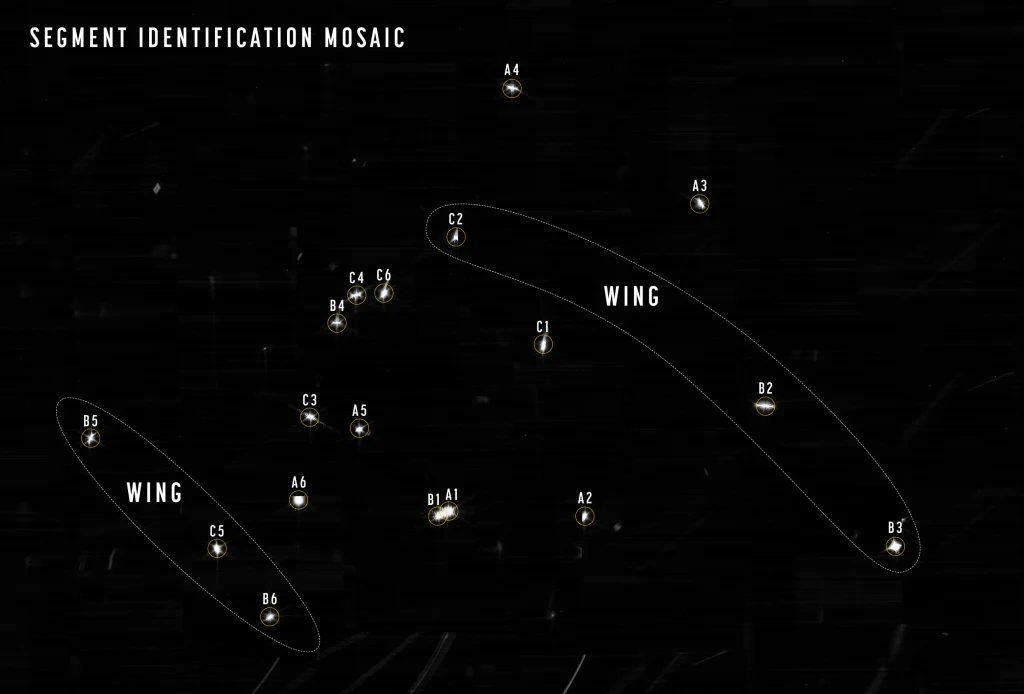
Image unavailable.
A dark engineering mosaic with 18 labeled points of light from the star HD 84406.
Why does Webb keep the mirrors in the shade?#
Everything warm emits infrared radiation. If nearby equipment glows brightly in a band Webb is observing, faint light from the sky becomes harder to pick out. The sunshield keeps the Sun, Earth and Moon on the warm side of the observatory and shades the telescope and instruments on the other side.
Five thin layers are separated by gaps. Sunlight warms the first layer, and each successive layer receives less heat. Some heat radiates away into space from the gaps. On the cold side, Webb can radiate enough of its own heat away for the near-infrared instruments to operate at roughly 39 kelvins. Keeping the temperature stable also helps the aligned mirrors keep their shape.
Why does the mid-infrared camera need its own refrigerator?#
The Mid-Infrared Instrument, or MIRI, observes longer wavelengths. Those measurements require still colder detectors than the sunshield can provide on its own. A helium cryocooler brings the detectors to about 7 kelvins. The passive shield and the active cooler work in stages on the same problem of unwanted heat.
MIRI and the near-infrared camera, NIRCam, can look at the same patch of sky and reveal different structures. The instruments collect light in their own bands. Scientists can compare the resulting measurements even when they assign visible colors to make the images easy to examine.
What do the colors in a Webb image represent?#
A filter admits a selected range of wavelengths to a detector. Image processors can give the measurements from one filter a blue display color and measurements from a longer-wavelength filter a red one. The color key for a published view tells you which measurements went into it.
That is how an image like Webb’s deep field can show light the eye would miss. The visible portrait comes at the end of a chain involving redshift, collected light, carefully aligned mirrors and cold detectors. The measured infrared signal is the part astronomers can compare with an independent image or spectrum.
Keep exploring
Sources & further reading
Follow the original research, records, and explanations behind this story.
- Infrared Astronomy NASA Science
Cosmological redshift and why Webb looks in the infrared.
- Webb’s Scientific Instruments NASA Science
The nominal 0.6 to 27.9 micrometer range and bands of individual instruments.
- Wavefront Sensing and Control NASA Science
Mirror dimensions, segments, alignment and wavefront sensing.
- Photons Received: Webb Sees Its First Star – 18 Times NASA Webb Mission Team
Identification of 18 images of HD 84406 from the mirror segments.
- Webb’s Sunshield NASA Science
The shield, layer spacing, and temperatures on the cold side.
- How Does Webb Stay Cold? NASA Science
Thermal background, shielding and active MIRI cooling stages.
- How Are Webb’s Full-Color Images Made? NASA Science
The color assignments used to display measured bands.
- Webb’s First Deep Field (NIRCam Image) ESA/Webb
Near-infrared image of SMACS 0723 and the bands used to make it.
Follow the thread